

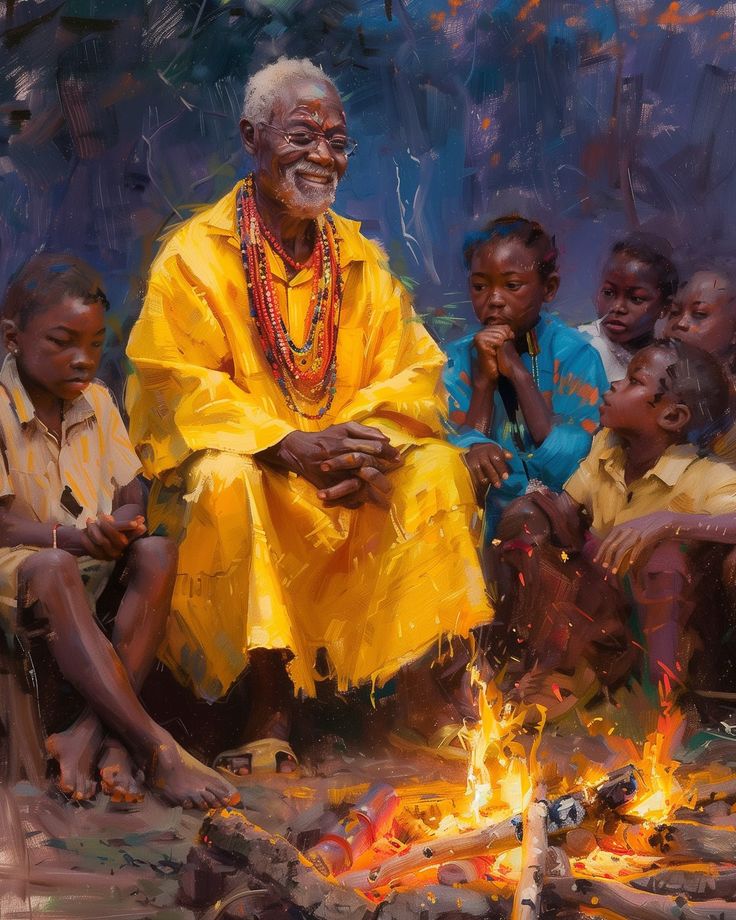
“The trap does not catch the mouse that is watching.” — Common East and Central African proverb, often paired with trickster tales to underline their real purpose
The short answer is that trickster tales are rarely just entertainment, even when they’re very funny. They are one of the most effective teaching tools a purely oral culture has ever developed — a way of smuggling serious lessons about power, morality, and survival into stories that audiences want to hear again and again.
Meet the Cast: Africa’s Other Great Tricksters
Beyond Anansi, several other trickster figures recur across the continent, each shaped by the landscape and social world of the people who tell their stories.
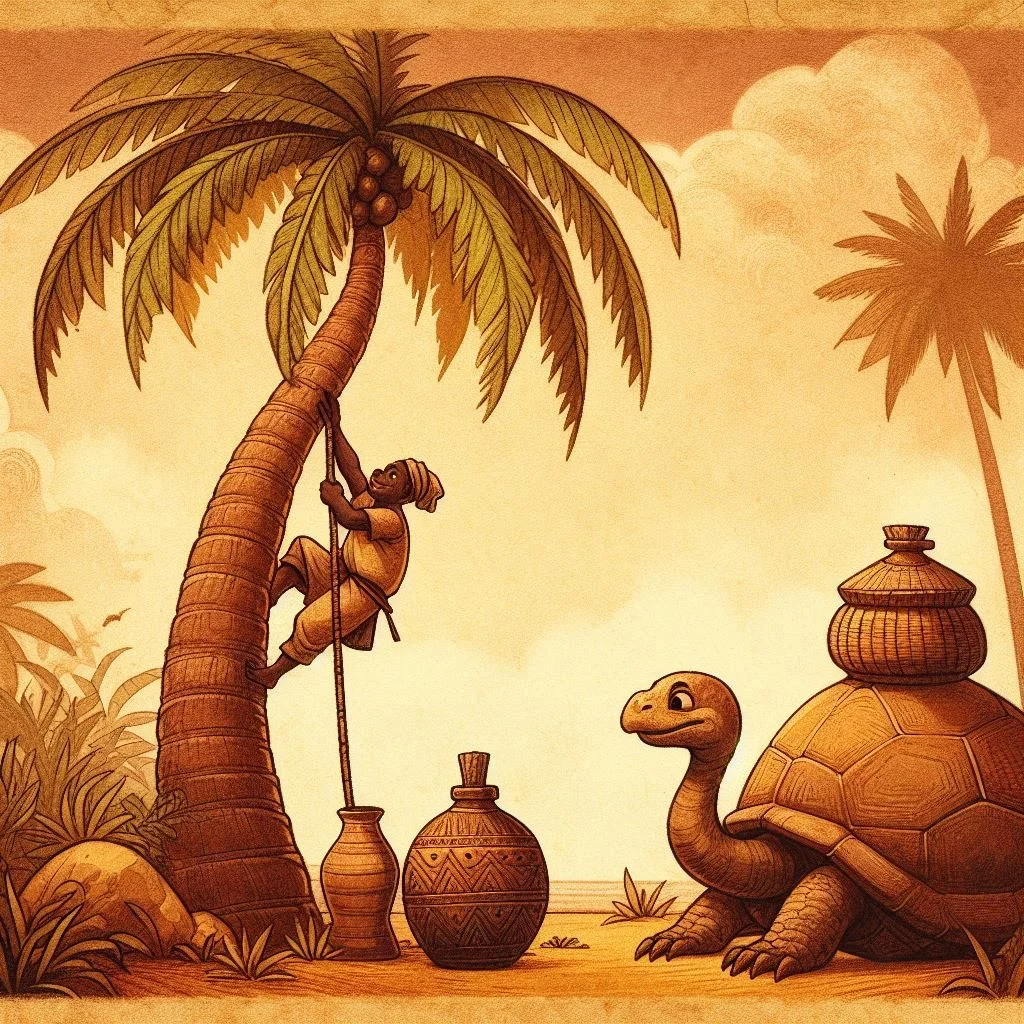
Ijapa, the tortoise, is the dominant trickster of Yoruba folklore in Nigeria, and one of the most widespread trickster figures in West Africa more broadly, appearing under different names among neighboring peoples. Ijapa is slow, physically unimpressive, and easily underestimated — which is precisely the point. His stories typically follow a pattern where he talks his way into situations far beyond what his modest physical abilities should allow, using flattery, false promises, disguise, and sheer nerve to outmaneuver animals many times his size and strength. Ijapa is also unusually self-defeating compared to some other tricksters: a striking number of his stories end with his schemes collapsing under the weight of his own greed, giving Yoruba trickster tales a moral texture that leans harder into consequence than some of their regional counterparts.
Sungura, the hare, plays a broadly similar role across large parts of East and Central Africa, particularly in Swahili-language storytelling traditions, where he’s often pitted against Fisi, the hyena — a pairing that mirrors, in some ways, the Anansi-versus-larger-animals dynamic found further west. Sungura’s stories frequently center on food scarcity and resource competition, with the hare repeatedly manipulating the greedier, more powerful hyena into situations that cost Fisi dearly, usually through elaborate deception rather than any direct confrontation the hare could never physically win.
Wakaima and other localized hare and jackal figures appear across parts of East Africa with regional variations reflecting specific local concerns, while jackal tricksters, prominent in Khoisan traditions of Southern Africa, tend to be portrayed as somewhat colder and more self-interested than Anansi or Ijapa — closer to a pure survivalist than a folk hero audiences are meant to fully admire.
Hyena deserves special mention as well, because the role hyena plays shifts noticeably depending on region and specific tale. In some East African traditions, hyena is himself cast as a trickster of sorts, though usually a less successful or more foolish one — frequently the character being outwitted rather than doing the outwitting, a useful reminder that trickster status in these traditions isn’t fixed to a single species across the whole continent the way it might feel to an outside reader encountering only Anansi.
What unites this entire cast, despite regional differences, is a consistent structural choice: the trickster is almost never the biggest, strongest, or most obviously capable character in the story. That choice is the engine that makes the whole genre work.
The Structural Genius of the Weak Outwitting the Strong
There’s a reason nearly every culture on earth develops some version of the trickster figure, and African oral tradition offers a particularly clear window into why. Stories about physical strength triumphing over physical strength don’t actually teach an audience much — the outcome is exactly what you’d expect. But a story where a tortoise outsmarts an elephant, or a hare outmaneuvers a hyena, does real cognitive work: it demonstrates, repeatedly and memorably, that intelligence, patience, timing, and social cunning can overcome raw power.
This had genuine, practical resonance in societies where a great many people — the young, the poor, women in patriarchal social structures, smaller or less politically powerful communities living alongside larger ones — regularly had to navigate situations where they were, in a very real sense, outmatched by someone or something stronger. Trickster tales offered those audiences a repeated, entertaining reassurance that being smaller or weaker didn’t mean being powerless, and modeled specific strategies — patience, misdirection, playing rivals against each other, exploiting an opponent’s own greed or vanity — for how that mismatch might actually be navigated in practice.
It’s worth being honest, too, that trickster stories don’t offer a naive or uncomplicated version of this lesson. Many trickster tales end badly for the trickster himself, caught out by his own overreach, or by an opponent who finally sees the trick coming. This matters: the genre isn’t simply “cleverness always wins.” It’s closer to “cleverness is a real and valuable form of power, and also a genuinely risky one, prone to backfiring on those who rely on it too heedlessly.” That double message — celebrate the wit, but watch its limits — is part of what keeps these stories interesting on the hundredth telling rather than collapsing into a simple formula.
Tricksters as Moral Instruction — Delivered Sideways
One of the most distinctive features of the trickster tale as a teaching device is that it rarely moralizes directly. A story doesn’t announce “greed is dangerous” and then illustrate the point — it simply shows Ijapa’s scheme collapsing spectacularly because he got too hungry to stick to the plan, and lets the audience draw the obvious conclusion themselves. This indirection is not incidental to the form; it’s central to why it works so well as instruction, particularly for younger listeners.
Direct moral instruction — a list of rules, a lecture on proper behavior — tends to provoke resistance, especially from children and adolescents testing the boundaries of authority. A trickster story sidesteps that resistance almost entirely by disguising the lesson as entertainment. The audience is laughing at Ijapa’s outrageous overconfidence, delighting in Sungura’s clever escape from Fisi’s trap, and absorbing, almost incidentally, a fairly sophisticated set of ideas about the consequences of greed, the value of patience, the danger of underestimating a weaker opponent, and the importance of reading social situations correctly before acting.
This is also part of why trickster tales are told and retold across an entire lifespan rather than being treated as strictly children’s material. A five-year-old hearing an Ijapa story absorbs the surface lesson about greed. An adult hearing the same story, in the same performance, at the same gathering, is often drawing more layered conclusions about specific social or political dynamics in their own community — village rivalries, colonial-era power imbalances, contemporary corruption. The story’s meaning isn’t fixed; it flexes to the audience and the moment, which is part of why griots and elder storytellers can retell the same core tale for decades without it going stale.
 The Trickster as Social Critique
Beneath the individual-morality lessons, many trickster tales carry a second, sharper layer of meaning: social and political critique, often aimed at figures and structures the storyteller could not safely criticize directly.
Across a great deal of African oral tradition, and particularly during the colonial period, trickster tales offered a relatively safe narrative space in which to explore, dramatize, and implicitly criticize abuses of power. A story about a small, clever animal repeatedly outwitting a larger, more powerful, and often somewhat foolish or arrogant animal carries an obvious resonance for audiences living under systems — whether a demanding local chief, a rival ethnic group, or a colonial administration — where they themselves held comparatively little formal power. The trickster’s repeated victories over stronger opponents offered both a form of wish fulfillment and, more practically, a coded vocabulary for discussing power dynamics that might have been genuinely dangerous to name outright.
This function of trickster folklore carried directly across the Atlantic during the transatlantic slave trade, and it’s one of the clearest, most well-documented throughlines connecting West African storytelling to African diasporic folklore in the Americas. The Br’er Rabbit stories of the American South, drawing heavily on West African hare and tortoise trickster traditions carried by enslaved Africans, functioned in a broadly similar way: stories about a small, clever, relentlessly resourceful animal outwitting larger, more powerful predators resonated with enslaved audiences navigating an extraordinarily dangerous and unequal power structure, offering both entertainment and a coded space for expressing resistance and asserting the value of wit against brute force, in a context where more direct expressions of resistance carried enormous personal risk.
Tricksters, Gender, and Community Boundaries
Trickster tales also frequently do quieter work around community norms and boundaries that don’t reduce neatly to a single “moral of the story.” A number of tales involving Ijapa, Sungura, and other trickster figures revolve around marriage negotiations, disputes over food distribution within a household or community, or conflicts between neighbors — everyday social friction rendered through an animal cast that allows the story to explore the situation with more freedom, and considerably more humor, than a story about actual named community members might allow.
This displacement onto animal characters is a genuinely useful storytelling technology. It lets a community rehearse and discuss touchy social situations — a greedy neighbor, a dishonest trader, an unfair distribution of resources at a gathering — through a layer of comic distance that makes the underlying critique easier to deliver and easier to hear, without anyone in the audience needing to feel personally accused. The animal mask does real social work, in other words, beyond simply making the story more entertaining for children.
Why the Trickster Never Fully Wins — or Loses
A final, often underappreciated feature of trickster tales across African oral tradition is their refusal to let the trickster settle into either a purely heroic or purely villainous role. Anansi, Ijapa, Sungura, and their regional counterparts are not consistently good, and they are not consistently punished for being bad. The same character who cleverly saves his community from famine in one story might, in the next, be humiliated for pure, petty greed that harms people who trusted him.
This moral inconsistency is not a flaw in the tradition — it’s arguably the single most important thing the trickster figure is teaching. Real cleverness, the stories seem to collectively insist, is morally neutral. It can be turned toward genuine community benefit, or toward pure self-interest at others’ expense, and the same intelligence and social skill are required for either outcome. By refusing to resolve the trickster into a simple hero or a simple villain across the full body of stories associated with him, African oral tradition preserves a more honest, more useful lesson than a tidier narrative could: that wit is a tool, not a virtue in itself, and that its value depends entirely on how it’s used.
A Closer Look: How a Single Trickster Tale Actually Works
It’s worth slowing down on one representative story to see this machinery in action rather than just describing it in the abstract. Consider a widely told Yoruba tale in which Ijapa, desperate during a famine, learns of a magical incantation that will let him fly up to a feast being held in the sky, on the condition that he shed his borrowed feathers — one from every bird in the forest — the moment the feast concludes and before he attempts to fly back down.
Ijapa talks his way into the feast by convincing the birds, through a mixture of flattery and outright deception, to lend him their feathers, and then further convinces the sky-dwellers hosting the feast that he alone represents all the birds of the earth and should therefore be served first and most generously. He eats magnificently. But when the birds discover how thoroughly he’s used and mocked them to secure his invitation, they strip their feathers back the moment the feast ends, stranding him in the sky with no way down. He’s eventually forced into a series of increasingly undignified bargains just to get back to earth, arriving battered, humiliated, and — in several tellings — with a permanently cracked shell, offered as a folk explanation for why tortoises have the uneven, patterned shells they do.
Notice everything this single story is doing simultaneously. It’s an origin story, explaining a physical feature of the natural world in a way that’s satisfying and memorable for a listening audience, particularly children. It’s a comedy, built on escalating, absurd overconfidence that audiences clearly enjoyed watching unfold. And it’s a genuinely pointed piece of moral instruction about the specific danger of using cleverness to exploit people who trusted you, rather than cleverness used to solve a real problem — Ijapa’s initial cunning in securing an invitation during a genuine famine is treated very differently, narratively, than his subsequent greed and disrespect toward the very birds who made his invitation possible in the first place. The punishment fits the specific betrayal, not the cleverness itself. This is the trickster tale operating at full capacity: entertainment, natural explanation, and moral instruction, fused into a single economical narrative that a skilled griot can deliver in a few minutes and an audience will remember for years.
Performance, Audience, and the Living Text
It’s easy, reading trickster tales in written or summarized form, to lose sight of how much of their actual meaning and impact depended on live performance. Traditional tellings of Ijapa or Sungura stories were rarely delivered as flat narration. Skilled storytellers used voice, physical gesture, and often song to distinguish characters, built in call-and-response moments where the audience actively participated — repeating a refrain, answering a rhetorical question the trickster poses, or vocally reacting to a particularly outrageous piece of scheming as it unfolds. Children in the audience were frequently invited to guess what happens next or to weigh in on whether a particular scheme seems likely to succeed, turning the telling into something closer to an interactive event than a passive one.
This performance dimension mattered enormously for how the moral content actually landed. A story where the audience has been actively rooting for the trickster’s initial scheme, only to watch it curdle into something they can collectively recognize as unjust, tends to produce a stronger and more personally felt understanding of the lesson than the same plot simply read silently off a page. The audience isn’t told that greed is dangerous — they experience, in real time and as an emotionally engaged group, their own affection for the trickster souring into disapproval, and that shift in feeling is arguably the actual mechanism of moral instruction at work, more than the plot events themselves.
This also explains why so much of this material has proven genuinely difficult to fully preserve through transcription and translation into written or filmed form, however valuable those efforts have been for keeping the stories alive across a wider geography and into future generations. Something real is lost — the specific cadence of a specific storyteller, the audience’s live reactions, the way a story might be extended, shortened, or reshaped on the spot depending on who’s listening and what’s happened recently in the community. Written versions capture the plot; they capture much less of the mechanism that made the plot actually work as instruction.
Tricksters in Contemporary Storytelling
Far from fading with the spread of literacy, broadcast media, and now digital platforms, Africa’s trickster tradition has proven remarkably adaptable to new formats. Sungura and Ijapa stories continue to circulate through children’s books, radio dramas, and animated adaptations across the continent, often updated with contemporary settings while preserving the core structural logic of the weak outwitting the strong through wit rather than force. Writers and filmmakers across the African diaspora have also returned repeatedly to trickster figures and trickster logic as a way of exploring modern power imbalances — corporate exploitation, political corruption, the specific vulnerabilities of immigrant and diaspora communities navigating unfamiliar and often hostile systems — recognizing in the old structure a framework still remarkably well suited to describing new situations.
This continuity is worth dwelling on, because it pushes back against any tendency to treat trickster tales as a closed, historical genre, fully explained once its origins and traditional functions are understood. The underlying situation the trickster tale was built to address — how does someone without much formal power actually navigate, resist, or outmaneuver someone who has a great deal of it — has not gone away. It’s simply taken new forms, and the trickster figure, remarkably, has kept pace. — not a single moral lesson repeated in different costumes, but a sustained, sophisticated, centuries-long meditation on the nature of power, cleverness, and consequence, delivered in a form so entertaining that audiences kept coming back for more, generation after generation, without ever quite realizing how much they were being taught.
