

“Wisdom does not belong to one head alone.” and the origin of Anansi’s own legend
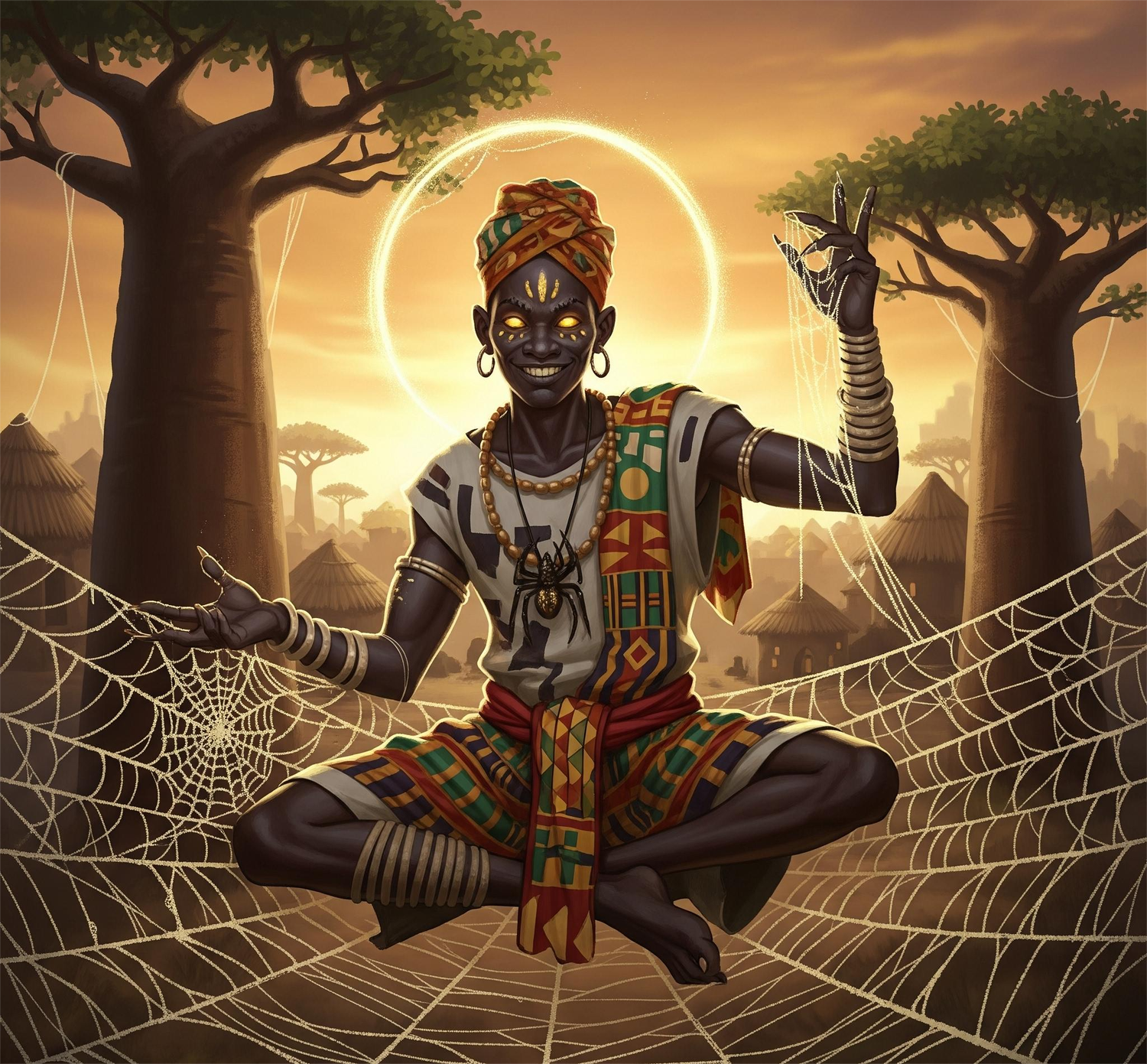
Of all the characters populating the vast landscape of African oral tradition, few have traveled as far, survived as much, or remained as beloved across so many centuries as Anansi the spider. Born among the Akan people of what is now Ghana, Anansi began as a single trickster figure within one region’s storytelling tradition and grew, over generations of retelling, into something closer to a cultural institution — so central to Akan oral literature that an enormous body of Akan folktales carries his name collectively, known as Anansesem, or “spider stories,” whether or not the spider himself appears as the central character in any given tale. He would go on to survive the transatlantic slave trade, cross an ocean in the memory of enslaved Africans who owned nothing else, and take root in new soil across the Caribbean and the Americas, emerging as one of the clearest living threads connecting contemporary African diaspora culture back to a specific, namable ancestral tradition.
To understand Anansi properly is to understand something essential about how African storytelling handles moral complexity, cleverness, and power — because Anansi is neither hero nor villain in any simple sense. He is greedy, vain, selfish, and manipulative, and he is also brilliant, resourceful, and frequently the underdog whose triumphs over larger and more powerful figures delight every audience who has ever heard his stories. This contradiction is not a flaw in his character; it is the entire point of him.
A Spider Among Gods and Giants
The foundational Anansi story, told and retold across Akan communities in countless variations, explains how the spider came to own all the world’s stories in the first place — a myth that functions as something like an origin point for the entire body of Anansesem that follows. In the most widespread version of this tale, all stories once belonged exclusively to Nyame, the sky god, who kept them locked away and refused to share them with the world below. Anansi, small and physically unimpressive compared to the towering figure of the sky god, nonetheless approached Nyame and asked to purchase the stories for himself.
Nyame, amused by the spider’s audacity, set what he assumed would be an impossible price: Anansi would have to capture and deliver four of the most dangerous and elusive creatures in the world — often named as Onini the python, Osebo the leopard, the Mmoboro hornets, and Mmoatia, a mischievous forest spirit, depending on which regional telling one encounters. Each of these creatures was, individually, far more powerful than the small spider tasked with capturing them, and Nyame’s price was clearly designed to guarantee failure and send the presumptuous spider back down to earth empty-handed.
Anansi’s capture of each creature forms its own miniature tale within the larger story, and each capture relies not on strength, which Anansi entirely lacks, but on a specific piece of psychological insight into his target’s own vanity, curiosity, or predictable behavior. He tricks the python into testing whether he is truly as long as a particular palm branch, then binds him to the branch while he is stretched out and distracted by his own vanity. He digs a pit disguised as solid ground and needles the leopard into an angry, uncontrolled leap that leaves him trapped. He convinces the hornets that a sudden rainstorm is coming and offers them shelter inside a hollow gourd, sealing them inside once they have gratefully accepted his hospitality. He carves a small doll, coats it in sticky sap, and places a bowl of pounded yam before it; the mischievous forest spirit, offended when the silent doll fails to thank her for a gift of food, strikes it in anger and finds her hand permanently stuck, allowing Anansi to walk her away captive.
Each of these small victories showcases the same underlying method: Anansi never overpowers his opponents directly. He studies them, identifies the specific flaw in their character or judgment, and constructs a situation in which that flaw defeats them on its own, with Anansi merely present to collect the result. Having delivered all four captives to a stunned Nyame, Anansi is granted ownership of the world’s stories, which the sky god renames Anansesem in recognition of the spider’s cunning and persistence. From that point forward, according to the tradition itself, every story told is understood to be, in some sense, one of Anansi’s stories — an elegant piece of self-referential mythology that positions the trickster not merely as a character within the tradition but as its very source and owner.
The Anatomy of a Trickster’s Cleverness
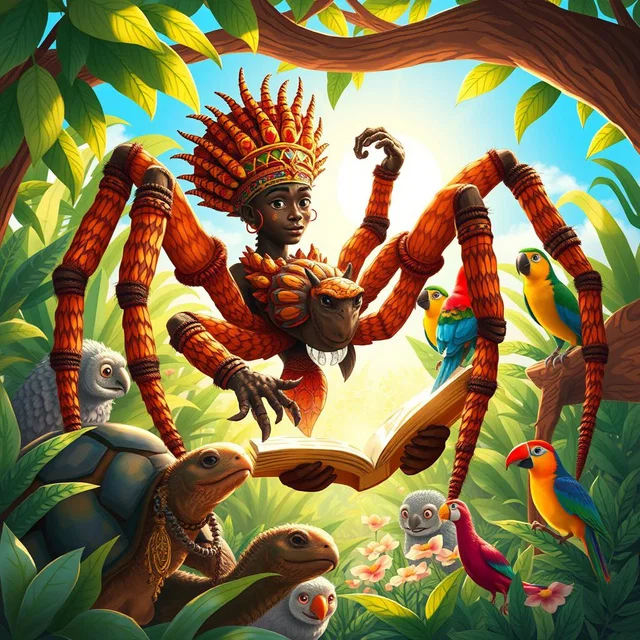
What distinguishes Anansi from a simple strongman hero, and what has made him such an enduringly compelling figure across centuries of retelling, is the particular quality of his intelligence. Where other folkloric heroes might triumph through courage or brute force, Anansi’s victories are almost always the product of careful observation combined with a willingness to manipulate language, social expectation, and his opponents’ own vanity against them.
A great many Anansi tales hinge specifically on bargains, bets, and promises — Anansi proposing an agreement whose terms sound straightforward to his unsuspecting opponent but which Anansi has carefully constructed to guarantee his own advantage once the fine details play out. This gives Anansi stories a distinctly verbal, almost legalistic flavor that sets them apart from animal tales built primarily around physical cunning or disguise. Anansi does not merely trick his opponents; he talks them into trapping themselves, using their own agreement to a seemingly fair bargain as the very mechanism of their downfall.
This verbal dimension of Anansi’s cleverness made him a particularly rich character for oral performance, since a skilled storyteller could use Anansi’s voice as an opportunity to showcase their own linguistic dexterity — clever turns of phrase, exaggerated persuasive speeches, comic asides — turning each telling of an Anansi story into a small performance of verbal artistry in its own right, layered on top of the narrative itself. Audiences did not simply want to know what happened in an Anansi story; they wanted to hear how a particular storyteller would voice the spider’s persuasive, self-serving logic, and a truly gifted narrator could make even a familiar tale feel fresh through sheer performative skill.
When Cleverness Turns to Greed
For all his brilliance, Anansi is rarely portrayed as a straightforwardly admirable figure, and this moral ambiguity sits at the very center of his enduring appeal. A significant portion of Anansi tales are not stories of his triumph at all, but stories of his humiliation — occasions when his scheming overreaches, his greed outpaces his caution, or his manipulation of others finally catches up with him in a moment of public, often comic, comeuppance.
In one widely told tale, Anansi, unwilling to share a pot of food he has magically obtained with his own hungry children, invents an elaborate excuse requiring them to wash their hands in a nearby river before eating, then quietly eats the entire pot himself while they are away, only to be caught and shamed when evidence of his gluttony becomes obvious to everyone present. In another common tale, Anansi attempts to secure an enormous meal for himself alone by tricking multiple animal neighbors into each preparing a dish and delivering it to his home under false pretenses, only for his scheme to unravel when the various guests arrive simultaneously and discover his deception together. In yet another, his attempt to hoard all the wisdom in the world inside a single sealed pot backfires when his own son points out the obvious flaw in his plan, embarrassing the supposedly all-wise spider in front of his own family and prompting him, in some versions of the tale, to scatter the wisdom back out into the world in frustration — which storytellers offer as an explanation for why wisdom, rather than belonging to any single person, is instead scattered throughout the whole of humanity, everyone possessing some small share of it.
These humiliation tales serve a crucial balancing function within the broader Anansi tradition. They ensure that Anansi’s cleverness is never presented as an unqualified virtue to be imitated without reservation; children hearing these stories absorb both halves of the lesson simultaneously — admiration for genuine wit and resourcefulness, paired with a clear-eyed recognition that cunning deployed purely for selfish gain, without regard for fairness or the feelings of others, eventually collapses under its own excess. Anansi’s periodic humiliations are, in this sense, just as important to his pedagogical function as his triumphs, and a skilled storyteller would typically balance stories of each type across an evening’s performance, ensuring that young listeners came away impressed by cleverness but wary of greed.

Family, Community, and the Limits of the Trickster
Unlike some trickster figures in world mythology who operate as solitary wanderers, Anansi is consistently embedded within a specific family and community context across the Akan tradition, and this domestic setting adds important texture to his stories. He has a wife, frequently named Aso in various tellings, and children who appear across numerous tales, sometimes as innocent victims of his schemes, sometimes as clever figures in their own right who occasionally outwit their own father, turning the tables on the trickster within his own household.
This family context matters because it grounds Anansi’s trickery within ordinary domestic and community relationships rather than treating him as an entirely mythic, distant figure. His schemes against his own wife and children carry a particular sting precisely because family relationships are supposed to be governed by mutual care and generosity rather than manipulation, and tales in which Anansi’s greed leads him to deceive his own household typically draw sharper moral condemnation, within the story’s own internal logic, than tales in which he merely outwits a rival animal or a stranger. At the same time, tales in which Anansi’s children or wife successfully outsmart him carry their own particular satisfaction, demonstrating that the trickster’s own cleverness can be turned back against him by those who know him best, and suggesting, gently, that no one — not even the cleverest character in the entire tradition — is immune to being outwitted in turn.
Anansi’s Journey Across the Atlantic
The historical trauma of the transatlantic slave trade forcibly separated millions of Africans from their homelands, their languages, and the vast majority of their material culture, yet it could not strip away the stories carried in memory, and Anansi proved to be one of the most resilient of all the cultural inheritances that survived this crossing. Enslaved Akan people carried Anansi with them into new, brutally different circumstances across the Caribbean and parts of North and South America, and the spider trickster took root in this new soil, evolving and adapting while retaining his essential character across the disruption.
In Jamaica, Anansi stories became so deeply integrated into the island’s broader oral tradition that they arguably shaped the fundamental character of Jamaican folk storytelling more than any other single narrative source, evolving new plots, new local details, and a distinctly Jamaican flavor while retaining the spider’s core identity as a clever, morally ambiguous trickster who survives through wit rather than strength. Anansi’s name itself became so embedded in local speech that “Anansi story” or “Nancy story” came to function, in some Caribbean communities, almost as a general term for a folktale, regardless of whether the spider himself actually appeared in the particular story being told.
In parts of the American South, Anansi transformed further, sometimes blending with related trickster traditions carried by enslaved people from other African regions, sometimes appearing under altered names such as Aunt Nancy, reflecting the linguistic drift and cultural blending that occurred as enslaved communities from diverse African origins were forced together under conditions of extraordinary hardship. Scholars examining African American folklore traditions, including the well-known Br’er Rabbit tales, have long noted the structural and thematic similarities to Anansi and other African trickster figures, suggesting a broader, complex web of influence and adaptation running beneath the surface of what later became recognized as distinctly American folklore.
This survival was never passive. Enslaved communities used trickster tales, with their celebration of the physically weak outwitting the powerful through cunning rather than force, as a means of processing and quietly resisting their own circumstances of subjugation. A story in which a small, clever spider consistently triumphs over creatures many times his size and strength carried an unmistakable resonance for people living under a system built entirely on brute force and denying them any official power of their own, and it is difficult to view Anansi’s continued popularity throughout the era of enslavement as mere coincidence rather than a form of coded resilience, understood clearly by the communities telling and hearing these tales even when it could not be spoken of openly.
Anansi Today
Contemporary interest in Anansi has expanded considerably beyond his traditional oral context, as the character has found new life across illustrated children’s books, animated adaptations, and literary fiction aimed at adult readers, including prominent works of contemporary fantasy literature that have introduced Anansi to entirely new international audiences with little or no prior exposure to West African oral tradition. This expanding visibility reflects a broader pattern explored elsewhere in this series: African folklore’s increasing recognition, both within Africa and internationally, as a source of rich, sophisticated narrative material fully capable of standing alongside any other major world mythological tradition.
For contemporary Ghanaian and broader West African communities, Anansi remains an active part of living cultural identity rather than a historical curiosity, continuing to appear in children’s storytelling, cultural education programs, and public celebrations of Akan heritage. For diaspora communities across the Caribbean and the Americas, Anansi functions as something even more specific and precious: a direct, traceable thread connecting contemporary African-descended communities back to a particular, namable ancestral tradition, surviving centuries of forced separation as living proof that a story, carried carefully enough in memory, can outlast almost anything history throws against it.
Few characters in any storytelling tradition, anywhere in the world, can claim quite so remarkable a journey — from a single spider outwitting a sky god to win ownership of all the world’s stories, to a figure recognized and beloved across an entire ocean and hundreds of years of separation, still teaching each new generation the same essential, complicated lesson he has always taught: that cleverness is a genuine gift worth celebrating, but that even the cleverest among us eventually meets the limits of what cunning alone can secure.
“The spider’s web is not woven in a day, and neither is a spider’s reputation.”
