

“When the lion tells the story, the hunter is never the hero.”
Walk into almost any collection of African oral tradition, from the coastal fishing villages of Senegal to the highland farms of Ethiopia, from the Kalahari to the Great Lakes, and one thing becomes immediately obvious: the animals never stop talking. They argue, they scheme, they marry, they hold court, they cheat one another out of meals and wives and reputations, and they do all of it with a vividness that makes them feel less like symbols borrowed for convenience and more like a second, parallel society running alongside the human one — a society whose business somehow always turns out to be commentary on our own.
This is the defining feature of African animal folktales: they are rarely, if ever, simply about animals. A hare outwitting a hyena is also, quietly, a meditation on how the weak survive among the strong. An elephant humiliated by a tortoise is also a lesson about the emptiness of raw power unaccompanied by thought. A tale explaining why the crocodile lives in water while the goat lives on land is also, often, an explanation of how the world came to be divided the way it is, and why every creature — human included — must accept the particular portion of existence it has been given. To read these tales only as stories about animals is to read only half of what is actually there.
A Cast as Old as the Continent
What makes African animal folklore so distinctive is not merely that animals talk — storytelling traditions worldwide have always given voice to beasts — but the sheer consistency and depth of character each recurring animal accumulates across thousands of individual tales, told over centuries, across dozens of language groups. The tortoise of Yoruba tradition, known as Ijapa, is not a new character in every story; he is the same figure, carrying forward a reputation built tale after tale, so that a child hearing a new Ijapa story for the first time already half-knows, from cultural osmosis alone, what kind of trouble he is about to cause.
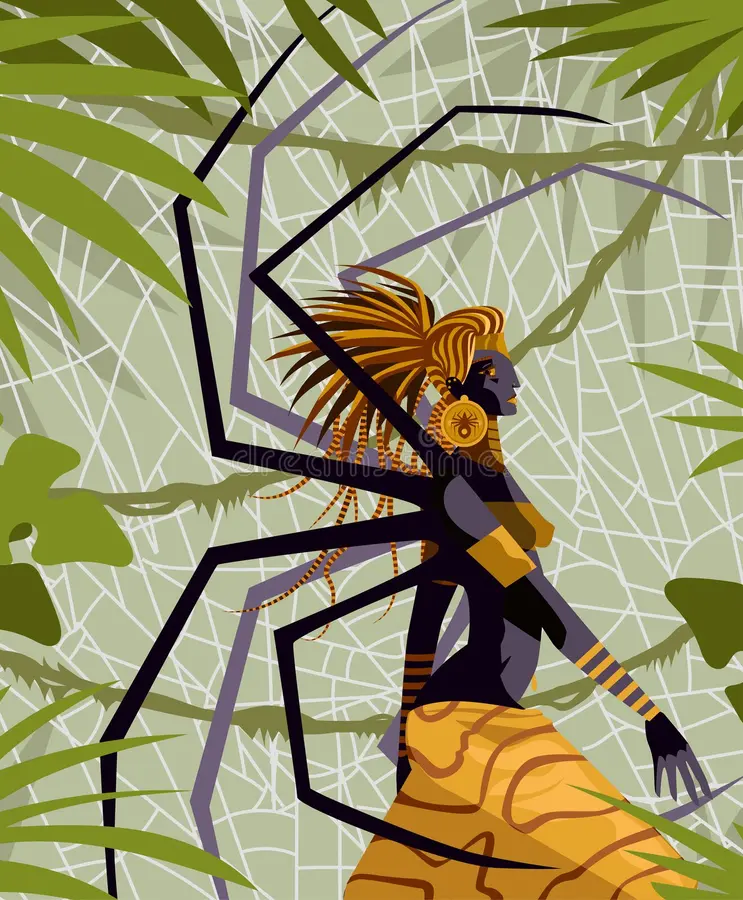
This continuity of character turns the animal kingdom of African folklore into something closer to an enormous, ongoing drama with a fixed cast, rather than a scattering of unrelated fables. The hare, found across huge stretches of Southern and Central Africa, is almost always quick-witted, physically unimpressive, and dangerously clever — a character whose survival depends entirely on out-thinking creatures many times his size and strength. The hyena, by contrast, appears again and again as an object of scorn: greedy, foolish, prone to being fooled by promises of food, forever undone by his own appetite. The lion carries the outward trappings of authority — size, roar, the fear he inspires — but is just as often shown to be gullible, easily flattered, or entirely dependent on cleverer animals to solve problems his strength cannot touch. The elephant, similarly, tends to represent raw power that proves strangely brittle when confronted with patience and wit. The spider, especially in West African tradition where he takes the name Anansi, occupies his own unique category entirely — a trickster so central to Akan storytelling that an enormous number of Akan folktales are still referred to collectively as Anansesem, “spider stories,” regardless of whether the spider himself even appears in a given tale.
This shared vocabulary of animal character meant that storytellers across a region, even those who had never met, could improvise new plots using recognizable figures whose personalities the audience already understood, the way a jazz musician might improvise a new melody over a chord progression everyone in the room already knows by heart.
Why the Small Outwit the Large
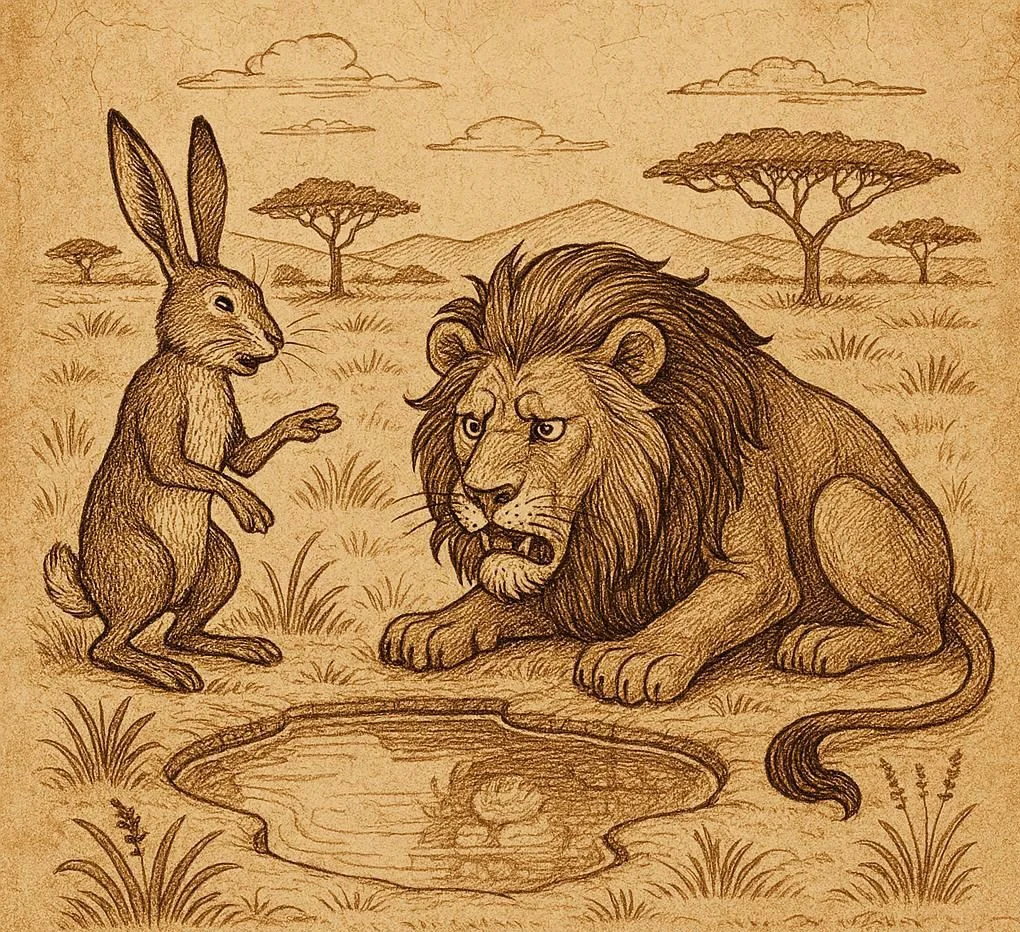
If there is a single pattern that dominates African animal folklore above all others, it is the triumph of the small, physically weak creature over the large, physically powerful one — not through strength, which the small animal manifestly lacks, but through patience, observation, and cunning. The hare defeats the lion. The tortoise defeats the elephant. The tiny bird outsmarts the crocodile. Again and again, across regions that share almost no direct historical contact, the same basic shape recurs: brains over brawn, and specifically, brains belonging to a creature society would otherwise dismiss as insignificant.
The social logic behind this pattern is not difficult to trace. These stories were told in agrarian and pastoral communities where the ordinary person — the farmer, the herder, the child, the elder past their physical prime — had no realistic hope of overpowering the forces that most threatened them: drought, disease, wild predators, more powerful neighboring groups, or simply the arbitrary authority of the powerful within their own community. In such a world, a story in which the physically weakest character consistently triumphs over the physically strongest was not idle fantasy; it was a form of communal reassurance and, quietly, a form of instruction. It told listeners, from the youngest child to the oldest elder, that raw power was not destiny, that intelligence and patience were resources available even to those with nothing else, and that the world’s apparent hierarchy of strength was not necessarily its true hierarchy of who would ultimately prevail.
This theme carried an additional, sharper edge in many communities that had direct experience of colonial domination. Storytellers and listeners alike frequently understood — sometimes explicitly, sometimes only implicitly — that a tale about a small, clever animal outwitting a large, brutish one carried an unmistakable resonance for people living under foreign rule backed by superior military force. The tale of the hare who tricks the lion could be, depending on who was listening and what era they were living through, simply a children’s story, or it could be a coded expression of hope that domination by size and strength was not, in the end, permanent or unanswerable.
The Comedy of Appetite
A great many African animal tales are, on their surface, comedies, and the engine of that comedy is almost always appetite — hunger, greed, the desire to eat well without doing the work that earns a meal honestly. The hyena’s endless schemes to steal food, the trickster’s elaborate deceptions to secure a feast at someone else’s expense, the foolish animal who agrees to an obviously bad bargain because the promise of food overrides its judgment — these appetite-driven plots recur so frequently across the continent’s folklore that hunger might fairly be called one of its central engines.
This comic emphasis on appetite served real social purposes beyond simple entertainment. In communities where food scarcity was a genuine, recurring seasonal reality rather than an abstraction, stories that mocked greed and rewarded restraint carried practical weight. A character whose uncontrolled hunger repeatedly led to disaster — caught in a trap because he could not resist one more mouthful, humiliated in front of the whole animal community because his greed was too obvious to hide — offered listeners a vivid, memorable, and genuinely funny illustration of why self-control around food and resources mattered, not as abstract virtue but as practical survival wisdom dressed in laughter.
At the same time, these tales rarely condemned hunger itself, or even cleverness deployed in pursuit of a meal. What they consistently punished was excess — taking more than one’s fair portion, deceiving others purely for personal gain rather than genuine need, refusing to share even when sharing cost little. The line these stories drew was subtle but consistent: cleverness in service of survival was admirable; cleverness in service of pure greed eventually collapsed on itself, usually in a moment of public, exaggerated humiliation that the youngest listener could not help but laugh at, and remember.
Explaining the World Through Animal Origins
Beyond the recurring cast of trickster and fool, African animal folklore contains an enormous body of what scholars often call origin tales or pourquoi stories — tales that answer a child’s most persistent question, “why,” by explaining some observable feature of the natural world through a narrative about how it came to be. Why does the tortoise have a cracked shell? Why does the hyena walk with a limp, or laugh the way it does? Why do certain birds have the particular markings they carry? Why does the crocodile live in the water while other creatures live on land? Each of these questions, in community after community, found its answer not in scientific explanation but in story.
These origin tales performed several functions simultaneously. Most obviously, they satisfied a child’s natural curiosity about the world in a way that was memorable and enjoyable rather than dryly informational — a lesson wrapped so thoroughly in narrative pleasure that the child absorbed it without feeling taught. But origin tales also frequently carried the same moral freight as other animal stories, using the explanation of a physical feature as the punchline to a tale that was really about greed, disobedience, pride, or betrayal. The tortoise’s cracked shell, in many Yoruba tellings, is not an arbitrary physical fact but the direct, visible consequence of his own overreaching cleverness — a permanent mark left on the world by a moral lesson, so that every time a child sees a tortoise’s shell afterward, the story and its lesson return to mind unbidden. In this way, origin tales turned the visible natural world itself into a kind of permanent, walking reminder of the community’s moral teachings — the landscape and its creatures became, quite literally, illustrations of the culture’s values, visible to anyone who knew how to read them.
Anansi and the Particular Power of the Spider
No single animal character looms larger across West African storytelling, and increasingly across the wider African diaspora, than Anansi the spider. Originating among the Akan people of what is now Ghana, Anansi occupies a category slightly apart from the broader menagerie of African animal tricksters, both because of the sheer number of tales attributed to him and because of the particular flavor of his cleverness, which tends toward the intellectual and the linguistic rather than simple physical cunning.
Anansi’s stories frequently hinge on wordplay, clever bargains, and the manipulation of promises and language itself — he is less a creature who outruns his enemies than one who out-talks them, securing advantages through bets, riddles, and agreements whose fine print his opponents fail to notice until it is too late. This gave Anansi tales a particular richness for oral performance, since storytellers could showcase their own verbal dexterity through Anansi’s voice, turning each retelling into an opportunity for linguistic display as much as narrative entertainment.
Anansi’s enduring popularity also owes something to his moral complexity, arguably even more pronounced than that of other tricksters. He is rarely purely heroic; his schemes frequently harm others, sometimes his own family, and his stories do not shy away from showing him humiliated, outsmarted in turn, or forced to pay for his manipulations. Yet children and adults alike continued — and continue — to delight in him, precisely because his combination of genuine cleverness and genuine flaw makes him feel more like a fully realized character than a simple moral device. The endurance of Anansi stories through the transatlantic slave trade and into the folklore of the Caribbean and the Americas, where he survives under names like Anansi, Aunt Nancy, or Br’er Anansi, stands as one of the most striking examples of how deeply rooted a single animal character can become in a people’s imagination — carried across an ocean, through unimaginable hardship, because the stories mattered enough to keep alive by memory alone.
Teaching Ecology Through Character
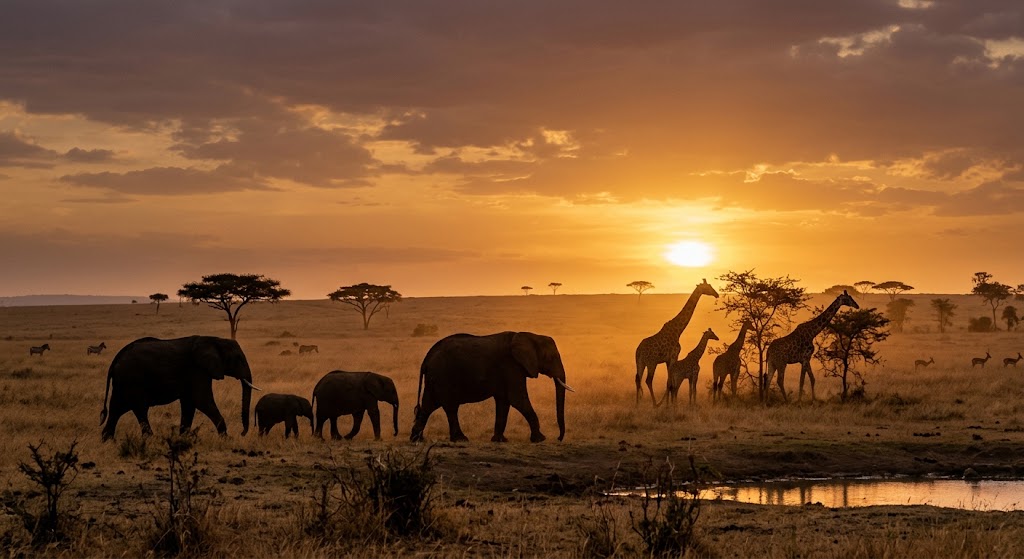
Beyond their moral and comedic functions, African animal folktales also carried, almost as a side effect, a substantial amount of practical ecological knowledge, encoded into the personalities and behaviors assigned to each species. A storyteller describing the hyena’s scavenging habits, the tortoise’s slow but persistent movement, the hare’s alertness and speed, or the crocodile’s patient, motionless ambush was not inventing these traits from nothing; the personalities assigned to each animal in folklore were almost always rooted in careful, generations-deep observation of the real creature’s actual behavior in the wild.
This meant that children absorbing these tales were simultaneously absorbing a working knowledge of the natural world around them — which animals were dangerous and under what circumstances, which were harmless despite fearsome appearance, which behaviors to expect from which species, and how different creatures fit into the broader web of the local ecosystem. A child who grew up on a steady diet of tortoise, hare, and hyena stories left childhood not only morally instructed but also quietly educated in the natural history of their own environment, in a form far more engaging, and therefore far more durable in memory, than any dry lesson in zoology could have achieved.
From Fireside to Page and Screen
The animal folktale tradition has proven, perhaps more than any other strand of African oral literature, remarkably successful at making the transition into new media without losing its essential character. Illustrated children’s books built directly from traditional tortoise and hare stories, animated adaptations of Anansi tales, and radio programs retelling hyena-and-hare stories for new generations have all found significant audiences, both within Africa and among diaspora communities eager to reconnect with ancestral storytelling traditions.
Part of what makes this transition so successful is the inherent portability of the animal tale’s structure. A story built around a fixed, widely recognized cast of characters, each carrying a consistent personality across countless individual plots, translates unusually well into new formats and new audiences, because a reader or viewer encountering the tortoise for the first time in a picture book is stepping into a role — the audience member learning the cast — that African children have played around countless fires for centuries. The medium has changed; the underlying architecture of character, consequence, and laughter has not.
What these adaptations preserve, at their best, is precisely what made the original tradition so effective in the first place: the sense that the animal kingdom is not simply a backdrop for human concerns but a fully imagined parallel society, populated by characters whose triumphs and failures, cleverness and greed, courage and cowardice, reflect the full complexity of human life back at the audience, filtered through fur, feather, and shell in a way that makes hard truths easier to hear, and impossible to forget.
“The tortoise does not boast of speed; he boasts of arriving.” — African proverb
