

Long before the written word found its way into African societies, before ink touched paper or letters formed sentences on any page, the continent had already developed one of the most sophisticated systems of knowledge transmission the world has ever known. This system was not built of paper and archives but of voice, memory, rhythm, and performance. It was oral tradition, and at its heart sat folklore — the stories, myths, legends, and fables that carried the values, fears, hopes, and history of entire peoples from one generation to the next. To understand African folklore is to understand how a continent as vast and varied as Africa managed to preserve identity, instill morality, explain the unexplainable, and entertain its people all at once, using nothing more than the spoken word and the presence of a skilled storyteller.
The Nature of Oral Tradition
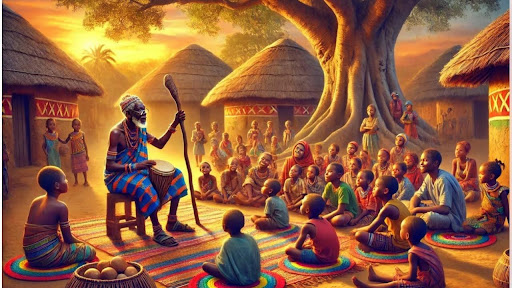
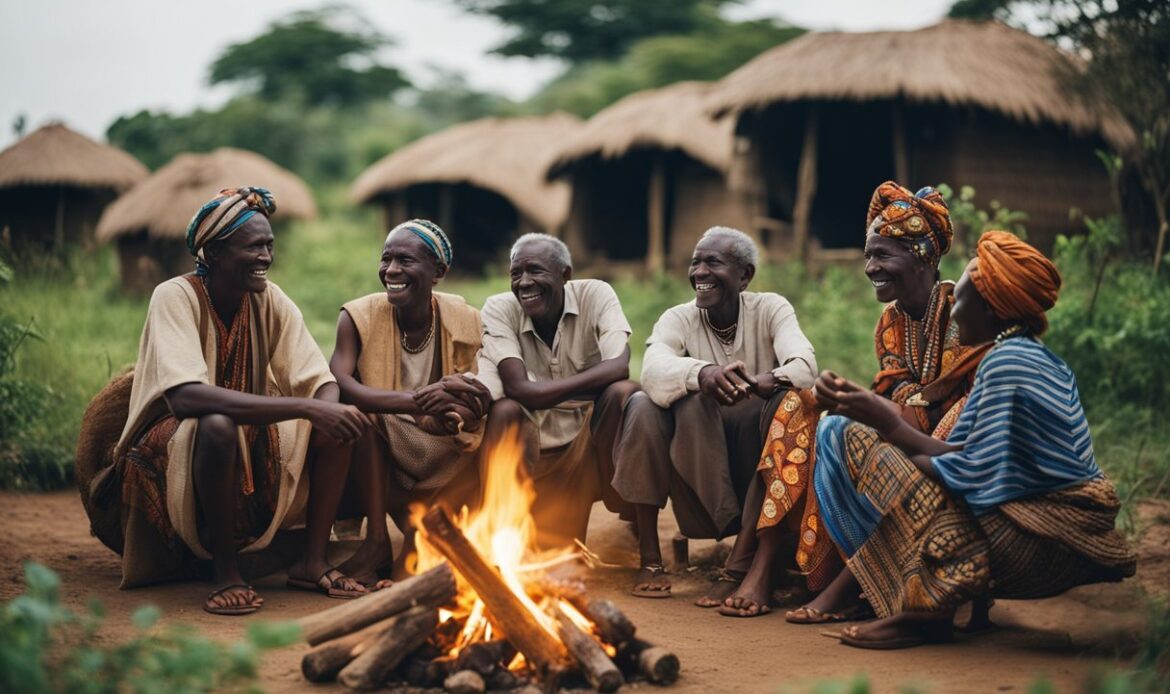
Africa is home to thousands of ethnic groups, each with its own language, customs, and worldview. Despite this staggering diversity, one thread runs through nearly every African culture: the central importance of oral storytelling. In many communities, storytelling was not a casual pastime reserved for idle moments. It was a structured, often ritualized practice woven into the rhythm of daily and communal life. Evenings, after the day’s labor was done and the meal had been eaten, were frequently set aside for gathering — children seated on mats or bare earth, elders positioned where their voices could carry, and the fire crackling as the only light source once the sun disappeared.
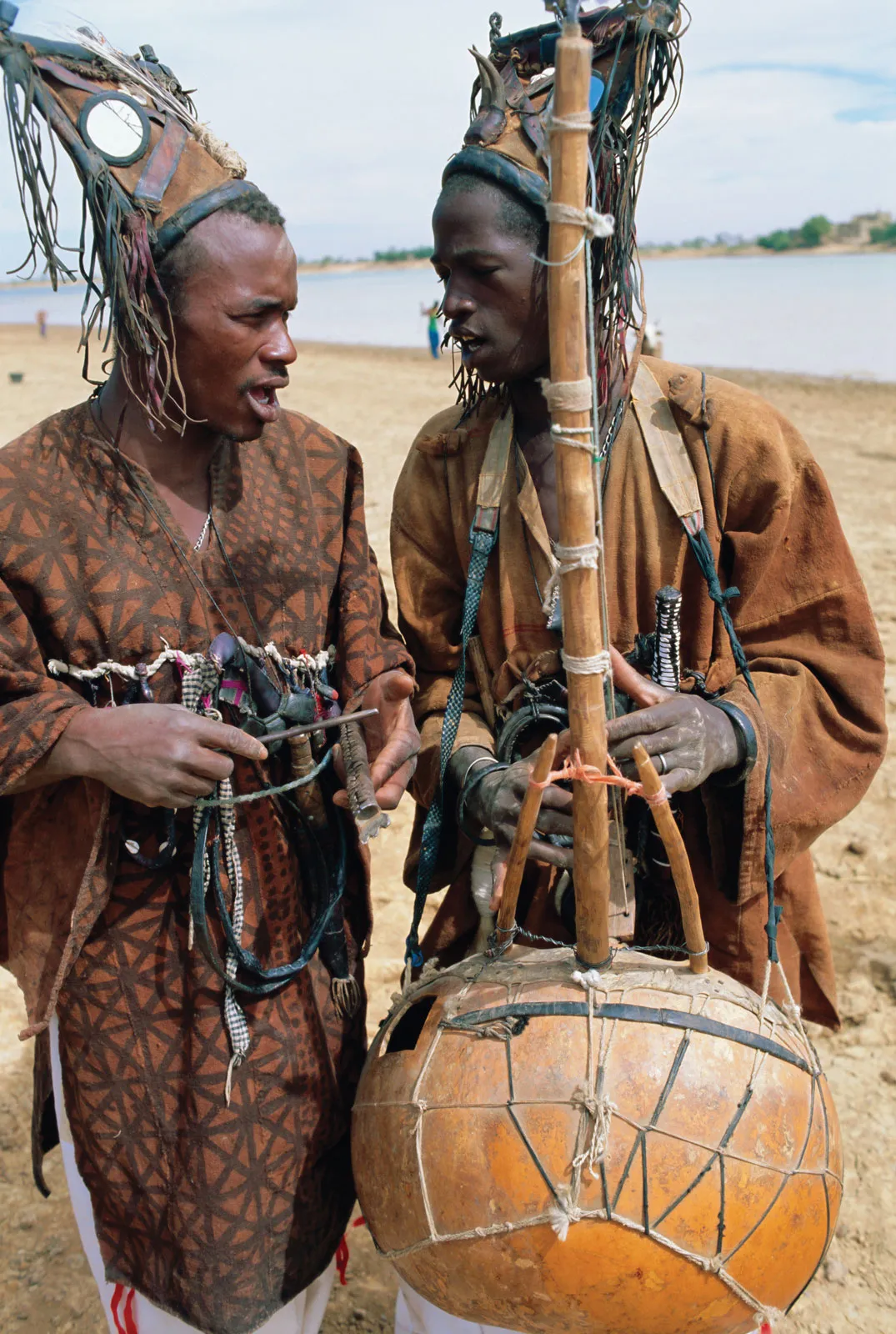
It was in these settings that a storyteller, sometimes an elder, sometimes a designated custodian of oral history such as a griot in West Africa, would begin to speak. The stories told were rarely delivered as flat narration. They were performed. A skilled narrator would change their voice for different characters, incorporate song, invite call-and-response participation from the audience, and use gesture and facial expression to heighten the drama of a tale. This performative quality meant that folklore was never simply “read” the way a modern audience might read a book; it was experienced collectively, with the listeners as active participants rather than passive recipients.
The physical setting of storytelling mattered as much as the words themselves. In many communities, the choice of when and where a tale could be told was governed by unwritten but firmly understood rules. Certain stories, especially those touching on the spirit world or ancestral matters, were reserved strictly for nighttime, when the boundary between the visible and invisible worlds was believed to thin. Daytime storytelling, by contrast, might be considered inappropriate or even dangerous in some traditions, thought to invite misfortune or confusion between the realm of the living and the realm of spirits. This careful structuring of when stories could be shared reveals just how seriously oral tradition was treated — not as casual chatter, but as a practice bound by its own internal logic and respect for unseen forces.
Children occupied a particularly important role in these storytelling circles. They were not merely an audience to be entertained; they were apprentices in the making, absorbing not just the plot of a tale but the cadence of language, the structure of proverbs, the appropriate use of call-and-response, and the subtle art of interpreting a story’s deeper meaning. Over years of repeated exposure to the same core tales told in slightly different ways by different narrators, children developed an intuitive grasp of their culture’s values, humor, and worldview — an education every bit as rigorous as formal schooling, though delivered through entirely different means.
Folklore as a Vessel of Memory
Perhaps the most important function of African folklore was its role as a vessel for cultural memory. In societies without widespread written record-keeping, oral tradition served as the primary archive of history, genealogy, law, and cosmology. Origin stories explained how a particular people came to exist, how they arrived at their ancestral lands, and how they related to neighboring groups. Genealogies recited by griots in places like Mali and Senegal preserved centuries of lineage, connecting living individuals to ancestors and, in some cases, to entire empires such as the Mali Empire and its legendary founder.
Because these stories were transmitted verbally, memory itself became a discipline. Storytellers, particularly professional or semi-professional ones, trained for years to master vast repertoires of tales, songs, and genealogical records. Some traditions required apprenticeship lasting well over a decade before a person was considered capable of accurately carrying and transmitting this knowledge. The stakes were high: a distorted genealogy could alter claims to land, leadership, or status, and a poorly remembered myth could weaken the very cosmological framework a community relied upon to make sense of its existence.
This function of folklore as living archive also meant that stories were rarely static. Unlike a written text fixed permanently on a page, an orally transmitted tale could shift subtly with each retelling, absorbing new details, adapting to changing social circumstances, or incorporating commentary on recent events. A skilled storyteller might insert a topical reference into an ancient tale to make its moral resonate with a contemporary problem the community was facing, whether a drought, a leadership dispute, or tension with a neighboring group. This flexibility did not undermine the integrity of the tradition; rather, it was precisely what kept folklore alive and relevant across centuries, allowing ancient narrative structures to continually renew their meaning for each new generation of listeners. Historians and anthropologists who have studied these traditions note that this adaptability is itself a form of preservation — the deep structure and moral core of a story remaining stable even as its surface details evolve to fit the present moment.
The Many Categories of African Folklore
African folklore is not a single genre but a broad umbrella covering several distinct categories of narrative, each serving different social and psychological functions.
 Creation myths attempt to explain the origins of the world, humanity, natural phenomena, and the relationship between the divine and the earthly. These stories often feature a supreme creator god who sets the world in motion, sometimes assisted or opposed by lesser spirits, ancestors, or trickster figures. Creation myths differ enormously from one ethnic group to another, yet they share a common purpose: situating a people within a larger cosmic order and answering the fundamental human question of “why are things the way they are?”
Trickster tales form one of the most beloved and enduring categories across the continent. Figures such as Anansi the spider among the Akan people of Ghana, or the hare in various East and Southern African traditions, use wit, cunning, and sometimes outright deception to outsmart larger, stronger, or more powerful adversaries. These stories are deceptively simple on the surface but often carry layered social commentary — celebrating intelligence over brute strength, questioning rigid hierarchies, and offering audiences the vicarious thrill of watching the underdog win.
Heroic legends recount the exploits of kings, warriors, and culture heroes whose deeds shaped the destiny of their people. These narratives often blend historical fact with mythic embellishment, transforming real rulers into larger-than-life figures whose courage, wisdom, or supernatural favor becomes a model for leadership and communal pride.
Supernatural and spirit narratives populate the African folkloric landscape with a rich cast of beings — ancestral spirits, nature deities, shape-shifters, and malevolent forces that must be respected, appeased, or outwitted. These stories reinforce a worldview in which the visible and invisible realms are deeply interconnected, and where human behavior can have consequences that ripple into the spiritual domain.
Moral and cautionary tales, often aimed primarily at children, use animal characters or exaggerated human scenarios to teach lessons about honesty, humility, respect for elders, generosity, and the dangers of greed or arrogance. These stories function as an early and enduring form of moral education, shaping character long before formal schooling became widespread.
The Social Function of Storytelling
Beyond entertainment, folklore in African societies performed critical social functions that helped hold communities together. It reinforced shared values by presenting consequences for behavior that violated communal norms — greed punished, kindness rewarded, arrogance humbled. It provided a safe space to explore difficult or taboo subjects indirectly, using animal characters or fantastical scenarios as a buffer that allowed listeners to reflect on real human failings without direct confrontation.
Storytelling sessions also served as informal spaces of education, where children absorbed history, ethics, environmental knowledge, and social expectations through narrative rather than lecture. This method of teaching through story proved remarkably effective, as the emotional engagement of a well-told tale often left a deeper impression than direct instruction could achieve. A proverb frequently invoked across many West African cultures captures this belief precisely: “A story is like the wind; it comes from a distant place, and we feel it.”
This proverb speaks to the way folklore transcends its immediate origin, traveling across generations and geographies while still carrying the emotional and moral weight it was imbued with at its source. Even when a listener cannot trace exactly where a tale began, its impact remains palpable, shaping character and community long after the fire has died down and the storyteller has fallen silent.
Folklore also functioned as a mechanism of social regulation in communities where formal written law was absent or supplemented by custom. Stories about greedy chiefs punished by the spirits, dishonest traders exposed by clever animals, or disrespectful children brought low by their own arrogance served as informal but powerful deterrents against antisocial behavior. Because these narratives were shared communally and repeated across generations, they created a shared moral vocabulary that everyone in a community could reference. A parent correcting a child’s behavior might simply invoke a familiar character from a well-known tale, and the child would instantly understand the implied warning without need for lengthy explanation. This shared narrative shorthand strengthened social cohesion, giving communities a common set of reference points for discussing right and wrong, wisdom and folly, courage and cowardice.
Furthermore, storytelling sessions often served practical, almost therapeutic functions. In times of hardship, illness, or communal grief, familiar tales offered comfort through their predictability and their embedded reassurance that hardship could be overcome, that the trickster would eventually be caught, or that the humble would eventually be rewarded. In this sense, folklore operated not only as entertainment and education but as a form of collective emotional processing, helping communities make sense of suffering and maintain hope through narrative structures that had proven their resilience across countless retellings.
Regional Variations Across the Continent
While certain themes recur across Africa, the specific content and style of folklore vary enormously by region, reflecting the continent’s ecological, linguistic, and historical diversity.
In West Africa, the griot tradition elevated storytelling to a hereditary profession. Griots served not only as entertainers but as historians, genealogists, diplomats, and advisors to royal courts. Their epics, such as the Sundiata epic of the Mali Empire, blend historical narrative with mythic grandeur, preserving the memory of empire-building figures for centuries after their deaths. Trickster tales featuring Anansi the spider also flourished here, later traveling across the Atlantic with enslaved Africans to become foundational figures in Caribbean and African American folklore.
In East Africa, folklore often reflects the pastoral and agrarian lifestyles of communities such as the Maasai, Kikuyu, and Swahili-speaking coastal peoples. Stories frequently involve cattle, the hare as a trickster figure, and moral lessons tied closely to community cooperation and resource sharing, themes that resonated strongly in societies dependent on collective herding and land management.
In Southern Africa, San (Bushman) folklore, among the oldest continuous storytelling traditions in human history, features intricate mythologies surrounding the natural world, animals, and celestial bodies. Zulu, Xhosa, and Sotho traditions similarly incorporate rich ancestral spirit narratives, reflecting the central role of ancestor veneration in these cultures’ cosmologies.
In Central Africa, folklore among groups such as the Congolese and various Bantu-speaking peoples often intertwines with initiation rites and secret societies, with certain stories reserved for specific stages of life or levels of communal initiation, underscoring the deeply ritualized function some folklore served beyond mere entertainment.
In North Africa, folklore takes on a somewhat distinct character shaped by centuries of interaction with Arab, Berber, and Mediterranean cultural currents. Berber oral traditions, for instance, preserve their own rich body of trickster tales, moral fables, and mythological narratives, often transmitted in Tamazight languages distinct from the Arabic literary tradition that came to dominate the region’s written record. These stories frequently center on themes of hospitality, cleverness in the face of scarcity, and the delicate balance between nomadic and settled ways of life, reflecting the ecological realities of desert and mountain environments.
What unites these regionally distinct traditions, despite their surface differences, is a shared underlying architecture: the use of narrative to encode communal wisdom, the reliance on memorable characters and repeated motifs to aid oral transmission, and the deep integration of storytelling into the fabric of everyday communal life. A comparative look across these regions reveals not a single monolithic “African folklore” but rather a vast constellation of related storytelling traditions, each shaped by its particular ecology, history, and language, yet all recognizably part of a broader continental heritage of oral narrative art.
The Threat and Resilience of Oral Tradition
The colonial era posed significant challenges to African oral traditions. Missionary education systems often dismissed indigenous storytelling as primitive superstition, favoring written Western literary forms instead. Urbanization, migration, and the breakdown of traditional communal structures further disrupted the settings in which storytelling naturally thrived — the evening gatherings around a fire, the extended family compounds where multiple generations lived within earshot of one another.
 Despite these pressures, African folklore has proven remarkably resilient. Scholars, cultural custodians, and communities themselves have worked to document, preserve, and revitalize these traditions, recognizing their irreplaceable value as repositories of history and identity. Written collections, academic ethnographies, and more recently, digital archives and multimedia adaptations have all played a role in ensuring that stories once confined to a single village’s oral memory can now reach global audiences.
Folklore in the Modern World
Today, African folklore continues to evolve rather than disappear. Contemporary African authors, filmmakers, and artists frequently draw upon traditional tales, reimagining trickster figures, creation myths, and heroic legends for new audiences. Animated adaptations, graphic novels, and films have introduced characters like Anansi to international viewers who might never have encountered West African oral tradition otherwise. Meanwhile, within Africa itself, efforts to reintroduce folklore into school curricula and community programming aim to ensure that younger generations, increasingly shaped by digital media and globalized culture, remain connected to this profound inheritance.
Digital technology, somewhat paradoxically, has emerged as one of the most powerful tools for folklore preservation in recent decades. Podcasts featuring elders recounting traditional tales, YouTube channels dedicated to animated retellings of trickster stories, and online archives cataloguing oral histories from across the continent have all created new pathways for these ancient narratives to reach audiences who might never sit around a village fire. Social media platforms, too, have become unexpected venues for folklore transmission, with younger Africans sharing abbreviated versions of familiar tales, memes referencing well-known trickster characters, and discussions comparing folkloric wisdom to contemporary situations. While purists might mourn the loss of the intimate, face-to-face performance context that traditionally defined these stories, this digital migration also represents a form of adaptive survival consistent with folklore’s historical tendency to change vessels while preserving its essential core.
Academic interest in African folklore has also grown substantially, with universities across the continent and internationally establishing programs dedicated to African oral literature, linguistics, and cultural preservation. This scholarly attention has helped counter decades of colonial-era dismissal, reframing African oral tradition not as primitive superstition but as a sophisticated literary and philosophical system deserving serious study alongside written literary canons. Comparative folklorists have found rich connections between African trickster traditions and similar figures in other world mythologies, situating African storytelling within a broader global conversation about the universal human impulse to explain, moralize, and entertain through narrative.
The survival of African folklore into the twenty-first century is a testament to its enduring relevance. These stories were never simply relics of a pre-literate past; they were, and remain, dynamic tools for teaching, healing, questioning, and celebrating what it means to be human within a specific cultural and historical context. As long as there are voices willing to speak these tales aloud and communities willing to listen, African folklore will continue doing what it has always done: carrying cultural memory forward, one story at a time.
Publishing houses across Africa and the diaspora have also begun actively commissioning collections of traditional tales retold for younger readers, often illustrated by contemporary African artists who bring fresh visual interpretations to characters and settings once imagined only in the listener’s mind. These published collections serve a dual purpose: they provide a durable written record that supplements the oral tradition without replacing it, and they introduce folklore to children growing up in urban environments far removed from the village storytelling circles their grandparents once knew. In this way, the written word, once viewed by colonial educators as a replacement for “primitive” oral culture, has instead become one more tool in the ongoing project of keeping African folklore alive and accessible.
African folklore stands as one of humanity’s great achievements in oral literature — a vast, living library built not of books but of voices, passed hand to hand, generation to generation, across a continent of extraordinary linguistic and cultural diversity. From the trickster tales of Anansi to the heroic epics of West African griots, from creation myths explaining the origin of the cosmos to cautionary fables teaching children the value of humility, these stories have shaped how African peoples understand themselves, their history, and their place in the world. In the chapters that follow in this series, we will explore individual figures, themes, and traditions within this vast body of storytelling in greater depth, beginning with one of the most iconic trickster figures in all of world folklore: Anansi the Spider.
