

The History, Political Tradition, and Cultural Legacy of the Igbo People
The history of the Igbo people is one of the most fascinating examples of social organization, economic creativity, and cultural resilience in Africa. Primarily associated with southeastern Nigeria, the Igbo have developed a rich civilization whose influence can be seen in agriculture, commerce, art, religion, literature, politics, and modern business.
Yet one of the most distinctive features of traditional Igbo society was its approach to political authority. Unlike some neighboring African societies that developed powerful centralized kingdoms ruled by hereditary monarchs, many Igbo communities historically organized themselves through decentralized systems in which authority was distributed among families, village assemblies, age grades, titled individuals, and other community institutions. The structure varied considerably from one Igbo community to another, so it is more accurate to speak of a broad tradition of decentralized governance than a single political system.
This social organization contributed to what is sometimes described as the republican spirit of Igbo society: an emphasis on participation, personal achievement, community responsibility, and the idea that political authority should be subject to social expectations. At the same time, Igbo history is deeply connected with enterprise. Agriculture formed the foundation of many communities, but trade, craftsmanship, markets, and long-distance commercial relationships also became important features of Igbo economic life. The importance placed on achievement helped create cultural attitudes toward work, wealth, titles, and social advancement that remain influential today.
The story of the Igbo is therefore not simply about a people who resisted centralized kingship. It is about a society that developed its own ideas about leadership, achievement, community, and individual responsibility.
Who Are the Igbo?
The Igbo are one of Nigeria’s major ethnolinguistic groups. Their traditional homeland is concentrated primarily in southeastern Nigeria, extending across areas that today include Anambra, Enugu, Ebonyi, Imo, and Abia states, as well as parts of neighboring states. Igbo communities have also historically existed in areas of the Niger Delta and Cross River region.
The term “Igbo” encompasses a large and culturally diverse population. There are numerous local communities, dialects, and traditions within Igboland. Consequently, Igbo culture should not be treated as completely uniform. A person from one Igbo-speaking community may share broad cultural values with another community while having different customs, dialects, political traditions, or artistic practices. This internal diversity is an important part of understanding Igbo history.
The Geography of Igboland
Geography played an important role in the development of Igbo society. Igboland contains a mixture of forests, farmland, rivers, hills, and densely populated settlements. The Niger River and its surrounding waterways provided opportunities for fishing, transportation, and trade.
Agricultural communities developed extensive knowledge of their environments. The cultivation of crops such as yam became particularly significant in many areas. The environment also influenced settlement patterns and economic activities, prompting communities to adapt their livelihoods to local conditions rather than following one uniform economic model.
Agriculture and the Importance of Yam
Agriculture was central to traditional Igbo life. Among the crops cultivated, yam became particularly important in many communities. Yam was not simply a food crop; it could also represent wealth, labor, achievement, and social status. The ability to cultivate large quantities of yam demonstrated agricultural skill and access to land and labor.
The New Yam Festival, known by different names and practiced in various forms across Igbo communities, remains one of the most important cultural celebrations associated with agricultural cycles. The festival demonstrates the connection between food production, spirituality, family, and community identity.
The Igbo New Yam Festival
The New Yam Festival marks the beginning of a new harvest season in many Igbo communities. Its specific practices vary from place to place. However, the broader idea is one of gratitude, renewal, and communal celebration. Newly harvested yam is presented and eaten after appropriate traditional observances. Families and communities gather, accompanied by music, dance, and the participation of traditional leaders. The festival therefore transforms an agricultural event into a cultural expression of collective identity.
A Decentralized Political Tradition
Perhaps the most frequently discussed feature of traditional Igbo political organization is its decentralized character. Many Igbo communities did not develop a single king ruling over an entire people. Instead, political authority was distributed across different institutions:
- Lineage Leadership: Family heads held authority within their respective lineages.
- Civic Deliberation: Village assemblies discussed and decided on broader community matters.
- Social Regulation: Age grades performed executive, administrative, and security functions.
- Meritocratic Authority: Titleholders acquired civic influence through personal achievement and public service.
- Spiritual Oversight: Religious specialists exercised authority within spiritual matters.
The exact arrangement differed significantly between communities, preventing the concept of a single “Igbo government” from being imposed on a highly varied historical landscape.
The Village Assembly
In many Igbo communities, the village assembly provided an important mechanism for collective decision-making. Community members could discuss disputes, land issues, security, festivals, and other matters affecting communal life. The principle of consultation was paramount, ensuring authority could be negotiated rather than simply imposed from above.
This does not mean traditional Igbo societies were perfectly democratic in the modern political sense; they maintained social hierarchies, inequalities, and restrictions based on gender, age, and status. Nevertheless, their political organization differed significantly from centralized monarchies.
The Role of the Family
The extended family formed an essential foundation of Igbo social organization. Families and lineages could own land, maintain shrines, preserve ancestral traditions, and participate in community decision-making. The individual was understood within a network of relationships, meaning family responsibilities extended beyond personal interests. At the same time, individual achievement could elevate a person’s standing within the community, creating a balance of communal responsibility and personal ambition.
Achievement and Social Status
Traditional Igbo society placed considerable value on achievement. A person’s social position could be influenced by their reputation, wealth, integrity, contribution to the community, and ability to accomplish important goals. This differed from systems where status depended almost entirely on hereditary nobility.
This principle is reflected in the famous Igbo proverb and cultural idea that achievement could earn a person recognition regardless of humble beginnings. Independent Igbo villages were frequently led by meritocratic groups of titleholders from different families, with achievement highly valued in determining status.
Titles and the Ọzọ Institution
One important expression of achievement was the acquisition of traditional titles. The ọzọ title, for example, was associated with respected individuals who demonstrated exceptional integrity and judgment. The title was far more than a decorative honor; historically, becoming an ọzọ involved an elaborate process of initiation, symbolic transformation, and communal celebration. Titleholders participated in councils and public gatherings, with their status represented through specialized stools and regalia.
Leadership Without a King
The absence of a king did not mean that Igbo communities lacked governance. Rather, leadership was distributed functionalist-style across multiple entities:
- Elders provided accumulated experience and judicial wisdom.
- Titleholders possessed recognized civic authority.
- Age Grades executed communal works and policy enforcement.
- Religious Specialists maintained spiritual order.
- Family Heads represented lineage interests.
- Assemblies provided spaces for collective consensus.
The result was a robust political environment in which authority existed simultaneously at several levels.
Age Grades and Community Service
Age-grade organizations were another critical institution in many Igbo communities. People of similar age belonged to structured groups that performed vital social responsibilities, such as maintaining roads, organizing festivals, enforcing decisions, or providing local security. Age grades effectively transformed age into a vehicle for civic responsibility, linking individual development directly with community service.
Women and Political Organization
Igbo women developed influential forms of collective organization. Women’s associations addressed economic, social, and political matters. Actively involved in agriculture and commerce, women could exert collective pressure when decisions affected their interests. The exact nature of women’s authority varied across communities, highlighting how different Igbo settlements struck unique balances of power between men, women, elders, and titled figures.
The Concept of Community Responsibility
The decentralized structure of Igbo society depended entirely on civic participation. A person who accumulated wealth but refused to support the community faced intense social criticism. Likewise, respected individuals were expected to exercise their status responsibly. This created an imperative relationship between personal success and social obligation: achievement was valuable, but lasting reputation depended on how that achievement served the collective.
Igbo Enterprise and Economic Life
Enterprise is strongly associated with modern Igbo identity, but its roots extend deep into history. Traditional economic life included farming, craft production, fishing, local markets, and regional trade networks. Markets served as primary centers of both economic and social interaction, circulating agricultural products, pottery, metalwork, textiles, and other goods.
Markets as Social Institutions
Igbo markets were much more than commercial venues; they functioned as social communication hubs where news traveled, relationships formed, and prices were negotiated. Products and ideas from different communities circulated freely, allowing commerce to create strong inter-community connections between politically independent settlements.
Long-Distance Trade
Some Igbo communities participated in trade extending far beyond their immediate surroundings. Waterways like the Niger River and inland road networks connected regional markets across different ecological zones. This trade encouraged specialization, allowing a community to focus on a particular craft or agricultural crop and exchange its surplus for external goods.
The Nsibidi and Cross-Cultural Exchange
Southeastern Nigeria has historically been a region of dynamic interaction. Extensive cultural exchange occurred between Igbo communities and neighboring groups, including the Ibibio, Efik, and Ijo. Institutions and artistic traditions crossed ethnic boundaries fluidly; for instance, the history of the Ekpe institution demonstrates how social organizations moved through regional networks connecting southeastern Nigeria and neighboring Cameroon.
Igbo-Ukwu and the History of Metalworking
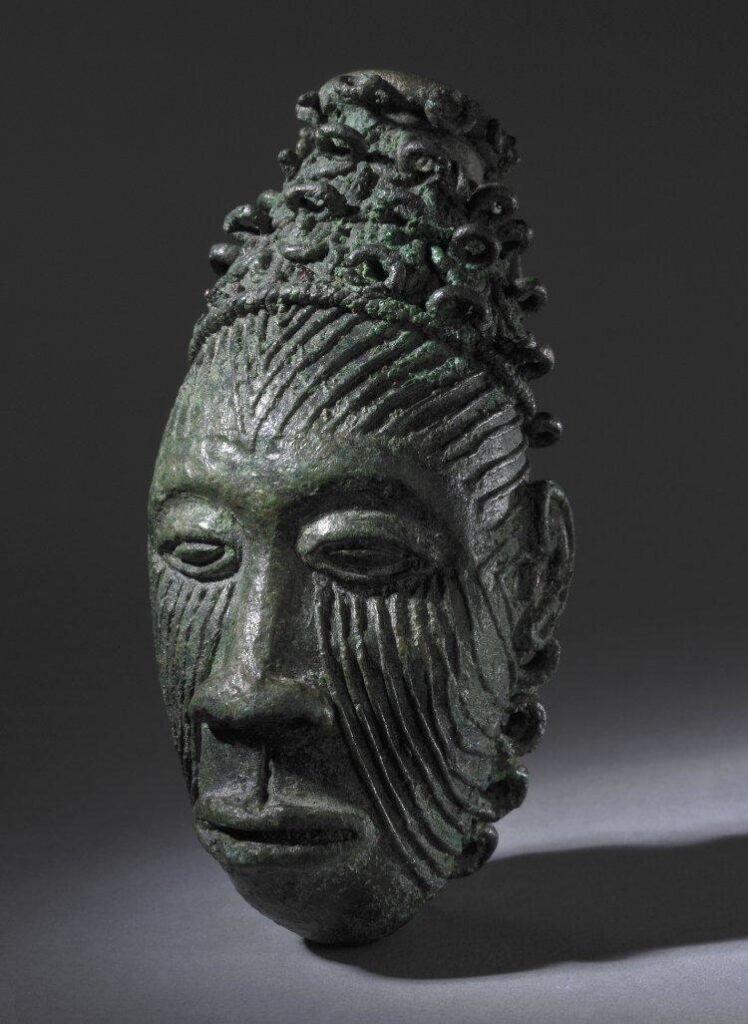
One of the most remarkable archaeological discoveries connected to Igbo history occurred at Igbo-Ukwu. Excavations uncovered extraordinary bronze and copper-alloy objects associated with a highly sophisticated metalworking tradition. The material from Igbo-Ukwu demonstrates accomplished craftsmanship dating as early as the ninth century. These discoveries transformed the global understanding of West African technological history.
The Igbo-Ukwu Bronzes
The artifacts discovered at Igbo-Ukwu include elaborate vessels, ornaments, and ritual objects. Their complexity proves that sophisticated metalworking existed in the region centuries before European contact. Artisans employed techniques including casting, hammering, bending, twisting, incision, and early lost-wax casting, standing as a testament to the technical creativity of ancient southeastern Nigerian communities.
Art and Social Achievement
Igbo art was intimately connected with social institutions. Sculptures adorned communal buildings, objects commemorated notable individuals, shrines housed spiritual representations, and architectural decorations communicated status. The famous obu (“House of Images”) in communities such as Abiriba and Ohafia serves as a central meeting structure integrating collaborative governance with elaborate sculptural programs.
The Obu: A House of Images
The obu was far more than a decorated structure; it was a communal civic hall whose sculptures embodied core cultural values and historical figures. The building itself served as a physical expression of collective identity, demonstrating how art was integrated directly into political, religious, and civic life.
Igbo Sculpture
Traditional Igbo sculpture encompasses a wide range of forms created for shrines, ancestral altars, social institutions, and ceremonies. While some sculptures emphasized naturalistic human proportions, others utilized stylized abstraction. Because meaning depended heavily on specific community contexts, understanding an object’s original social function is essential to interpreting its aesthetic value.
Ala and the Moral Order
Traditional Igbo religious thought emphasizes a profound relationship with Ala, the earth deity associated with morality, fertility, and social order. The earth was viewed not merely as physical territory, but as a sacred entity. Moral violations were understood as disruptions of both social and spiritual balance, deeply shaping traditional ethics and community governance.
Personal Spirituality and Community
Igbo religious life was decentralized rather than organized around a single authority. Individuals, families, and communities maintained shrines dedicated to specific spiritual forces. Divination offered guidance, while priests and ritual specialists managed specific ceremonial functions—a spiritual structure that directly mirrored the decentralized character of Igbo politics.
Shrines and the Household
Family compounds frequently housed shrines dedicated to particular deities or ancestral spirits, often established following divinatory revelations. These practices highlight the seamless connection between household management, daily spirituality, and broader community identity.
Enterprise as a Cultural Value
The reputation of Igbo enterprise stems from long-standing cultural values. Commercial success allowed individuals to accumulate resources, expand trade networks, build prestige, and gain social recognition. The link between personal achievement and elevated status encouraged ambition. However, enterprise was not an innate stereotype, but a set of economic behaviors continually shaped by institutions, education, and historical circumstances.
Apprenticeship and Skill Transmission
A cornerstone of southeastern Nigerian economic success is the traditional apprenticeship system. Modern Igbo commercial apprenticeship allows young people to acquire practical business skills by working under established entrepreneurs. Through observation, participation, and gradual responsibility, apprentices master trade before being “graduated” or funded to establish independent enterprises—creating a sustainable cycle of generational wealth and knowledge transfer.
The Spirit of Self-Reliance
Igbo culture strongly emphasizes personal initiative and self-reliance. Individuals are expected to work diligently, develop skills, and support both family and town. This ethos remains highly visible today across manufacturing, retail, transportation, technology, fashion, construction, and agriculture, driven by a historical culture of mobility and achievement.
Migration and Commercial Networks
Migration has long played an important role in Igbo economic history. Moving from rural settlements into urban centers across Nigeria and beyond, Igbo entrepreneurs established vast commercial networks. This mobility fostered durable economic links between Igboland and external markets across West Africa.
The Colonial Period
British colonial rule fundamentally transformed Igbo society through the expansion of missionary Christianity, Western education, cash-crop economies, and new administrative systems. However, colonial attempts to govern decentralized communities through centralized administrative structures (such as Warrant Chiefs) clashed with existing political traditions, generating widespread social tension.
Christianity and Social Change
Christianity became deeply influential during the nineteenth and twentieth centuries. Mission schools introduced formal literacy, and Christian institutions became major centers of social life. While many traditional religious practices declined, Igbo cultural identity adapted; many families successfully integrated Christian faith with Igbo language, family obligations, and cultural traditions.
Education and Igbo Society
The pursuit of Western education brought sweeping societal shifts in the twentieth century. Schools yielded new generations of professionals—teachers, lawyers, doctors, civil servants, and academics. Igbo intellectuals subsequently played pivotal roles in Nigerian literature, journalism, political thought, and university leadership.
Chinua Achebe and Igbo Identity
Few writers brought Igbo society to the world stage as effectively as Chinua Achebe. His seminal novel, Things Fall Apart, portrayed Igbo life before and during the onset of colonialism. By depicting a complex society rich in political institutions, religious traditions, and internal debates, Achebe challenged simplistic colonial narratives and authored one of the most influential literary works of the twentieth century.
Igbo Identity and Biafra
Modern Igbo history is deeply marked by the Nigerian Civil War. Following severe political crises and anti-Igbo violence in the late 1960s, the southeastern region declared the independent Republic of Biafra in 1967. The devastating civil war lasted until 1970, causing immense suffering, displacement, and loss of life. The war remains a profound memory, continuing to shape contemporary discussions around identity, politics, and national integration.
Rebuilding After the Civil War
The post-war era presented monumental challenges, including destroyed infrastructure, lost savings, and displaced populations. Through intense self-reliance, families reinvested in education, rebuilt commercial enterprises, and expanded urban market centers—a process that cemented the modern reputation of Igbo commercial resilience.
Igbo Cities Today
Modern urban centers illustrate the evolution of historical trade routes into modern industrial hubs:
- Onitsha: Famous for hosting one of West Africa’s largest commercial markets and river ports.
- Aba: Widely recognized for light manufacturing, garment production, and artisanal leatherwork.
- Nnewi: Renowned for industrial manufacturing, automotive parts production, and major corporate enterprise.
- Enugu & Awka: Major administrative, political, and educational centers.
Nnewi and Industrial Enterprise
Nnewi serves as a unique case study in indigenous industrialization. Local entrepreneurs successfully transitioned from retail and import trade into large-scale factory manufacturing, automotive assembly, and international supply chains, proving that local enterprise could scale into major industrial capacity.
Aba and Manufacturing
Aba’s economic engine is powered by dense networks of skilled artisans, tailors, and cobblers. Producing shoes, textiles, and leather goods for markets across Africa, Aba demonstrates how localized technical craftsmanship can power expansive regional commerce.
Igbo Women and Commerce
Igbo women remain vital pillars of commercial life. Building on traditional roles in agriculture and local market trade, contemporary Igbo women manage extensive enterprises across retail, fashion, food production, education, and international trade, utilizing powerful commercial networks to drive community development.
Cultural Values and Wealth
While Igbo culture celebrates material success, wealth alone does not guarantee respect. Integrity, character, generosity, and community investments are strictly required. A wealthy individual who ignores social responsibility loses public standing, balancing personal drive with collective moral expectations.
The Individual and the Community
The core of Igbo social philosophy rests on the dynamic between personal initiative and communal responsibility. An individual is encouraged to strive for greatness, but success creates immediate obligations to uplift relatives, mentor youth, and fund community infrastructure—ensuring that individual progress directly powers collective advancement.
Igbo Proverbs and Wisdom
The Igbo preserve philosophical discourse through an extensive tradition of proverbs. Used in disputes, civic assemblies, and everyday conversation, proverbs communicate complex ideas regarding patience, justice, leadership, and human nature—proving that philosophy thrives within spoken language as much as in written texts.
The Meaning of Individual Agency
Igbo thought strongly emphasizes personal agency and human effort. Individuals are expected to actively shape their destinies while recognizing that personal choices carry social consequences. Freedom is thus understood not as absolute individualism, but as responsible action within a community framework.
Igbo Identity in the Diaspora
Historic and contemporary migration has established vibrant Igbo diaspora communities across Africa, Europe, and the Americas. Through cultural unions, language programs, and civic associations, the diaspora preserves ancestral traditions while contributing to their host nations. Furthermore, many descendants of enslaved Africans in the Americas continue to trace and celebrate their Igbo heritage.
Preserving the Igbo Language
Language remains a fundamental anchor of Igbo identity. Despite challenges posed by urbanization and the dominance of English or Pidgin, language preservation flourishes through literature, music, film, digital media, and academic study across global institutions.
Igbo Culture in Contemporary Media
Nollywood (the Nigerian film industry) has played a massive role in broadcasting Igbo narratives, customs, and contemporary life to global audiences. Modern digital creators and musicians continuously integrate Igbo language, folklore, and aesthetics into global pop culture.
The Changing Meaning of Tradition
Igbo tradition is dynamic rather than static. Communities continuously adapt their heritage by integrating modern technology into traditional festivals, combining global fashion with traditional textiles, and utilizing historical symbols within contemporary business practices.
Why the Igbo Matter to African History
The history of the Igbo challenges narrow definitions of civilization by proving that complex, prosperous societies do not require centralized, autocratic monarchies. Through decentralized governance, technological innovation (as seen at Igbo-Ukwu), commercial systems, and literary contributions, the Igbo demonstrate the profound power of participation, adaptability, and resilience.
Conclusion: The Power of Community and Enterprise
The history of the Igbo people offers a compelling model of how a society can balance personal drive with collective responsibility. Rather than relying on centralized kingship, Igbo communities historically distributed authority across families, assemblies, titleholders, and age grades—fostering a culture of active participation and meritocracy.
From ancient metalworking at Igbo-Ukwu to the modern commercial hubs of Onitsha, Aba, and Nnewi, the Igbo story highlights a long-standing commitment to enterprise, education, and adaptation. Despite the upheavals of colonialism, religious transformation, and the devastation of the Civil War, the Igbo have continually rebuilt and evolved. Ultimately, the enduring legacy of the Igbo rests in their republican spirit: the belief that individual success is highest when it serves the community, and that a society flourishes when ambition and responsibility go hand in hand.
