

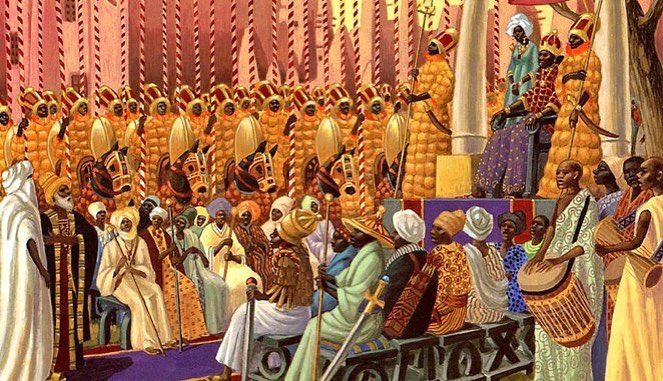
Every culture keeps a shelf of names it refuses to let die. In Africa, that shelf is long, and it is loud with hooves, drums, spears, and the low murmur of griots passing stories from one fireside to the next. These are not simply “old tales” filed away for children. They are the record-keeping systems of civilizations that chose memory over paper, voice over ink, for a very long time — and they worked. A praise-singer in Mali can still recite the genealogy of an empire that fell seven hundred years ago. A grandmother in KwaZulu-Natal can still tell you, almost word for word, how a boy with a limp became the most feared king in southern African history.
This entry in the African Folklore series turns to the legends of heroes, kings, and warriors — the larger-than-life figures whose stories blur the line between history and myth so completely that historians and folklorists often can’t agree where one ends and the other begins. That blur is not a flaw. It’s the point. These stories were never meant to be filed as fact or fiction. They were meant to teach, to warn, to inspire, and to bind a people to a shared sense of who they are.
Why Africa’s Heroic Legends Don’t Look Like Europe’s
If you come to African hero legends expecting a straightforward parallel to Greek epics or European chivalric romance, you’ll notice something different almost immediately: African heroes are rarely perfect, and their greatness is almost never handed to them.
In much of European legend, the hero’s virtue is often assumed from birth — Arthur pulls the sword because he is the rightful king. In African tradition, greatness is earned through hardship, humiliation, exile, or even outright failure before the turn comes. The hero limps. The hero is despised by his own family. The hero is sold into slavery, banished from the kingdom, or ridiculed as slow-witted before revealing the cunning or strength that changes everything. This isn’t incidental — it reflects a worldview in which destiny and struggle are intertwined, where the community shapes the hero as much as the hero shapes history.
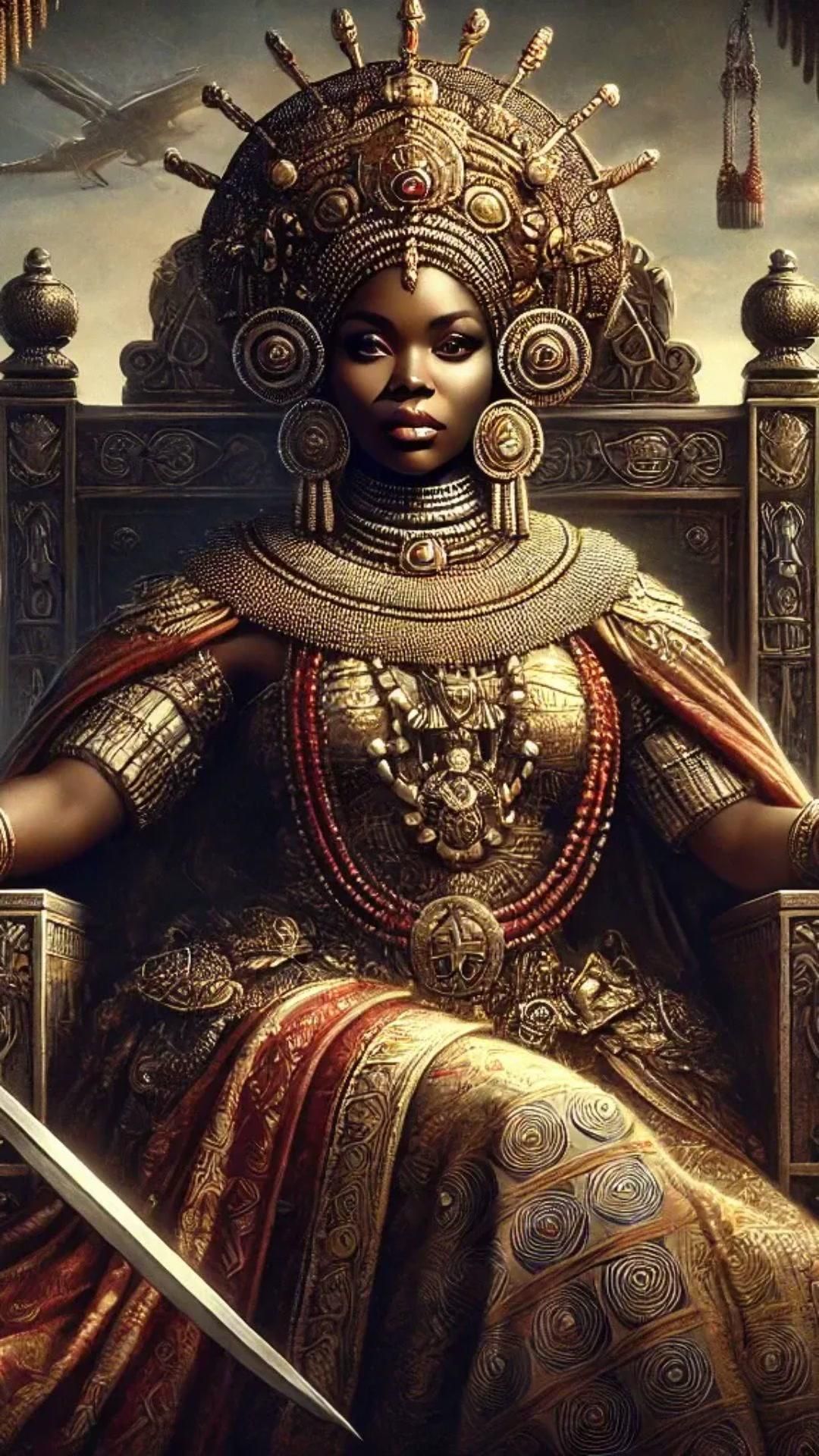
Another key difference: African legends are communal property, not individual authorship. There’s no single “author” of the Sundiata epic the way there’s a Homer credited (however loosely) with the Iliad. These stories are living oral traditions, carried and reshaped by generations of griots, praise-singers, and elders, adapted slightly with every performance depending on audience, occasion, and even political climate. A griot performing for a wedding might emphasize different themes than one performing before a chief. The “text” is fluid by design.
Sundiata Keita: The Lion King of Mali
No figure looms larger in West African heroic legend than Sundiata Keita, the founder of the Mali Empire in the 13th century. His story — preserved primarily through the Mandinka oral epic known as the Sunjata or Sundiata, still performed by griots today — is one of the richest hero narratives to survive from precolonial Africa.
The broad strokes of the legend go like this: Sundiata is born the son of a king, but he is a sickly, disabled child who cannot walk until well into boyhood. His father’s other wife, jealous and ambitious for her own son, mocks and torments Sundiata’s mother relentlessly. When Sundiata’s father dies, the throne passes to a rival line, and Sundiata and his mother are driven into exile, wandering from court to court as unwanted refugees.
And then — as these stories so often do — the turn comes. Whether through sheer will, the intervention of blacksmiths and spiritual forces, or simple stubborn refusal to stay pitiable, Sundiata rises to his feet for the first time. He grows into a formidable warrior and strategist during his years of exile, gathering allies as he goes. Eventually he returns to confront Soumaoro Kanté, the sorcerer-king who had usurped and terrorized his homeland, and defeats him in a battle understood as much in spiritual terms as military ones — a contest between rival forms of power, cunning, and destiny. From that victory, Sundiata unifies the Mande peoples and founds what becomes the Mali Empire, one of the wealthiest and most powerful states in medieval world history.
What makes the Sundiata epic endure isn’t just the drama of the plot — it’s what the story insists on teaching. Weakness is not permanent. Exile is not the end of the story. And legitimate power is proven, not merely inherited. Even today, Malian and broader Mandinka identity is deeply tied to this narrative; griot families still trace their lineage and duty to the telling of Sundiata’s story back to his own era, treating the epic less as folklore and more as a form of civic inheritance.
Shaka Zulu: The Making — and Myth-Making — of a Warrior King
Move southeast a few centuries and you land on another towering figure: Shaka kaSenzangakhona, better known as Shaka Zulu, who transformed a small chiefdom into the formidable Zulu Kingdom in the early 19th century. Unlike Sundiata, Shaka is close enough to living memory and colonial-era documentation that his story sits more visibly on the border between recorded history and legend — which makes it a fascinating case study in how heroic narratives get built, amplified, and sometimes distorted.
The legendary version of Shaka’s youth follows a familiar pattern: he is born out of wedlock, his name reportedly derived from a word associated with a digestive ailment his mother’s pregnancy was blamed on by suspicious in-laws. He and his mother, Nandi, are cast out, mocked, and forced to move from settlement to settlement, enduring poverty and humiliation. As a young man he’s conscripted into military service under a regional chief, and it’s there — away from a home that never wanted him — that Shaka distinguishes himself as a fighter and tactician of extraordinary ability.
When he eventually claims leadership of the Zulu, the legends credit him with battlefield innovations that reshaped warfare across the region: the short stabbing spear (the iklwa) replacing long throwing spears for close combat, the famous “buffalo horns” encirclement formation, and a discipline and cohesion in his regiments (amabutho) that outmatched rival forces built on looser, more traditional structures. Under his rule, the Zulu Kingdom expanded rapidly, and the surrounding chaos and displacement of peoples fleeing or resisting Zulu expansion — a period remembered as the Mfecane — reshaped the political map of southern Africa.
“A roaring lion kills no game.” — West African proverb, often used to praise quiet strength over loud boasting
It’s worth pausing on something important here: much of what circulated about Shaka in the 19th and 20th centuries, especially in colonial European accounts, leaned hard into portraying him as uniquely bloodthirsty or tyrannical — a narrative later historians have worked to complicate and, in places, actively dispute. Some of that framing reflected genuine oral tradition and Zulu memory of a harsh and demanding ruler. But some of it was shaped by colonial writers with their own reasons to depict African political power as inherently savage, in ways that conveniently justified conquest. This is a useful reminder for anyone studying African heroic legend: the story you receive has often passed through hands with their own agendas, and separating communal memory from imperial propaganda takes real care.
What survives across both the celebratory and critical tellings, though, is the image of a man who turned marginalization into military genius, and who reorganized an entire society’s approach to war, loyalty, and statehood in the space of a single reign — a transformation still central to Zulu identity and pride today.
Queen Nzinga: The Warrior Who Outmaneuvered Empires
Not every heroic legend in African tradition centers on kings — some of the fiercest and most enduring belong to queens. Njinga Mbandi, remembered widely as Queen Nzinga, ruled the kingdoms of Ndongo and Matamba (in present-day Angola) through much of the 17th century, and her legend is built less on a single battlefield triumph and more on decades of relentless, adaptive resistance against Portuguese colonial encroachment.
The stories surrounding Nzinga emphasize her political shrewdness as much as her physical courage. One of the most famous (and frequently retold) episodes describes a diplomatic meeting where the Portuguese governor offered her only a mat on the floor to sit on during negotiations — a deliberate insult meant to signal her inferior status compared to his own chair. According to the legend, Nzinga calmly had one of her own attendants get down on hands and knees to serve as a human seat, meeting the governor eye to eye and refusing to be diminished. Whether every detail of that moment happened exactly as told, the story endures because it captures something essential about her: she refused, at every turn, to accept the terms others tried to set for her.
Nzinga went on to convert to Christianity for political leverage, forge and break alliances as circumstances demanded, personally lead troops into battle well into her sixties, and offer refuge to enslaved people fleeing Portuguese-controlled territory, building a base of resistance that outlasted her own lifetime. She is remembered today across Angola and the wider African diaspora not just as a monarch but as a symbol of resistance to colonial domination — a legend invoked in art, literature, and political rhetoric well into the 20th and 21st centuries.
Her story also complicates any tidy notion of the “warrior hero” as purely a figure of martial glory. Nzinga’s legend is as much about negotiation, adaptability, and sheer refusal to be erased as it is about combat — a different but equally vital model of what heroism can look like.
The Mwindo Epic and the Warrior-Child Archetype
Among the Nyanga people of the Democratic Republic of the Congo, one of the great heroic epics is the story of Mwindo, a child hero born under extraordinary and defiant circumstances. In the traditional telling, Mwindo’s father, a chief, has decreed that no more sons be born to him — he already has enough daughters and doesn’t want the complication of male heirs challenging his rule. When Mwindo is born anyway, emerging (in some versions) already able to speak and carrying magical tools, his father tries repeatedly to kill him: burying him alive, drowning him, burning him. Each time, Mwindo survives through supernatural means and eventually sets out on a quest to confront his father directly, accompanied by spirit allies and wielding a magical fly-whisk and conga scepter that grant him extraordinary powers.
The Mwindo epic, performed traditionally over multiple nights by specialized narrators, is a striking example of how African heroic legend often merges the warrior figure with the trickster and the divine child — categories that Western storytelling tends to keep more separate. Mwindo isn’t just physically powerful; he’s clever, occasionally arrogant in ways the story pointedly critiques, and ultimately learns humility through his trials before being reconciled with his father and community. The epic functions simultaneously as entertainment, moral instruction about pride and reconciliation, and a kind of constitutional document for Nyanga ideas about legitimate authority and father-son succession.
The Ozidi Saga and the Cost of Vengeance
The Ijaw people of the Niger Delta preserve one of the longest and most structurally complex heroic narratives in African oral tradition: the Ozidi Saga, a cycle traditionally performed over seven nights, combining narration, music, masked dance, and audience participation into a single sprawling epic.
The saga follows young Ozidi as he grows up seeking to avenge his father’s murder, aided by his grandmother, a powerful sorceress named Oreame, who trains him and imbues him with supernatural strength. What sets the Ozidi Saga apart from more straightforwardly celebratory hero narratives is its unflinching interest in the psychological and moral cost of vengeance. As Ozidi works his way through a series of increasingly powerful and monstrous enemies, defeating each in turn, the story doesn’t simply celebrate his growing power — it tracks how his hunger for battle begins to curdle into something closer to bloodlust, disturbing even his own allies. By the saga’s end, Ozidi has become genuinely dangerous, and the community must find a way to contain the very warrior spirit they once needed to protect them.
This is heroic legend used as a cautionary tale about the warrior archetype itself — a recognition, embedded directly into the story’s structure, that the qualities which make someone a formidable protector can just as easily make them a threat to the people they were meant to defend. It’s a sophistication of moral thinking that rewards close attention, and it’s part of why the Ozidi Saga is considered one of the great achievements of African oral literature.
Askia the Great and the Warrior as Reformer
Not every legendary ruler earns their place in memory through conquest alone. Askia Muhammad, who seized the throne of the Songhai Empire in the late 15th century and ruled into the early 16th, is remembered as much for statecraft as for the battlefield victories that got him there — a useful reminder that “warrior king” and “wise administrator” were rarely treated as separate categories in African heroic tradition.
The legends around Askia describe a general, born Muhammad Ture, who served the erratic and increasingly unpopular king Sunni Ali Ber before ultimately overthrowing Ali’s heir in a decisive battle usually remembered as much for its political necessity as its military drama — the empire, in the traditional telling, needed a steadier hand, and Askia was the one willing to seize it. Once in power, though, the stories pivot quickly away from bloodshed and toward institution-building: standardizing weights and measures, organizing a professional bureaucracy, expanding trade routes, and turning Timbuktu into one of the great intellectual centers of the medieval world, drawing scholars, jurists, and students from across North and West Africa.
What makes Askia’s legend distinct within this category of heroic narrative is its implicit argument about what makes a ruler worth remembering. The story doesn’t dwell on his martial prowess the way Sundiata’s or Shaka’s legends do — it treats the conquest almost as a prerequisite, a necessary but ultimately secondary chapter, before getting to the real substance: what he built once the fighting was done. It’s a version of heroism measured in libraries and legal codes as much as in spears and horses, and it complicates any assumption that African heroic legend is preoccupied purely with combat.
When Legend and History Pull Apart
One more thing is worth naming plainly: for several of the figures covered here, especially those closer to the colonial era, there’s an ongoing, active scholarly project of trying to separate what actually happened from what got added, exaggerated, or invented later — by griots serving political patrons, by colonial administrators serving imperial narratives, or simply by the natural drift of stories retold over generations.
This isn’t a weakness unique to African oral tradition; every culture’s heroic legends undergo the same kind of embellishment over time. But because so much of the documentary record for early African empires depends on oral transmission, external accounts from Arab travelers and European colonizers, and archaeology that’s still ongoing in many regions, the gap between “legend” and “verified history” can be harder to close than it is for, say, medieval Europe, which left behind more redundant written sources to cross-check against each other. Modern historians, archaeologists, and folklorists — many of them African scholars working to reclaim and rigorously document this history — continue to do the painstaking work of triangulating oral tradition, archaeological evidence, and outside written accounts to build the clearest possible picture. That work is ongoing, and it means the legends explored here should be read as living, contested, and culturally vital — not as settled, static fact.
Common Threads Across the Continent
Pulling back from individual epics, a few patterns recur across African heroic legend widely enough to be worth naming directly:
The hidden or humiliated origin. Sundiata’s paralysis, Shaka’s illegitimacy and exile, Mwindo’s attempted infanticide — heroes are rarely born into obvious greatness. Their early suffering is treated as formative rather than incidental, a forge rather than a footnote.
Power as earned and communal, not simply inherited. Even kings and queens in these stories must prove themselves through trial, and their authority is frequently framed as something granted or withheld by ancestors, spirits, or the community itself — not a right that exists independent of that recognition.
The blending of physical and spiritual power. Battles in African heroic legend are almost never purely physical contests. Sorcery, ancestral favor, magical objects, and spiritual discernment are treated as being just as decisive as swordsmanship or military strategy — sometimes more so.
Moral complexity over uncomplicated glory. From the critical retellings of Shaka’s reign to the Ozidi Saga’s warning about vengeance, African heroic tradition frequently resists turning its central figures into flawless icons, instead using their stories to interrogate what power costs the people who hold it.
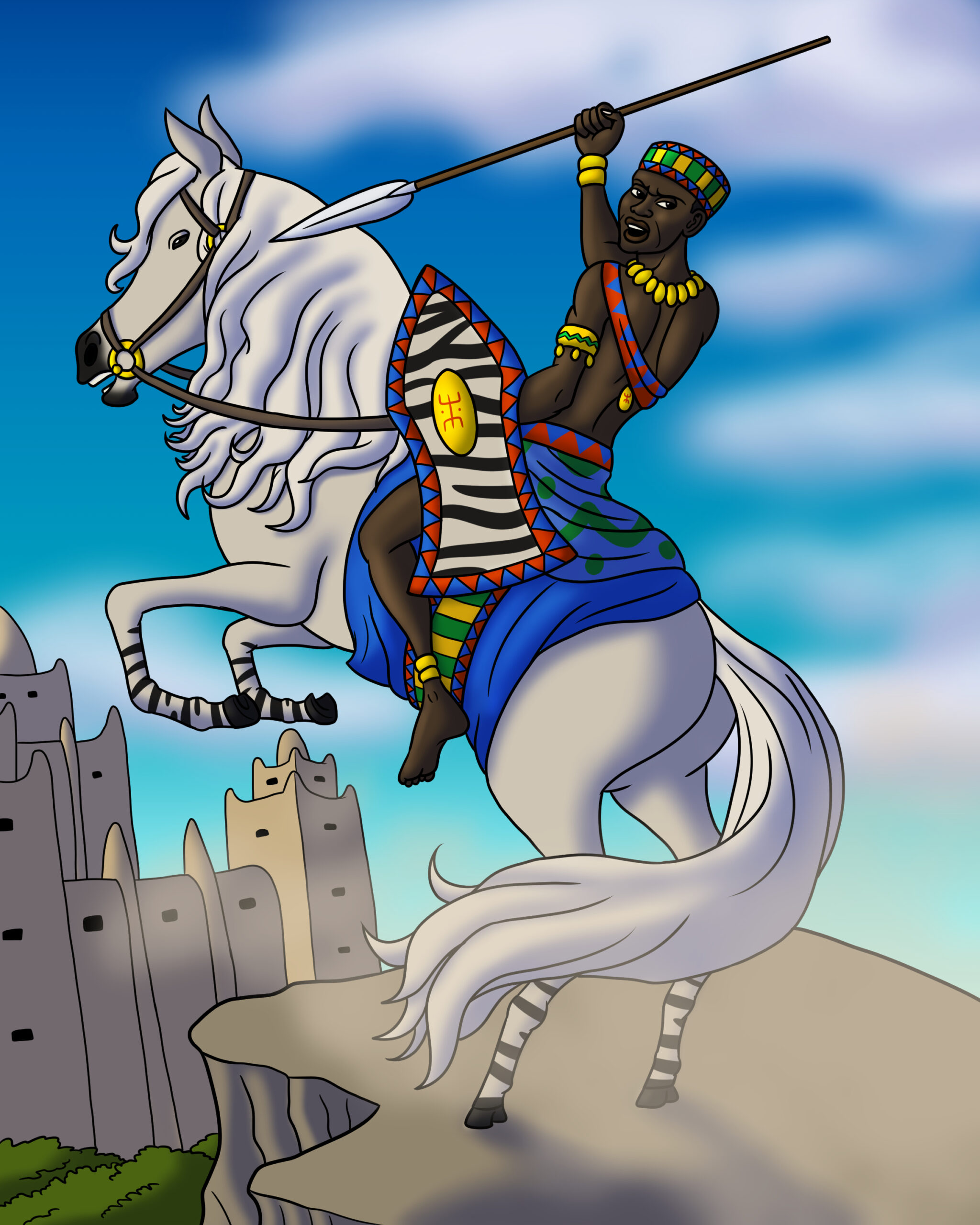 The oral performance as inseparable from the story. Unlike a novel or a fixed epic poem, many of these narratives only fully exist in performance — shaped by a specific griot, a specific audience, a specific night. Reading a transcribed summary (as you’re doing right now) captures the plot, but misses the music, the audience call-and-response, the dance, and the improvisation that are, for many communities, actually part of the story itself.
Why These Stories Still Matter
It would be easy to file these legends away as historical curiosities, artifacts of societies and political structures that, in many cases, no longer exist in their original form. But that undersells what’s actually happening every time one of these stories gets told again.
Heroic legend, across cultures, tends to do double duty: it entertains, and it instructs a community in what it values. When a Malian child hears the Sundiata epic, they’re not just hearing an adventure story — they’re absorbing a set of ideas about resilience, legitimate leadership, and the possibility of transformation that shapes how they think about their own setbacks. When a Zulu elder retells the story of Shaka, the telling itself becomes a small act of claiming a narrative that was, for a long stretch of colonial history, told mostly by outsiders with their own interests in the outcome. When an Angolan writer or artist invokes Nzinga, they’re reaching for a specific, well-worn symbol of dignity under pressure that still resonates in conversations about sovereignty and self-determination today.
These stories have also proven remarkably portable. Across the African diaspora — in the Caribbean, in Brazil, in the United States — themes, structures, and sometimes direct references from these heroic traditions have been carried, adapted, and rewoven into new cultural forms, from music to literature to political symbolism, a testament to how durable and exportable this storytelling tradition has been even under the immense pressure of displacement and forced migration.
As this series continues, later entries will look more closely at the tricksters, spirits, and animal characters that populate the rest of African folklore’s cast — figures who often operate by very different rules than the heroes and kings covered here. But it’s worth sitting with this category on its own terms first: these are the stories a continent has told itself, across centuries and empires and enormous political upheaval, about what strength actually looks like, what it costs, and who gets to hold it.
