


West African cuisine stands as one of the most vibrant, expressive, and culturally resonant culinary traditions anywhere on the globe. Its irresistible appeal stems from an ancient, harmonious relationship between indigenous staple crops, resilient agricultural methods, time-honored cooking techniques, and centuries of dynamic cross-cultural exchange. Across the sweeping geography of West Africa, basic ingredients like rice, cassava, yams, plantains, maize, cowpeas, leafy greens, fresh river fish, and livestock form the canvas for daily dining. Yet, it is the ingenious application of fiery chili peppers, sweet onions, sun-ripened tomatoes, roasted groundnuts, aromatic palm oils, and complex spice blends that elevates simple regional sustenance into an unforgettable sensory journey.
Among the vast universe of West African dishes, three specific culinary masterpieces have achieved legendary status, transcending local borders to gain enthusiastic recognition across the global culinary stage: Jollof rice, Egusi soup, and Suya. Each of these iconic foods tells a completely distinct story about the region’s historical evolution and social values. Jollof rice exemplifies the historical centrality of grain cultivation, the artistry of one-pot cooking, and the spirited cultural dialogues linking neighboring nations. Egusi soup demonstrates the scientific ingenuity of transforming humble indigenous oilseeds into a rich, velvety, protein-dense foundation for communal dining. Suya reflects the pulsating energy of urban street-food culture, the mastery of open-flame meat grilling, and the historic migration of pastoral traditions into bustling metropolitan centers.
These three dishes are immensely popular, but their cultural footprint extends far beyond mere taste. They serve as living, edible symbols of regional identity, national pride, and social solidarity. In West Africa, a recipe is never a static set of instructions locked in a textbook; it is a flexible, evolving tradition that adapts as it crosses river basins, trade lines, and national borders. An ingredient like fermented locust beans (iru or dawadawa) may be used to build a deep, umami base in one forest community, while a neighboring savanna region might rely on dry-roasted groundnuts to achieve a similar aromatic depth. To understand West African food is to appreciate that every bite contains layers of history, agricultural adaptation, traditional science, and the warmth of family life.
The Foundations and Agricultural Ecology of West African Cooking
The development of West African foodways is deeply tied to the diverse ecological zones that span the region. Historically, human settlements tailored their agricultural practices and daily diets around what their immediate geography could sustainably provide. Along the sweeping Atlantic coastline and throughout sprawling river delta networks, fishing communities built their food culture around fresh, dried, and smoked seafood, using fish and crustaceans to infuse depth into vegetable-based stews. Moving inland into the dense, humid tropical forest belt, agricultural life centered on root crops, tubers, and tree products. Here, white yams, cassava, cocoyams, and cooking plantains provided necessary caloric energy, while native oil palms supplied deep red palm oil—a nutrient-rich fat that imparts a distinct color, rich mouthfeel, and earthy aroma to traditional cookery.
Further north, where the tropical forest yields to the open, sun-drenched savannas and semi-arid Sahelian plains, farming communities cultivated hardy, drought-resistant grains like pearl millet, fonio, and sorghum while raising cattle, sheep, and goats. These vast ecological zones were never isolated from one another. For centuries, extensive trade networks linked coastal fishermen, forest farmers, and savanna pastoralists. Long before modern transportation, merchants traveled along ancient trade trails and river routes, exchanging rock salt, dried fish, indigenous peppers, kola nuts, and oilseeds.
As traders, artisans, and pastoral communities migrated across the continent, culinary techniques and agricultural knowledge moved with them. Languages borrowed food terminology from one another, and cooking tools—such as heavy wooden mortars, carved pestles, and earthenware cooking pots—became universal fixtures of domestic life. Consequently, contemporary West African food culture represents both hyper-local ecological adaptation and a long, continuous history of regional integration.
Rice Culture and the Story of Jollof Rice
Rice holds a position of absolute nobility on the West African dining table. While Asian rice (Oryza sativa) was widely adopted over recent centuries, indigenous African rice (Oryza glaberrima) has been domesticated and cultivated in the inland delta of the Niger River for over three thousand years. West African farmers developed sophisticated flood-plain engineering and tidal irrigation techniques long before European contact, establishing rice as a prestigious grain associated with abundance, community feasts, and high honor.
Among all rice preparations generated by this long agricultural heritage, none commands more international fame than Jollof rice. At its core, Jollof is a fragrant, vibrant, one-pot dish crafted by slow-simmering long-grain rice in a rich reduction sauce composed of blended fresh tomatoes, red bell peppers (tatashe), fiery scotch bonnet peppers (atarodo), onions, garlic, ginger, and savory broth. As the rice absorbs this concentrated pepper-tomato matrix over low heat, it transforms into a uniform, savory masterpiece where every individual grain carries deep flavor.
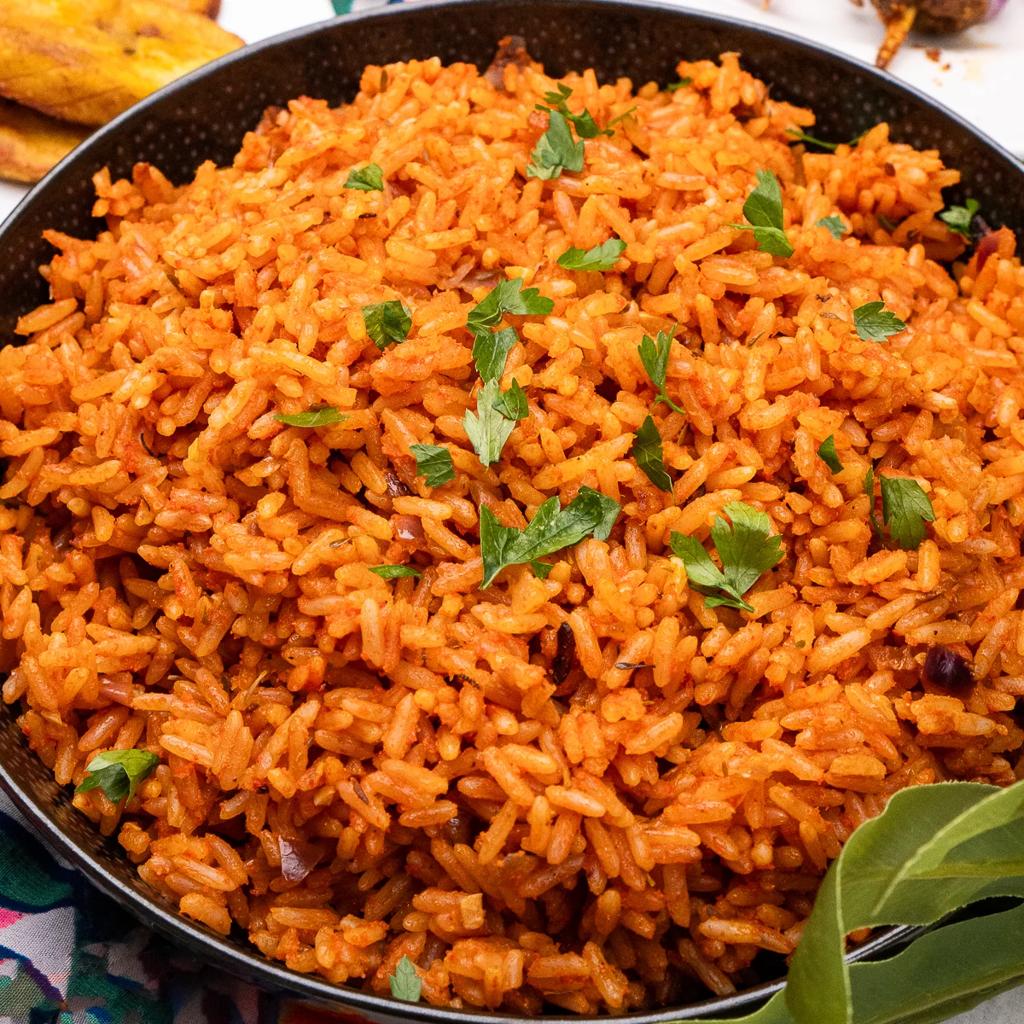
Today, Jollof rice is celebrated as a cultural treasure across Senegal, The Gambia, Ghana, Nigeria, Sierra Leone, Liberia, and Côte d’Ivoire. However, because each country adapts the dish to suit local palates and available ingredients, noticeable regional variations have emerged. In Senegal, Ceebu Jën remains a rich, seafood-heavy, highly complex culinary ritual often featuring broken jasmine rice and stuffed fish (Lard). In Ghana, Jollof is frequently made using aromatic basmati or long-grain rice, cooked with a deeply fragrant, spiced tomato stew that highlights notes of nutmeg, clove, and garlic, often served alongside fried plantains and shito (a spicy black pepper sauce). In Nigeria, Jollof is typically crafted using long-grain parboiled rice, emphasizing a bold, savory pepper balance, bay leaves, thyme, and a signature smoky finish.
This diversity of preparation has sparked the world-famous, playful cultural phenomenon known as “The Great Jollof Debate.” On social media platforms, in international cooking competitions, and across dinner tables in the global diaspora, West Africans—most notably Nigerians and Ghanaians—engage in passionate, humorous arguments over whose version of the dish reigns supreme. While these debates are lighthearted, they reveal something profound about the social power of food: Jollof is not merely sustenance; it is an emotional touchstone of national identity, home, family memory, and cultural pride.
In West African social life, Jollof rice is the indisputable crown jewel of celebratory gatherings. A wedding, birthday, christening, or anniversary is considered incomplete without massive steel cauldrons of Jollof simmering over open outdoor woodfires. This outdoor preparation style gives rise to the revered “Party Jollof.” As the rice cooks over intense, crackling heat, the bottom layer lightly scorches against the metal pot, infusing the entire batch with a distinctive, irresistible wood-smoke aroma. This smoky depth of flavor is impossible to replicate in small kitchen pans, turning Party Jollof into an irreplaceable culinary experience.
Egusi Soup: Indigenous Science and the Art of the Stew
While Jollof rice represents the celebration of grain, Egusi soup illustrates the brilliant culinary utilization of indigenous oilseeds. The word Egusi refers specifically to the protein- and oil-rich seeds of certain wild melon plants (Cucumeropsis mannii or Citrullus lanatus) native to tropical West Africa. These pale seeds are enclosed in hard shells that are harvested, dried, shelled, and ground into a coarse, creamy meal before being transformed into one of the continent’s most beloved soups.
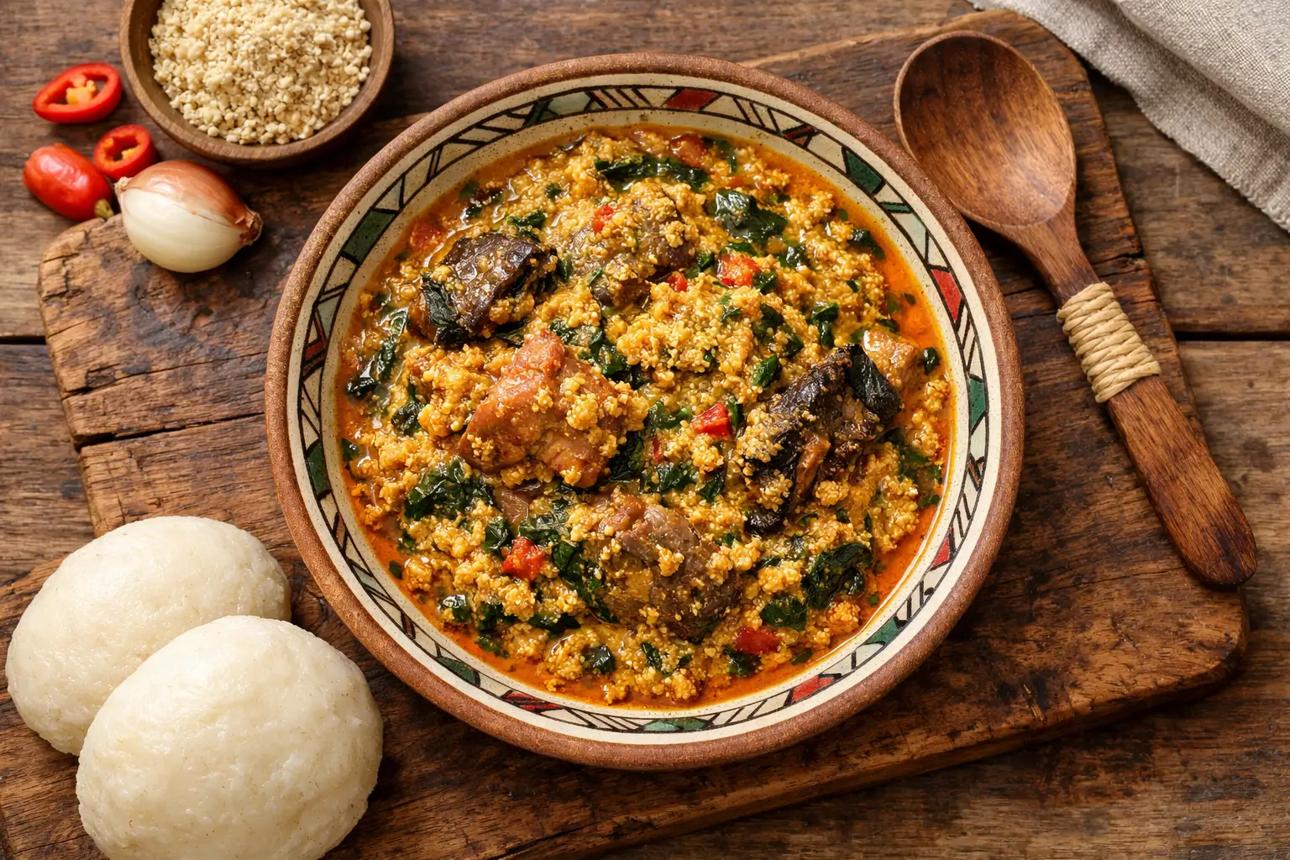
The soup is almost universally finished with generous quantities of fresh leafy green vegetables, such as bitterleaf (ewuro), fluted pumpkin leaves (ugu), spinach, or waterleaf. The bitter or earthy notes of the greens perfectly cut through the rich, nutty density of the ground melon seeds and the velvety mouthfeel of palm oil. The finished soup possesses a thick, hearty texture designed specifically to be eaten alongside “swallows”—dense, pliable starches like pounded yam, eba (made from cassava garri), fufu, or amala. The tactile experience of dipping a warm, smooth piece of starch into a bold, textured bowl of Egusi soup represents the essence of home cooking across millions of West African households.
Beyond its culinary appeal, Egusi soup highlights the sophisticated agricultural wisdom embedded in traditional African foodways. Egusi seeds are exceptionally nutritious, containing high concentrations of healthy plant fats, vegetable proteins, essential minerals, and vitamins. Long before modern nutritional science existed, African communities recognized ground egusi as a vital source of nourishment, particularly in forest areas where animal protein was historically reserved for special occasions or required labor-intensive hunting. Furthermore, red palm oil—when unrefined—serves as a vital natural source of beta-carotene and vitamin E. Egusi soup is thus a masterclass in nutritional balance, combining plant proteins, healthy lipids, dark leafy greens, and energy-dense starches into a single, perfectly integrated meal.
Suya: Open Flames, Street Culture, and Pastoral Heritage
If Jollof rice represents celebration and Egusi soup anchors domestic family life, Suya embodies the electric, nocturnal spirit of West African urban street culture. Suya is an intensely spiced, fire-grilled meat skewer that originated within the Hausa culinary traditions of northern Nigeria, Niger, and the broader Sahelian belt. Historically crafted by skilled pastoral butchers known as Majisas, Suya represents centuries of mastery over livestock processing, meat cut selection, dry spice blending, and open-flame cooking.

The peanut cake powder in the Yaji serves a dual purpose: its natural plant proteins and remaining oils form a protective, savory crust around the meat as it grills over glowing charcoal embers, sealing in juices while preventing the high heat from drying out the lean cuts. As the skewers roast over radiant heat, the fats render, the spices caramelize, and rising wood-smoke infuses the meat with a rich, complex aroma.
Suya culture is intimately connected with urban night life. As twilight falls over cities like Lagos, Abuja, Kano, and Accra, glowing Suya stands (Mai Suya spots) spring to life along bustling street corners, outside lively open-air bars, and near transportation hubs. Smoke rises into the night air, carrying the irresistible scent of roasting spices, seared meat, and charcoal. Patrons gather around the grill stand, watching the vendor flip skewers over hot coals with practiced rhythm.
When cooked, the tender skewers are removed from the fire, sliced into bite-sized pieces, tossed with an additional dusting of extra Yaji powder, and wrapped in traditional butcher paper or newsprint. It is traditionally served piping hot alongside thick slices of crisp, raw red onions, juicy tomatoes, and shredded cabbage. The sharp crunch and sweet acidity of the raw onions offer a refreshing palate cleanser that balances the smoky richness and fiery spice of the grilled meat.
The rapid spread of Suya across West Africa provides a vivid demonstration of how internal migration shapes food culture. During the 20th century, as northern Nigerian artisans and trade networks expanded into southern coastal cities, Hausa grill masters brought their grilling techniques and secret Yaji formulas with them. Southern populations enthusiastically embraced the dish, making Suya a national icon that transcends ethnic, linguistic, and religious divisions. Today, Suya is enjoyed equally in high-end lounge menus and modest roadside stalls, proving the universal appeal of great street food.
Traditional Markets, Economic Livelihoods, and Global Expansion
It is impossible to discuss West African food without honoring the vibrant open-air market, which serves as the economic engine and social heart of the region’s culinary system. In famous, sprawling markets such as Makola Market in Accra, Balogun Market in Lagos, or Kejetia Market in Kumasi, thousands of female traders, farmers, spice grinders, and merchants gather daily. Open-air stalls overflow with dried crayfish, mounds of crimson chili peppers, baskets of shelled egusi, jars of fragrant palm oil, freshly harvested tubers, and giant blocks of stockfish.
These markets function as dynamic spaces where agricultural supply chains meet human community. Price negotiations, recipe advice, and gossip flow freely between stallholders and shoppers. Female market traders, historically known as “Market Queens” or Iyaloja, have long wielded immense economic and political influence, controlling regional trade networks and stabilizing local food prices. Furthermore, street food vendors, neighborhood bukas (local eateries), and catering entrepreneurs turn raw agricultural products into steady employment, supporting millions of families across the region.
In the contemporary era, West African food has broken through international boundaries to capture global attention. As West African diaspora communities settle in major world cities like London, New York, Toronto, Houston, and Paris, they bring their cherished recipes and foodways with them. Specialist grocery stores stock imported garri, frozen yam, scotch bonnets, and dried egusi, allowing diaspora families to preserve their culinary connection to home.
Simultaneously, a new generation of visionary West African chefs, cookbook authors, and digital content creators is introducing traditional flavors to international audiences. Modern restaurants in global capitals present Jollof rice, Egusi soup, and Suya skewers alongside fine wines and contemporary presentation styles, demanding that West African gastronomy be recognized with the same respect accorded to Italian, French, or Japanese culinary traditions. Social media platforms, international food festivals, and digital recipe archives have further democratized access to these recipes, allowing home cooks across the globe to master West African cooking techniques.
Preserving Culinary Identity in a Modernizing World
As West Africa undergoes rapid urbanization and economic modernization, traditional foodways face both new challenges and exciting opportunities. Busy urban lifestyles have led to an increased demand for convenience, prompting food manufacturers to create instant Egusi soup powders, pre-packaged Suya seasoning blends, and canned Jollof sauce bases. Modern kitchen appliances like high-powered blenders and food processors have largely replaced labor-intensive traditional equipment like stone grinders and wooden mortars.
While these technological adaptations make home cooking faster and more accessible, cultural historians and culinary purists emphasize the critical importance of preserving ancestral cooking knowledge. Informal educational rituals—such as children sitting beside elders in open-air kitchens, learning to judge spice levels by sight, aroma, and touch—remain essential for transmitting non-codified culinary wisdom down to future generations.
In the final analysis, Jollof rice, Egusi soup, and Suya represent far more than delicious, comforting meals. They are vibrant cultural ambassadors that reflect the incredible history, agricultural brilliance, and social warmth of West Africa. Jollof tells a grand historical tale of coastal trade, grain heritage, and spirited national pride. Egusi illustrates the scientific resourcefulness of transforming indigenous seeds into rich, nourishing family stews. Suya captures the kinetic energy, pastoral mastery, and communal spirit of urban street life. Together, they offer an unforgettable invitation to explore one of the world’s richest, most expressive culinary landscapes—a landscape where food is always a celebration of identity, community, and life itself.
