

The Long History of African Resistance to Colonial Rule
When European powers expanded across Africa during the late nineteenth century, they encountered societies with their own governments, armies, traditions, economies, and political ambitions. Colonization was therefore never simply a process in which Europeans arrived and Africans quietly accepted foreign rule. Across the continent, African communities resisted. Some resistance was military; some was diplomatic; some took the form of religious movements. Others involved refusing taxes, abandoning villages, sabotaging colonial projects, organizing workers, or preserving cultural institutions.
In many places, resistance lasted for years. Some African armies defeated European forces in major battles. Others were eventually overwhelmed by superior weaponry, larger military resources, and the ability of European governments to sustain prolonged campaigns. But military defeat did not necessarily mean the end of resistance. Opposition continued through political organizations, newspapers, labor movements, religious communities, and nationalist campaigns. This long history of resistance is essential for understanding the eventual collapse of colonial rule. The independence movements of the twentieth century did not emerge from nowhere—they grew from generations of African resistance.
Resistance Before Colonialism
African resistance to European expansion did not begin with the formal creation of colonies. European commercial expansion along African coasts had already produced conflicts. African rulers negotiated treaties, regulated foreign merchants, and sometimes fought European forces. As European influence moved inland, African political authorities confronted a new challenge: the possibility that foreign traders and governments intended to control territory rather than simply trade. This distinction changed everything. A trading relationship could be negotiated, but foreign political domination was much harder to accept.
Consequently, African rulers developed different strategies. Some purchased modern weapons, others strengthened armies, some formed alliances, and others tried to use European rivalries to protect their independence. Some fought, while others temporarily cooperated with European powers because they believed doing so would protect them from neighboring enemies. There was no single African response; resistance reflected local circumstances.
Why Did Africans Resist?
The reasons differed from one society to another. Some resisted because Europeans threatened political sovereignty, while others fought because land was being seized. Some opposed taxation, others resisted forced labor, and religious leaders sometimes mobilized communities against foreign rule. Pastoral societies resisted restrictions on movement, farmers resisted land confiscation or agricultural demands, kings and chiefs resisted the loss of political authority, and ordinary people resisted the disruption of their communities. In many cases, several of these motivations existed simultaneously. Resistance therefore cannot be explained simply as hatred of Europeans; it was often a complex struggle over land, sovereignty, labor, culture, taxation, religion, and political independence.
 Military Technology and the Colonial Advantage
One of the most important factors affecting the outcome of African resistance was military technology. European armies increasingly possessed modern rifles, machine guns, artillery, and organized logistical systems. African armies also used firearms in many regions—some African states had substantial military traditions and acquired modern weapons through trade. However, European industrial economies could generally produce and supply weapons on a much larger scale. European armies could also use steamships and railways to transport troops and supplies, providing critical logistical advantages.
The result was not that Africans lacked military skill—quite the opposite. Many African armies demonstrated extraordinary tactical ability. The fundamental problem was that successful resistance often required defeating an opponent whose industrial capacity allowed it to continuously replace soldiers, weapons, and supplies.
Key Early Resistance Movements and Leaders
Ethiopia: A Historic Victory at Adwa
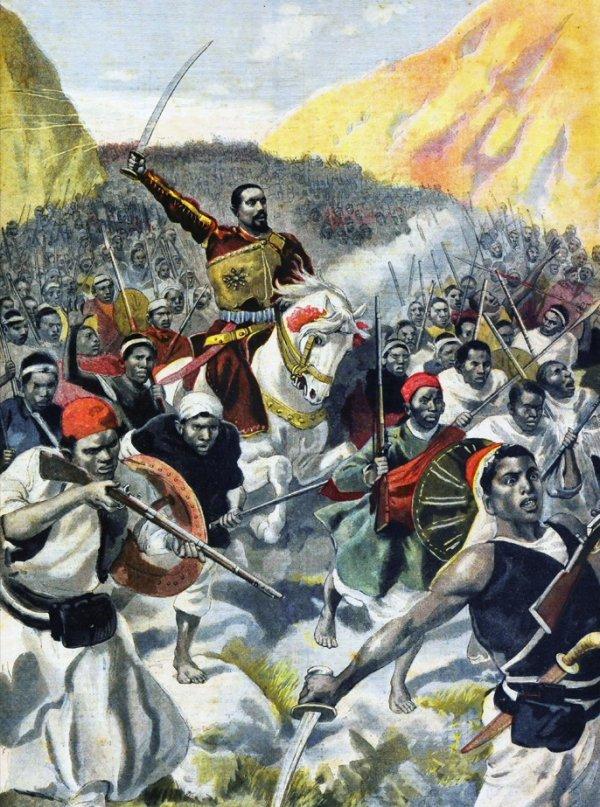
One of the most famous examples of successful African resistance occurred in Ethiopia. Emperor Menelik II understood the growing threat posed by European imperialism. Ethiopia strengthened its military capabilities and acquired weapons from abroad. When Italy attempted to establish control over Ethiopia, tensions eventually developed into war. On March 1, 1896, Ethiopian forces defeated the Italian army at the Battle of Adwa. The victory was extraordinary, preventing Italy from turning Ethiopia into a colony during the main period of the Scramble for Africa. The Metropolitan Museum of Art identifies Ethiopia as the only African state to successfully resist European colonization during this period. Adwa became much more than a military victory—it became a universal symbol of African sovereignty.
Menelik II and Strategic Diplomacy
Menelik’s success was not based entirely on battlefield strength; diplomacy played a major role. He maintained relationships with European powers while acquiring modern weapons. He also understood that European governments competed against one another, and that competition could be used to Ethiopia’s advantage. Menelik strengthened the Ethiopian state while attempting to prevent any single European power from gaining overwhelming influence, proving that resistance could involve diplomacy as well as warfare.
Queen Taytu Betul
Empress Taytu Betul, Menelik II’s wife, also played a significant political role during the crisis with Italy. She strongly opposed Italian attempts to establish control over Ethiopia. Her political influence and involvement in the Ethiopian response have made her an important figure in the history of African resistance. Her story also challenges the tendency to portray anti-colonial resistance as an exclusively male history, highlighting how African women repeatedly played vital roles in political and military struggles.
The Asante Resistance and Yaa Asantewaa
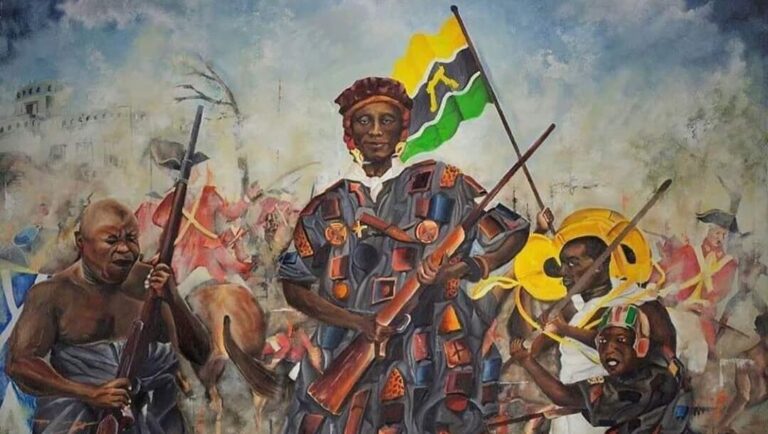
In West Africa, the Asante Empire resisted British expansion. The Asante state had a sophisticated political structure and a powerful military. British interests in the region increasingly conflicted with Asante sovereignty, leading to a series of wars between Asante and British forces. Although the British eventually established colonial control, resistance continued.
One of the most famous episodes occurred in 1900, known as the War of the Golden Stool. At the center of this resistance was Yaa Asantewaa, Queen Mother of Ejisu. When British authorities demanded the Golden Stool—the sacred symbol of Asante political and spiritual authority—Yaa Asantewaa became one of the leading figures opposing them and called for open resistance. Her leadership became legendary. Although the uprising was eventually defeated and Yaa Asantewaa was captured and exiled, her legacy survived. Today, she remains one of the most recognized symbols of African women’s resistance to colonial rule.
Samori Touré and the Mandinka Resistance
In West Africa, Samori Touré built a powerful state that resisted French expansion. Samori understood that European armies were increasingly dangerous, so he developed a disciplined military organization and sought modern firearms. His forces fought the French for years, utilizing mobility, strategic retreats, and military organization to prolong resistance. French forces eventually captured Samori in 1898, but his movement remains one of the major examples of sustained opposition to French colonial expansion.
Abdelkader and North African Resistance
Resistance to European expansion also occurred in North Africa. In Algeria, Emir Abdelkader led resistance against French conquest during the nineteenth century. He combined military resistance with diplomacy and political organization, fighting French armies for years. Eventually, French military pressure forced his surrender, yet Abdelkader’s reputation survived. He became an important symbol of Algerian resistance and political leadership, demonstrating that resistance to European imperialism spanned the entire continent.
The Zulu Kingdom: Isandlwana and Rorke’s Drift
Southern Africa produced another dramatic example. The Zulu Kingdom had developed a powerful military system under leaders including Shaka Zulu and his successors. When Britain invaded Zululand in 1879, the Zulu army confronted one of the world’s most powerful imperial militaries. At the Battle of Isandlwana, Zulu forces achieved a remarkable victory, killing thousands of British and colonial troops. The defeat shocked Britain and demonstrated that European armies were not invincible.
However, British forces eventually regrouped and defeated the Zulu Kingdom. The same Anglo-Zulu War produced another famous episode at Rorke’s Drift, where a small British garrison successfully defended its position against a much larger Zulu force. The contrasting battles of Isandlwana and Rorke’s Drift demonstrate how unpredictable colonial warfare could be: Zulu forces could achieve major victories, yet European armies could still recover through their vast resources.
Resistance and Genocide in German South-West Africa
In what is now Namibia, German colonial expansion encountered resistance from the Herero and Nama peoples. Land dispossession, political domination, and economic pressure contributed to growing tensions. The Herero uprising began in 1904, to which German forces responded with extreme violence. General Lothar von Trotha issued an extermination order against the Herero. Thousands were driven into the desert to die from starvation and dehydration, while others were imprisoned in brutal camp systems. The Herero and Nama genocide remains one of the darkest chapters of European colonial history.
Assessing the Outcomes of Resistance
 Resistance Was Not Always Successful
It is tempting to remember only resistance movements that achieved famous victories, but historical resistance should also include movements that were defeated. Defeat does not mean the resistance was meaningless. A rebellion could delay colonial expansion, expose the brutality of colonial rule, inspire future generations, preserve political identities, and demonstrate that colonial rule was always contested. In this sense, resistance had significance even when it did not immediately produce independence.
The Maji Maji Rebellion and Religious Resistance
One of the largest anti-colonial uprisings in East Africa was the Maji Maji Rebellion (1905–1907) in German East Africa. The uprising involved several communities responding to German colonial policies, particularly forced cotton cultivation, which disrupted local agricultural systems. The rebellion drew strength from religious beliefs centered around the spiritual leader Kinjikitile Ngwale. He promoted belief in maji (water), which was believed by some followers to provide spiritual protection against German bullets.
Although spiritual protection could not stop modern weapons and German forces eventually crushed the rebellion using scorched-earth tactics, the movement had a lasting legacy. German forces destroyed villages and crops, causing large numbers to die from warfare, famine, and disease. Despite the devastating human cost, the rebellion became an important symbol of anti-colonial resistance in Tanzania and demonstrated the power of religion in mobilizing communities against colonial power.
Religion appeared repeatedly in African resistance movements because colonialism threatened existing cultural institutions. Traditional religious leaders could mobilize followers, prophetic movements could create new political identities, and Christian and Muslim leaders alike became prominent opponents of colonial rule. Religion offered something military organization alone could not provide: a sense of collective purpose that transformed political resistance into a moral struggle.
Everyday and Structural Resistance
Women in Resistance Movements
Women were central to African resistance, contributing through military leadership, political organization, intelligence gathering, food supply, communication, protests, religious mobilization, tax resistance, and underground political activity. Yaa Asantewaa is a famous example, but she was far from unique. Women participated extensively in later nationalist movements as well, proving that the history of African resistance extends far beyond traditional images of male warriors.
A key example occurred in 1929 in southeastern Nigeria, where women organized a major protest against British colonial policies, known as the Aba Women’s War. Opposing taxation and abuses by colonial authorities and warrant chiefs, thousands of women gathered at administrative centers, confronted officials, and used traditional forms of collective protest. Despite violent responses from British forces, the movement remains a landmark example of women’s political organized resistance.
Resistance to Taxation, Forced Labor, and Land Dispossession
Taxation became a major source of opposition. Colonial governments introduced taxes to force African households into the cash economy, requiring people who were previously self-sufficient to earn money to meet government obligations. Tax resistance became widespread—people refused to pay, communities attacked tax offices, and leaders negotiated—making taxation one of the most visible symbols of colonial control.
Forced labor generated another major source of resistance. Colonial governments and private entities required African workers to build infrastructure, work mines, and labor on plantations. Recruitment was often coercive, separating people from families and disrupting agricultural cycles. Escaping labor demands became a widespread form of everyday resistance.
Above all, land was the most fundamental source of conflict. Colonial governments and European settlers seized large areas, particularly in southern and eastern Africa. Land loss threatened food production, livestock, family security, cultural identity, and political independence, making land resistance central to later nationalist movements.
Twentieth-Century Resistance Movements
The Mau Mau Movement in Kenya
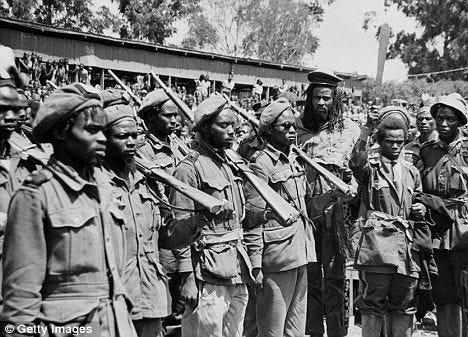
One of the best-known twentieth-century resistance movements was the Mau Mau uprising in Kenya during the early 1950s. Rooted in land dispossession, racial inequality, political exclusion, and colonial economic structures, many participants were Kikuyu, though the political context involved broader Kenyan communities. The movement targeted colonial authorities and African collaborators, leading Britain to declare a state of emergency.
British authorities conducted extensive military operations and detained large numbers of suspected Mau Mau supporters in camps where prisoners experienced harsh conditions and documented torture. The British government later acknowledged these abuses and reached a settlement with thousands of Kenyan claimants.
Leaders like Dedan Kimathi, who operated in the forests of central Kenya, became symbols of armed resistance. Kimathi was captured in 1956 and executed. While colonial narratives originally portrayed Mau Mau as criminals, post-independence Kenya recognized Kimathi and his peers as freedom fighters, illustrating how historical memory shifts when colonial perspectives are dismantled.
Political Resistance, the Press, and Labor Unions
Not every freedom fighter used weapons; political resistance grew increasingly important during the twentieth century. African leaders established political parties, organized newspapers, created trade unions, negotiated constitutional reforms, organized strikes, and appealed to international organizations.
- The Written Word: The spread of newspapers helped African political movements communicate. Editors criticized colonial governments, journalists exposed abuses, and intellectuals debated nationalism. The written word allowed ideas to cross colonial borders easily.
- Trade Unions and Workers: Urbanization produced new working classes. Railway workers, dock workers, miners, and government employees organized trade unions. They demanded higher wages, better working conditions, racial equality, and political representation. Strikes became vital political tools, transforming anti-colonial resistance into a mass social movement.
International Pan-Africanism
Resistance also expanded internationally as African intellectuals and the African diaspora developed Pan-Africanism to promote solidarity among African peoples worldwide.
- Marcus Garvey: Jamaican activist Marcus Garvey became one of the most influential voices through the Universal Negro Improvement Association (UNIA), promoting Black pride, economic independence, and self-determination. His ideological contributions popularized the idea of a shared global political destiny.
- W. E. B. Du Bois: American intellectual W. E. B. Du Bois helped organize Pan-African Congresses that brought activists together to challenge colonialism and racial hierarchy, demonstrating how the diaspora actively participated in the intellectual struggle.
The Mid-Century Nationalist Leaders
By the mid-twentieth century, resistance had entered a new phase of mass political organization:
- Kwame Nkrumah: In the Gold Coast, Nkrumah promoted mass political organization using strikes, boycotts, and political mobilization. His strategy led to Ghana’s independence in 1957, inspiring nationalist movements continent-wide.
- Jomo Kenyatta: In Kenya, Kenyatta became a pivotal nationalist leader whose career spanned colonial imprisonment during the Mau Mau emergency to becoming Kenya’s first prime minister and president in 1963.
- Patrice Lumumba: In the Congo, Lumumba opposed Belgian colonialism and demanded genuine sovereignty. Becoming prime minister in 1960, his assassination in 1961 transformed him into an international symbol of anti-colonial struggle.
- Algerian FLN: The National Liberation Front (FLN) launched armed resistance against France in 1954, enduring a violent war of decolonization before securing independence in 1962.
- Southern African Armed Struggles: In southern Africa, where colonial and minority-rule systems persisted longer, liberation movements such as FRELIMO (Mozambique), MPLA (Angola), ZANU/ZAPU (Zimbabwe), and SWAPO (Namibia) fought prolonged armed struggles that intersected with Cold War rivalries.
- Nelson Mandela: Mandela became an iconic symbol of resistance against South African apartheid. Moving from nonviolent activism with the ANC to armed resistance with Umkhonto we Sizwe, his 27-year imprisonment, 1990 release, and 1994 election as president marked a defining moment in modern history.
Analyzing the Dynamics of Resistance
Why Resistance Was a Long, Complex Process
African liberation did not happen suddenly; it developed across generations through a sequence of military resistance, political organization, labor movements, nationalist parties, international diplomacy, mass protests, and armed struggles. Successful resistance depended on strong political organization, military strategy, access to weapons, popular support, international recognition, economic pressure, and shifting post-WWII international attitudes that viewed formal colonialism as illegitimate.
Conversely, movements were sometimes defeated due to European military, financial, and logistical superiority, as well as colonial strategies that exploited divisions between African groups.
Collaboration, Resistance, and Memory
Reality was rarely as simple as dividing historical figures into heroes and traitors. Some African leaders collaborated with European governments voluntarily, while others did so believing it would protect their communities. Some later turned against colonial rule. Understanding these choices requires evaluating the specific political pressures of each period.
Furthermore, historical memory is shaped by political power. Leaders once branded as criminals by colonial states were celebrated as national heroes after independence, showing how historical memory evolves when colonial narratives are challenged.
Cultural Survival as Resistance
Not all resistance involved fighting or formal politics. Preserving culture was itself a profound political act. By maintaining traditional names, languages, clothing, religious practices, ceremonies, oral histories, music, and social institutions, Africans ensured that while colonial governments could control territory, they could never completely control memory and identity. Cultural survival stands as one of the most enduring forms of resistance.
Conclusion: The People Who Refused to Surrender
The history of African resistance is much larger than a list of famous warriors. It is the story of societies refusing to surrender control over their land, communities, cultures, and political futures. Menelik II demonstrated that European imperial armies could be defeated; Yaa Asantewaa demonstrated the power of women’s leadership; Samori Touré demonstrated the importance of strategic military organization; the Maji Maji rebels demonstrated the power of spiritual mobilization; the Mau Mau demonstrated the persistence of resistance; and Pan-African thinkers transformed local struggles into an international movement.
Whether they won or lost battles, were imprisoned, executed, or lived to see new national flags raised, these figures collectively challenged the assumption that colonial rule was permanent or legitimate. Across regions and generations, African resistance consistently answered a fundamental question: Who has the right to determine Africa’s future? Their answer laid the groundwork for the wave of independence that redefined the modern continent.
