

Among the Akan people of Ghana, there is a proverb rendered through one of their most famous Adinkra symbols, Sankofa: “Se wo were fi na wosankofa a yenkyi” — “It is not wrong to go back for that which you have forgotten.” Few art forms embody this philosophy as literally as African metalwork, a tradition in which the smith does not merely shape raw ore into tools and ornament, but transforms fire and earth into objects believed, across countless African societies, to carry memory, power, and the presence of the ancestors themselves. To take up a hammer at the forge, in much of traditional Africa, was never simply a trade. It was to step into one of the oldest and most spiritually charged occupations a person could hold.
This article turns to the world of African metalwork — the blacksmiths who worked iron into tools and weapons, the goldsmiths who transformed the wealth of empires into wearable art, and the silversmiths of the Sahel whose intricate jewelry continues to define entire cultural identities. It is a story of fire, skill, secrecy, status, and extraordinary artistic achievement, running in parallel to — and distinct from — the celebrated bronze-casting traditions of Benin already explored elsewhere in this series.
The Blacksmith: Feared, Revered, and Set Apart
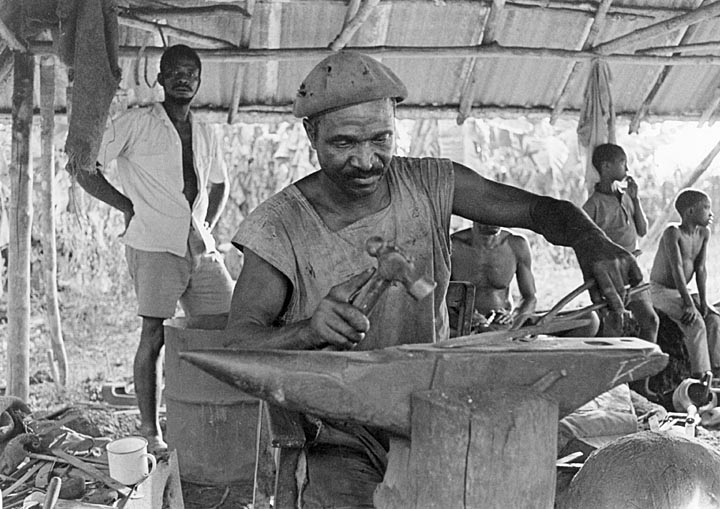
In an extraordinary number of African societies, spanning West, Central, and East Africa, blacksmiths occupy a uniquely paradoxical social position — simultaneously essential and set apart, respected and, in some contexts, feared. Among Mande-speaking peoples of West Africa, including the Bamana, Malinke, and related groups, blacksmiths belong to a distinct hereditary caste known as numu or nyamakala, a category that also includes leatherworkers, griots (oral historians and musicians), and woodcarvers. Membership in this caste is typically determined by birth, and marriage between smith families and non-smith families has historically been restricted or entirely prohibited in many communities.
This social separation stems from beliefs surrounding the immense, dangerous spiritual energy — often called nyama in Mande cosmology — believed to be released and manipulated during the transformation of ore into iron. The blacksmith who tames fire, extracts metal from stone, and reshapes it through repeated heating and hammering is understood to be handling forces far beyond ordinary craft; he is, in a very real cosmological sense, performing a kind of alchemy that mirrors acts of creation and destruction usually reserved for spiritual specialists. Blacksmiths in many of these societies also serve as circumcision specialists, herbalists, and diviners, their mastery over transformative processes extending naturally into other domains believed to require careful management of spiritual power.
This dual status — essential craftsman and feared spiritual operator — meant that blacksmiths historically occupied villages’ physical and social margins even while their work was indispensable to agriculture, warfare, and daily survival. Iron tools made hoes for farming, machetes for clearing land, and weapons for both hunting and warfare possible. Without the blacksmith, the material infrastructure of pre-colonial African life would simply not have existed. Yet the smith rarely occupied a position of casual social equality with farmers, traders, or royalty; his was a role defined by necessary distance.
Iron Smelting: An Ancient and Sophisticated Technology
Africa’s relationship with iron technology is far older and more independently developed than many historical narratives, shaped heavily by colonial-era scholarship, once acknowledged. Archaeological evidence from sites in present-day Niger, Nigeria, Tanzania, and elsewhere indicates that iron smelting was practiced across multiple regions of the continent by at least the first millennium BCE, and in some contested but increasingly credible archaeological findings, potentially even earlier — developed independently rather than solely diffused from Middle Eastern or North African sources, as older colonial-era theories insisted.
Traditional African iron smelting relied on furnaces constructed from clay, often built to impressive heights of several meters, designed to reach and sustain the extreme temperatures — typically over 1,100 degrees Celsius — required to separate usable iron from raw ore. Bellows, frequently made from animal skin and wood, were used to force air into the furnace, intensifying the fire. Charcoal, produced through its own specialized process of controlled wood burning, served as the fuel source. The entire process, from ore preparation to final smelting, often took days and required precise knowledge passed down through generations — knowledge of which ores worked best, how to time bellows operation, how to read the colour and behaviour of the fire to know when the smelt was complete.
Remarkably, some traditional furnace designs, particularly among groups in East Africa such as the Haya people of present-day Tanzania, achieved smelting temperatures and techniques that some metallurgical historians argue anticipated principles later associated with more industrialized steel production methods developed independently in Europe centuries afterward — a striking testament to the sophistication of indigenous African metallurgical science, long undervalued in mainstream historical accounts.
 Gold: Empires Built on Metal
If iron represented practical necessity, gold represented power, wealth, and political legitimacy across vast stretches of the African continent, particularly in West Africa. The medieval empires of Ghana, Mali, and Songhai owed much of their extraordinary wealth and international renown to gold extracted from the goldfields of the Akan forest region, the Bambuk and Bure regions along the upper Niger and Senegal rivers, and other deposits scattered across the West African interior. The legendary fourteenth-century pilgrimage of Mansa Musa of Mali to Mecca, during which he reportedly distributed such vast quantities of gold that he temporarily disrupted currency values across the regions he passed through, remains one of history’s most vivid illustrations of just how central gold was to West African political and economic power.
Among the Akan peoples of present-day Ghana and Ivory Coast, gold became deeply entwined with both political authority and artistic expression. Akan goldsmiths developed extraordinary skill in casting gold ornaments, regalia, and, most famously, the small brass and gold goldweights — miniature figurative and geometric sculptures used to measure gold dust in trade transactions. Far from being mere functional tools, these goldweights, often depicting animals, human figures, tools, and abstract symbols, frequently encoded proverbs and moral lessons, transforming an act of economic measurement into an act of cultural transmission — a trader weighing gold dust was, simultaneously, being reminded of a proverb about wisdom, caution, or community obligation embedded in the very weight used to conduct the transaction.
Akan royal regalia, including elaborate gold rings, pendants, sword ornaments, and the sandals and jewelry of chiefs, remain among the most visually spectacular expressions of African goldsmithing, with gold reserved almost exclusively for royalty and the highest-ranking members of society — its scarcity and radiant permanence understood as a fitting material analogy for the enduring, quasi-sacred nature of chieftaincy itself.
Silver and the Sahel: Tuareg and Fulani Jewelry Traditions
Across the Sahel and Sahara, a markedly different metalworking tradition flourished, centred on silver rather than gold. Among the Tuareg people, a historically nomadic Berber population spanning parts of present-day Mali, Niger, Algeria, and Libya, silversmithing — traditionally practiced by a specialist caste known as inadan — produced some of Africa’s most recognisable jewelry forms, most famously the Croix d’Agadez (Cross of Agadez), a distinctive geometric silver pendant whose exact form varies by region and whose precise symbolic meaning, though debated, is often associated with protection, the four cardinal directions, and Tuareg identity itself.
Tuareg silverwork is characterized by bold geometric engraving, often filled with dark niello inlay that creates striking contrast against the polished silver surface. These pieces were historically worn by both men and women, functioning as protective amulets as much as decorative jewelry, frequently believed to guard against the evil eye or malevolent spiritual forces encountered during long desert journeys.
Among Fulani (Fulɓe) communities spread across a vast swath of West and Central Africa, gold and gold-coloured metal jewelry — particularly large, ornate hoop earrings known as kwottenai kanye or “Fulani earrings” — became powerful markers of feminine beauty, marital status, and family wealth. These substantial earrings, often requiring the earlobe to be gradually stretched to accommodate their weight, are traditionally given to a bride as part of marriage negotiations, their size and craftsmanship a direct, visible statement of a family’s means and the value placed upon the daughter being married.
Copper and Brass: Currency, Art, and Status
Beyond gold, silver, and iron, copper and brass occupied their own significant place within African metalworking traditions, particularly in Central Africa. Among the Kuba, Luba, and related peoples of the Congo basin, distinctive copper cross-shaped ingots known as handa or “Katanga crosses” functioned as a recognized form of currency across a wide trading region, their standardized shape and weight facilitating exchange across considerable distances and diverse language groups.
Brass, an alloy of copper and zinc, became closely associated with royal courts and religious institutions across significant portions of West and Central Africa, valued for its workability, golden lustre, and durability. Beyond the renowned Benin bronzes — more accurately brass castings, produced through the lost-wax method — brass was cast into numerous other ceremonial and decorative objects across the Guinea Coast and Congo Basin regions, including elaborate staffs, ceremonial vessels, and figurative sculptures used in ancestor veneration and royal display.
Techniques: Casting, Forging, Filigree
African metalworking traditions encompass a remarkable range of technical approaches, each requiring years of specialized training. The lost-wax casting method — used extensively for Akan goldweights, Benin brass sculpture, and numerous other traditions — involves sculpting a design in wax, encasing it in clay, then heating the mould until the wax melts and drains away, leaving a hollow cavity into which molten metal is poured. Once cooled, the clay mould is broken away to reveal the finished metal object, meaning each lost-wax casting is, by its very process, a unique original rather than a mass-produced duplicate.
Forging, by contrast, involves the direct hammering and shaping of heated metal — the primary technique used by blacksmiths producing iron tools and weapons, requiring exceptional physical strength combined with precise control, as repeated heating and cooling cycles (a process related to what metallurgists call annealing) allow the smith to manipulate metal that would otherwise be too brittle or too hard to shape effectively.
Filigree work, particularly associated with Tuareg and broader Sahelian silversmithing traditions, involves twisting and soldering fine metal wire into delicate decorative patterns, often combined with granulation — the application of tiny metal spheres to create textured surface designs. This technique demands extraordinary manual dexterity and patience, with a single elaborate piece sometimes requiring days of continuous, painstaking work.
 Jewelry as Wealth Storage and Social Security
Across much of pre-colonial and, in many communities, contemporary Africa, gold and silver jewelry has functioned not merely as personal adornment but as a practical and highly portable form of wealth storage — a role of particular importance in societies without formal banking infrastructure, or in circumstances of political instability, migration, or economic hardship. A woman’s collection of gold or silver jewelry, accumulated through marriage gifts, inheritance, and personal acquisition over a lifetime, has traditionally represented not vanity but genuine financial security, capable of being sold, pawned, or melted down in times of need.
This economic dimension helps explain why jewelry gifting remains such a central feature of marriage negotiations and ceremonies across so much of the continent — a family is not merely offering a beautiful object but transferring genuine, liquid wealth into the hands of the bride, wealth that remains legally and culturally hers even in circumstances of marital breakdown in many traditional legal frameworks, offering a measure of financial independence that predates, and in some communities continues to coexist alongside, more modern financial institutions.
Guilds, Secrecy, and the Transmission of Knowledge
Metalworking knowledge across Africa has traditionally been transmitted through tightly controlled apprenticeship systems, often restricted along caste, family, or gender lines. Among Mande blacksmith families, technical knowledge — the precise composition of alloys, the specific timing of forging stages, the ritual practices believed necessary to safely handle transformative spiritual energy — has historically been considered proprietary family or caste knowledge, deliberately withheld from outsiders and revealed to apprentices gradually, over years, as they demonstrate both technical competence and appropriate spiritual maturity and discretion.
This secrecy served practical as much as spiritual purposes, protecting valuable technical and economic advantages within specific families or lineages across generations. It also means that, today, the loss of even a single senior smith without a fully trained successor can represent a genuine, sometimes irreversible loss of specific technical knowledge — a concern that runs throughout discussions of heritage preservation across virtually every craft tradition explored in this series.
Metalwork and Warfare: The Smith’s Other Role
Beyond agricultural tools and personal ornament, African blacksmiths historically played an indispensable role in producing the weaponry that shaped the continent’s military and political history. Iron spearheads, arrowheads, swords, and later, the local reproduction and modification of firearms, all passed through the blacksmith’s forge. In many pre-colonial kingdoms, the relationship between political rulers and blacksmith communities was one of careful mutual dependency — a king’s military strength rested directly on the skill and loyalty of his smiths, and smiths, in turn, often received royal patronage, land grants, or protected status in exchange for reliable weapon production.

This military dimension added yet another layer to the smith’s already complex social position. In times of conflict, a community’s blacksmiths became strategically vital figures, sometimes deliberately targeted by rival forces seeking to weaken an opponent’s capacity to arm itself, and sometimes deliberately protected or even conscripted by conquering powers eager to absorb valuable technical expertise rather than lose it to violence. Oral histories from numerous West African kingdoms recount instances of entire smith communities being relocated, by force or by negotiated agreement, following conquest — a testament to how highly this specialized knowledge was valued as a strategic resource in its own right, comparable to controlling a vital trade route or agricultural region.
Regional Variation: East and Central African Metalworking
While West African metalworking traditions — particularly Akan goldsmithing and Mande blacksmithing — often dominate popular discussion of African metal arts, East and Central African traditions developed equally sophisticated and distinct practices worth dedicated attention. Among the Haya people near Lake Victoria in present-day Tanzania, iron smelting technology reached a level of thermal efficiency that has drawn considerable scholarly attention, with furnace designs enabling smiths to achieve unusually high, sustained temperatures using comparatively modest fuel inputs — evidence of generations of accumulated, empirically refined engineering knowledge passed down entirely through oral instruction and hands-on practice rather than written technical documentation.
In the Great Lakes region more broadly, iron production supported not only tool and weapon manufacture but also elaborate ceremonial ironwork, including finely wrought iron currency objects, ceremonial spears reserved for royal and ritual use, and decorative iron objects incorporated into shrine and ancestral veneration practices. Among Central African peoples such as the Luba and neighbouring groups, iron and copper working intersected closely with political authority, with certain forged objects — including ceremonial axes and staffs — serving as physical emblems of chiefly office, handed down through royal succession much as a crown or sceptre might function in other cultural contexts.
The Ritual Dimension of the Forge Itself
It is worth emphasizing that in many traditions, the forge was never simply a workshop in a purely secular, functional sense — it was frequently treated as a semi-sacred space, subject to its own rules, taboos, and ritual observances. Among various Mande and related communities, specific rituals were performed before major smelting operations, including offerings intended to appease spiritual forces associated with the earth from which ore was extracted and the fire through which it would be transformed. Menstruating women, in numerous traditions, were historically prohibited from approaching an active smelting furnace, reflecting broader cosmological beliefs about the dangers of combining certain forms of spiritual potency.
The furnace itself was, in many West African iron-smelting traditions, symbolically constructed and understood in gendered, often explicitly anthropomorphic terms — sometimes built with features suggestive of a human or female figure, understood as a kind of womb from which iron was, quite literally, “born” through the transformative heat of the smelting process. This conceptual framing — smelting as a form of birth, requiring careful ritual management akin to the protocols surrounding human childbirth in the same societies — illustrates just how deeply intertwined African metalworking traditions were, and in many communities remain, with broader cosmological and spiritual frameworks, rather than existing as a separate, purely technical domain of activity.
Today, African metalworking traditions continue to evolve, sustained by both the persistence of traditional practice in many communities and a vibrant contemporary design movement reinterpreting historical techniques for global fashion and art markets. Contemporary jewelry designers across Ghana, Nigeria, Mali, Senegal, and elsewhere increasingly draw directly on Akan goldweight motifs, Tuareg silverwork geometry, and Fulani earring forms, producing pieces that circulate through international galleries, boutiques, and fashion houses while explicitly referencing and crediting their traditional sources.
Simultaneously, traditional blacksmithing faces genuine pressure from the availability of cheap, mass-produced imported tools and metal goods, reducing demand for hand-forged agricultural implements in many rural areas. Some communities have responded by shifting traditional smithing skill toward the production of decorative and artistic metalwork for tourist and export markets, while others maintain traditional forging specifically for ceremonial and ritual objects whose spiritual authenticity is understood to require production by properly initiated, traditionally trained smiths rather than industrial manufacture.
Conclusion: Fire, Memory, and the Weight of Meaning
To handle a piece of traditional African metalwork — whether a hand-forged iron hoe, an Akan gold ring, or a Tuareg silver cross — is to hold an object shaped by fire, generations of accumulated technical knowledge, and systems of meaning that stretch back millennia. The blacksmith who transforms raw ore into a functional tool, the goldsmith who casts a proverb into a tiny brass weight, and the silversmith who twists fine wire into a protective amulet are all engaged in the same fundamental act: making the invisible — wealth, protection, status, memory — visible and wearable.
As the Sankofa proverb reminds us, there is no shame in reaching back for what might otherwise be forgotten. In a rapidly modernizing Africa, the deliberate, patient work of returning to traditional metalworking knowledge — documenting it, teaching it, and honouring the smiths who carry it — is not nostalgia. It is the necessary work of ensuring that fire continues to carry meaning for generations still to come.
