

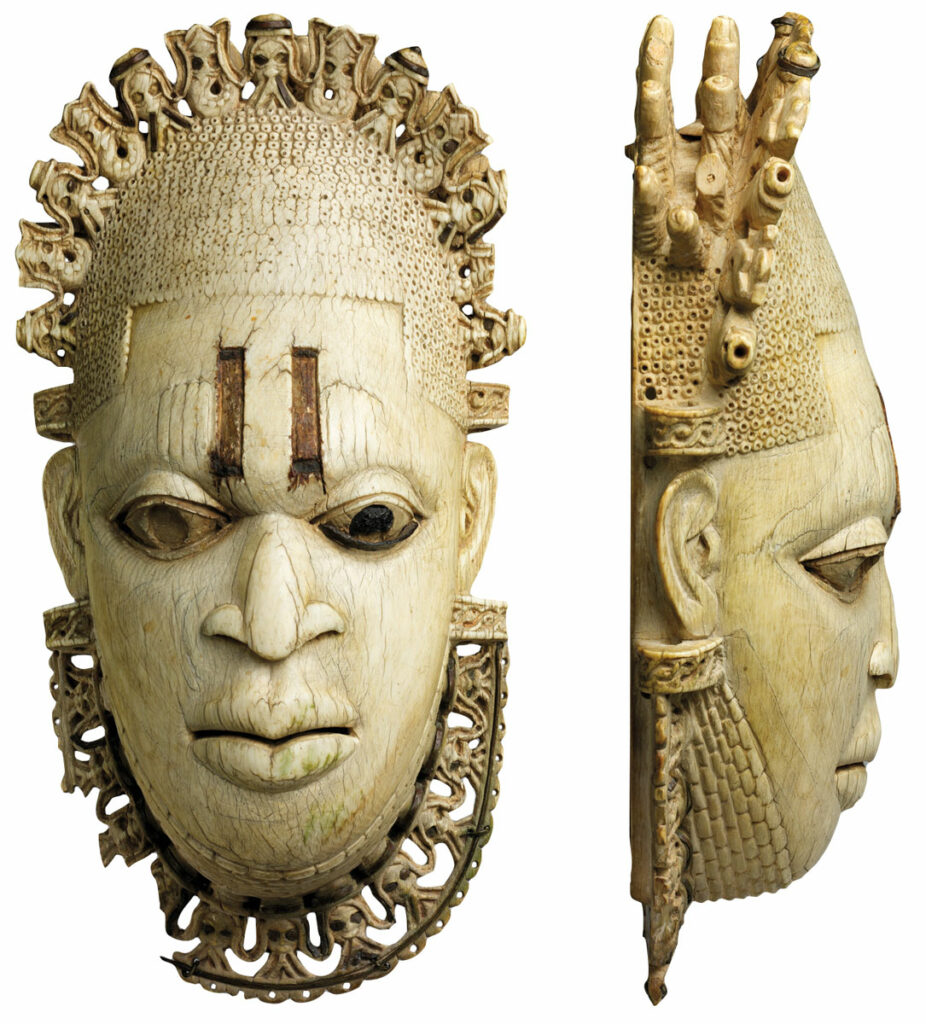
In the royal court of the historic Benin Kingdom, in what is now southern Nigeria, a proverb was often invoked to describe the weight of memory and obligation carried by art created for a king:
“A river that forgets its source will dry up.”
For the guild of bronze casters who served the Oba — the divine king of Benin — for more than half a millennium, this was not an abstract metaphor. Every plaque, every commemorative head, every ceremonial object cast in their workshops was, quite literally, a vessel of memory, commissioned to record royal history, honour ancestors, and keep the kingdom’s source of spiritual and political legitimacy alive and flowing. This article explores the extraordinary artistic tradition of Benin bronze casting — its origins, its technical mastery, its role within Benin’s royal and spiritual life, the catastrophic 1897 British punitive expedition that scattered its treasures across the globe, and the ongoing, unfinished story of restitution that continues to unfold today.
The Kingdom of Benin: Context and Origins
The Benin Kingdom, not to be confused with the modern Republic of Benin located further west, was one of the most powerful and sophisticated pre-colonial states in West Africa, centred in what is today Edo State, Nigeria. Tradition holds that the kingdom’s ruling dynasty, the Eweka dynasty, was established around the thirteenth century, following a period of political transition during which the Benin people, dissatisfied with rule under a line of leaders known as the Ogiso, invited a prince from the neighbouring Yoruba kingdom of Ife to establish a new royal line. This dynastic connection to Ife carries direct artistic significance, because Ife was already, by this period, home to one of Africa’s most sophisticated bronze and terracotta casting traditions, renowned for naturalistic royal portrait heads of extraordinary technical refinement.
According to Benin oral history, it was from Ife that the art of bronze casting was formally introduced to Benin, traditionally credited to a bronze caster named Iguegha, sent by the Ife court at the request of an early Benin Oba specifically to establish bronze casting practice within the kingdom. Whatever the precise historical details, the artistic connection between Ife and Benin is widely acknowledged by art historians, even as Benin bronze casters would go on to develop their own highly distinctive stylistic and technical traditions, diverging significantly from Ife naturalism toward the more stylized, hierarchically composed imagery that would come to define classical Benin art.
The Guild System: Igun Eronmwon
Central to understanding Benin bronze casting is the highly structured guild system through which the craft was organized, controlled, and transmitted across generations. Bronze casters in Benin belonged to a specific hereditary guild known as Igun Eronmwon, whose members lived together in a dedicated quarter of Benin City still known today as Igun Street, continuing a craft tradition in the same physical location for well over five centuries.
Membership in the bronze casters’ guild was, and largely remains, hereditary, passed down through specific families, with knowledge of casting techniques, alloy composition, and iconographic conventions transmitted through structured apprenticeship beginning in childhood. Critically, and this point cannot be overstated in understanding the social and political significance of Benin bronze art, casting in bronze was historically a royal monopoly — the Igun Eronmwon guild worked exclusively for the Oba, and bronze casting for any other patron, without direct royal authorization, was traditionally forbidden. This meant that every historical Benin bronze object in existence was, by definition, created either for the king himself or for a purpose the king had specifically sanctioned, making the entire corpus of Benin bronze art simultaneously a body of religious and artistic achievement and a direct, unbroken visual record of royal history and political authority.
This royal monopoly over bronze casting stands in notable contrast to ivory carving, ceramics, or beadwork traditions elsewhere on the continent that were more widely dispersed across a community; in Benin, bronze was reserved deliberately and exclusively as a royal medium, its scarcity and difficulty of production reinforcing rather than diminishing its status as the highest-prestige art form within the kingdom’s artistic hierarchy.
Materials and the Question of “Bronze”
It is worth pausing on a point of technical accuracy that continues to generate discussion among art historians and metallurgists: much of what is popularly termed “Benin bronze” is, more precisely, brass — an alloy of copper and zinc — rather than true bronze, an alloy of copper and tin. The terminology “bronze” became entrenched in Western art historical literature from the earliest period of European engagement with these objects and has persisted in common usage ever since, even as more precise metallurgical analysis has clarified that many, though not all, Benin castings are technically brass.
The raw copper and zinc required for casting was not locally available within the Benin Kingdom itself and was obtained almost entirely through long-distance trade, initially via trans-Saharan routes bringing metal from North Africa and the Mediterranean, and later, from the sixteenth century onward, increasingly via direct maritime trade with Portuguese, and subsequently Dutch and English, traders arriving on the West African coast. This trade dimension carries important historical significance: the flourishing of Benin bronze casting during its most celebrated periods was directly tied to the kingdom’s access to international trade networks, with European traders exchanging manilla-shaped brass and copper ingots — themselves manufactured specifically for African trade, particularly in centres such as Birmingham in England — for goods including pepper, ivory, and, in a history that cannot be separated from this artistic legacy, enslaved people, during the period when Benin, like many West African coastal kingdoms, participated to varying degrees in the transatlantic slave trade.
 The Lost-Wax Casting Process
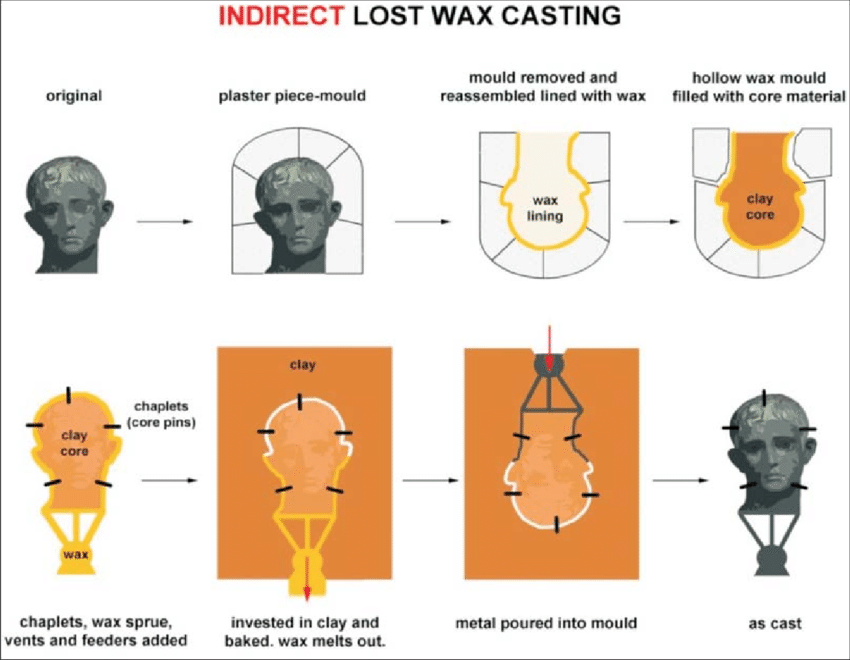
Benin bronze casters employed the lost-wax method — known technically as cire perdue — a casting technique of extraordinary sophistication requiring precise control at every stage of an intricate, multi-step process. The process began with the creation of a core, typically formed from a mixture of clay and other materials, roughly approximating the final shape of the intended object. Over this core, the caster applied a layer of beeswax, into which the fine surface details of the final object — facial features, decorative patterning, inscriptional elements — were meticulously carved and modelled by hand.
This wax model was then encased in another layer of fine clay, carefully applied to capture every detail of the wax surface, followed by additional layers of coarser clay to create a sturdy outer mould, with narrow channels, known as sprues and vents, built into the mould to allow molten metal to flow in and displaced air and wax to escape during the casting process. Once the mould was complete and thoroughly dried, it was heated, causing the wax layer to melt and drain away entirely through the prepared channels — hence “lost wax” — leaving behind a precise negative cavity in the exact shape and detail of the original wax model, sandwiched between the inner clay core and outer clay mould.
Molten brass or bronze, heated to extreme temperature in a specialized furnace, was then carefully poured into this cavity through the prepared channels, filling every fine detail the wax had occupied. After cooling, the outer clay mould was broken away — meaning each mould, and by extension each lost-wax casting, could only be used once, making every Benin bronze casting a genuinely unique object rather than a mass-produced duplicate, even when multiple objects shared closely related iconography or composition. The clay core within the hollow cast object was then carefully removed, and the final casting was cleaned, filed, and polished to achieve its finished surface. This entire process, requiring exceptional skill at every single stage, could take weeks or months for a single significant commission, and the guild’s continued mastery across many centuries speaks to remarkably sophisticated accumulated technical knowledge, refined and transmitted entirely through hands-on practice and oral instruction rather than any written technical documentation.
Iconography: Plaques, Heads, and the Visual Language of Kingship
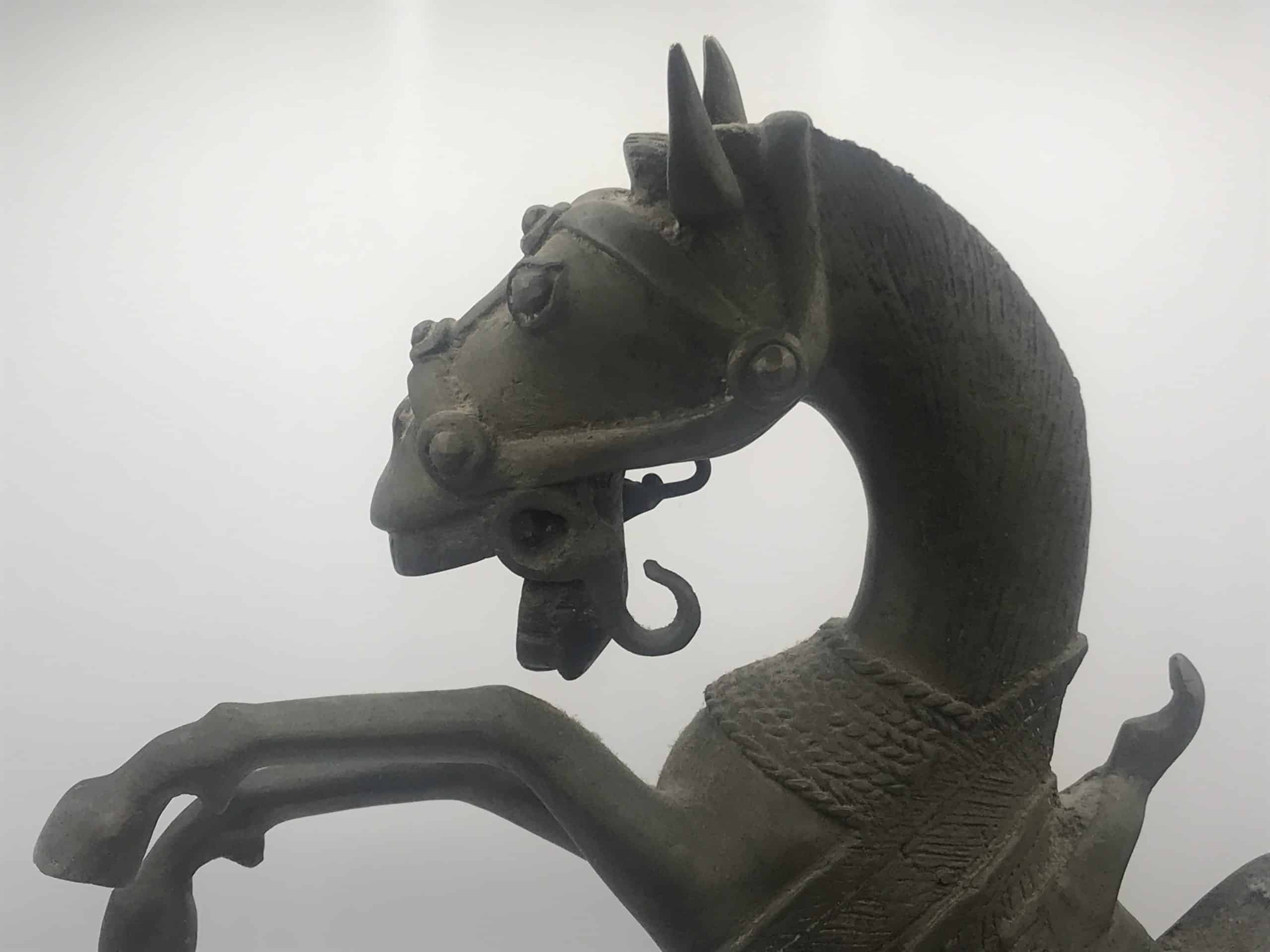
Benin bronze casting produced several distinct categories of object, each serving specific functions within royal and religious life. Most famous among these are the celebrated bronze plaques, numbering in the many hundreds, which historically adorned the wooden pillars of the royal palace in Benin City, forming an extensive visual chronicle of Benin history, royal ceremony, military achievement, and court life. These plaques depict the Oba himself, often flanked by attendants and warriors, along with Portuguese traders and soldiers — recognisable through their distinctive dress, weaponry, and, in some depictions, elongated facial features conveying their status as foreign, non-Edo figures — court musicians, animals imbued with symbolic royal significance including leopards and pythons, and elaborate scenes of ceremony and warfare.
The compositional conventions of these plaques follow a consistent hierarchical logic characteristic of much traditional African royal art: figures of greater status and importance, invariably including the Oba himself when depicted, are rendered larger than surrounding figures, regardless of their actual physical proportions relative to one another — a visual grammar prioritizing symbolic and political significance over naturalistic accuracy, immediately communicating social hierarchy to any viewer familiar with the convention.
Equally significant are the commemorative brass heads created to honour deceased Obas and, in some periods, Queen Mothers, placed on ancestral altars within the royal palace as part of Benin’s rich tradition of ancestor veneration. These heads, along with the ceremonial ivory tusks often mounted upon them, were understood to serve as a means of maintaining connection between the living Oba and his royal ancestors, whose continued spiritual support was considered essential to the kingdom’s ongoing prosperity and stability. Stylistic analysis of these commemorative heads has allowed art historians to trace a chronological development across Benin’s history, with earlier heads generally displaying thinner-walled, more naturalistically proportioned casting, and later heads, particularly from the eighteenth and nineteenth centuries, becoming progressively larger, thicker-walled, and more elaborately decorated with beaded regalia — changes generally understood to reflect not a decline in technical skill, but evolving aesthetic and ceremonial priorities within the royal court over time.
Ivory: The Companion Art of Benin
Alongside bronze, ivory carving held nearly equivalent prestige within Benin’s royal artistic tradition, similarly organized through a dedicated hereditary guild working under royal patronage. Among the most celebrated examples of Benin ivory art are the exquisite pendant masks associated with Queen Idia, mother of the sixteenth-century Oba Esigie, believed to have been worn by the Oba himself during important ceremonial occasions as a symbol connecting his authority to that of his powerful royal mother, whose political and spiritual counsel was credited with helping secure and stabilize his reign during a period of significant military conflict.
 These ivory masks, along with elaborately carved ivory tusks mounted atop commemorative bronze heads and displaying dense, intricate figurative relief carving depicting court scenes and royal genealogy, represent artistic achievements of comparable sophistication and historical significance to the bronze castings with which they are so closely associated within Benin’s broader royal artistic tradition.
The Punitive Expedition of 1897
The single most consequential event in the modern history of Benin bronze art occurred in February 1897, when a British military force launched what has become known as the Punitive Expedition against Benin City, ostensibly in retaliation for the earlier killing of a British trade delegation that had attempted to enter the city despite explicit warnings that the timing conflicted with important religious observances. The British force overwhelmed Benin’s defences, the reigning Oba, Ovonramwen, was forced into exile, and Benin City itself was burned, with the royal palace and its extraordinary accumulated collection of bronze, ivory, and coral artistic treasures — representing centuries of continuous royal patronage — comprehensively looted by British forces.
The scale of this looting was staggering: several thousand bronze, ivory, and other objects were removed from the palace, subsequently transported to Britain, where many were sold at auction to defray the costs of the military expedition itself, entering private collections and, over subsequent decades, major museum collections across Europe and North America, including the British Museum, which today holds one of the world’s largest collections of Benin bronzes, alongside significant holdings in Germany, the United States, and numerous other countries. This dispersal fundamentally and permanently altered the physical location and institutional context of Benin’s royal artistic patrimony, scattering objects created specifically for the sacred, ceremonial space of the Benin royal palace across museum vitrines and private collections thousands of kilometres away, entirely divorced from the ceremonial and ancestral context that had originally given them meaning.
The 1897 expedition also had the effect, somewhat ironically given its violent and extractive circumstances, of introducing Benin art to European audiences and, in doing so, playing a significant role in eventually challenging prevailing European assumptions about African artistic capability — the sheer technical sophistication of the looted bronzes proved difficult for contemporary European observers to reconcile with the racist assumptions about African civilization that had, in part, justified the colonial expedition in the first place, prompting some early European scholars to speculate, quite wrongly and in ways that themselves reflected colonial-era prejudice, that such sophisticated work must have originated from ancient Mediterranean or other non-African sources, rather than accepting straightforwardly that West African craftsmen had independently developed casting techniques of this calibre.
Restitution: The Ongoing Reckoning
In recent years, the question of returning Benin’s looted bronzes to Nigeria has become one of the most closely watched and significant restitution debates in the international art world, carrying implications well beyond this specific collection for broader conversations about African cultural heritage held in Western institutions. Momentum accelerated significantly following the influential 2018 Sarr-Savoy report commissioned by the French government, and a series of subsequent institutional commitments and actual returns have followed.
Germany has emerged as a particularly significant participant in this process, with the German government and several German museums formally agreeing in 2022 to return ownership of their Benin bronze holdings to Nigeria, with physical repatriation of specific objects beginning shortly thereafter — though arrangements in some cases have involved certain objects remaining on loan display within German institutions even after formal ownership transfer, reflecting the practical complexity of managing such transitions. Other institutions, including several university museums and individual private collectors, have made smaller-scale returns, while major holders including the British Museum have, to date, been constrained from full restitution by British legal frameworks governing national museum collections, though loan arrangements and continued negotiation remain active areas of discussion.
Within Nigeria, planning has proceeded for the Edo Museum of West African Art, intended to provide a world-class facility in Benin City capable of appropriately housing, researching, and displaying returned bronzes, alongside ongoing discussion regarding the respective roles of the Nigerian federal government, Edo State government, and the traditional institution of the Oba of Benin — whose royal court remains an active, functioning institution today — in determining ownership, stewardship, and display of returned objects, questions that remain, as of this writing, not yet fully and finally resolved.
Contemporary Benin Bronze Casting
Despite the catastrophic disruption of 1897, the Igun Eronmwon bronze casters’ guild has, remarkably, survived into the present day, with practitioners on Igun Street in Benin City continuing to cast bronze objects using techniques directly descended from the historical royal tradition, even as the guild’s exclusive royal monopoly has necessarily evolved in the post-colonial era, with contemporary casters now producing work for a broader range of patrons, including tourists, collectors, and cultural institutions, alongside continued work for the still-functioning royal court.
This continuity represents a genuinely remarkable achievement of cultural resilience — the same hereditary families, working in the same historic quarter of the city, continue to practice lost-wax casting techniques passed down across more than five centuries, even through the profound disruption of colonial conquest, the physical removal of the vast majority of the historical bronze corpus, and the significant social and economic transformations of the twentieth and twenty-first centuries. Contemporary Benin bronze casters increasingly produce work explicitly referencing and reproducing historical designs, in part to meet demand from collectors and cultural institutions, and in part as a deliberate act of cultural memory and continuity, keeping alive both the technical knowledge and the visual vocabulary of a tradition that, despite everything, has never actually died.
Benin Coral: The Third Royal Material
Bronze and ivory are frequently discussed together as Benin’s premier royal artistic materials, but a third material — coral — deserves equal attention within any full account of the kingdom’s artistic and symbolic system. Coral beads, obtained historically through long-distance trade networks eventually connecting to Mediterranean sources, became so closely associated with Benin royal authority that they were, according to court tradition, considered the exclusive property of the Oba, with elaborate coral beaded regalia — crowns, collars, and full body nets of tightly strung coral beads — worn only by the Oba and those he specifically authorized, including senior chiefs on ceremonial occasions.
Benin oral tradition attributes the acquisition of coral beads to Oba Ewuare, a fifteenth-century ruler credited with numerous foundational achievements in consolidating Benin’s political and spiritual authority, said to have obtained the beads through a legendary journey to the spiritual realm of Olokun, deity of the sea and source of wealth, rather than through the more mundane historical reality of Mediterranean trade — a narrative that itself illustrates how thoroughly Benin’s material culture was woven into cosmological and religious frameworks, with even a traded commodity reframed within royal tradition as a gift of direct spiritual origin, reinforcing rather than diminishing the Oba’s sacred authority.
The story of Benin bronze casting is, in many respects, the story of an entire kingdom’s history rendered in metal — every plaque and commemorative head a deliberate act of memory, recording royal succession, military triumph, spiritual practice, and international trade across more than five centuries of continuous royal patronage. It is also, unavoidably, a story shaped by the violent rupture of colonial conquest, the looting of 1897 scattering a court’s accumulated artistic patrimony across the globe, and the still-unfolding, still-incomplete process of restitution and reckoning that continues today.
Yet as the proverb reminds us, a river that forgets its source will dry up — and despite everything, the source has not been forgotten. The Igun Eronmwon guild continues its work on the same street in Benin City where it has stood for centuries, the Oba’s court continues to function, and a growing number of the kingdom’s looted treasures are, slowly, beginning to make their way home. The legacy of Benin bronze casting endures, not merely as a celebrated chapter of art history, but as a living tradition, still flowing from the source that gave it life.
