

Africa’s Ancient Past Was Far More Complex Than the Popular Story
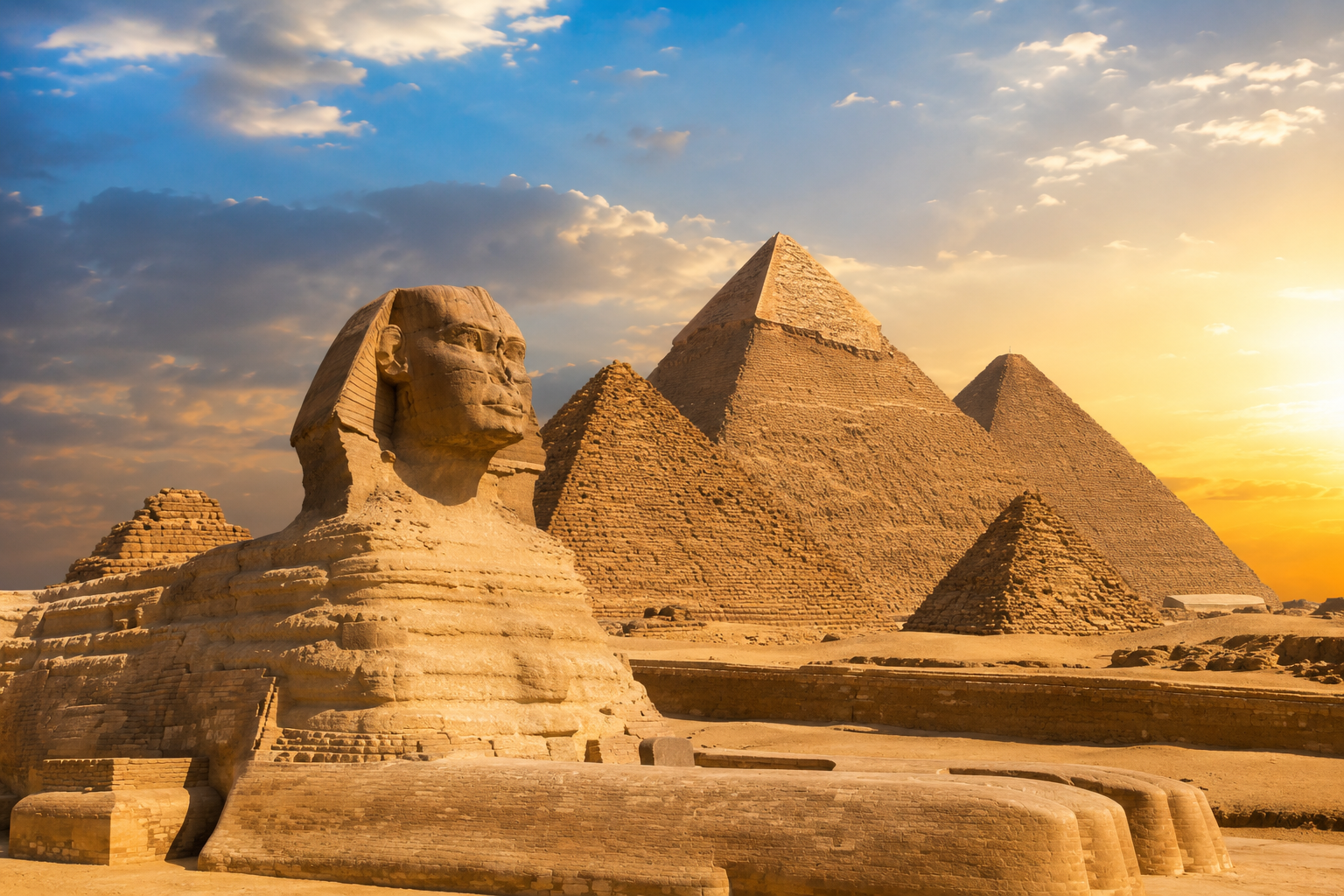
When people hear the phrase ancient African civilizations, one name often comes to mind immediately: ancient Egypt. The pyramids, pharaohs, temples, hieroglyphs, and monuments along the Nile have become some of the most recognizable symbols of the ancient world.
But Egypt was only one part of a much larger African historical landscape.
Long before European colonial powers divided the continent into modern political territories, African societies developed cities, kingdoms, agricultural systems, religious institutions, trading networks, artistic traditions, technologies, political structures, and intellectual cultures. Some flourished thousands of years ago; others emerged much later but still belonged to historical worlds that predated European colonial rule.
UNESCO’s General History of Africa approaches ancient African history across multiple regions rather than treating the continent as a single civilization. Its volume on ancient civilizations covers nearly 9,000 years, examining areas including the Nile Valley, Egypt and Nubia, the Ethiopian highlands, the Maghreb, the Sahara, and other parts of Africa.
This broader perspective matters because Africa’s past cannot be reduced to a single kingdom, ethnic group, language, or region.
The history of the continent was built by many peoples living in different environments and responding to different circumstances. Farmers along river valleys developed alongside pastoralists, merchants connected distant communities, coastal societies interacted across seas, and urban centers emerged around trade, political authority, agriculture, craft production, and religion.
Some civilizations left monumental architecture. Others are known through archaeological settlements, inscriptions, pottery, tools, oral traditions, burial sites, agricultural remains, or evidence of long-distance trade.
Together, they reveal an Africa that was dynamic, inventive, connected, and historically diverse long before the colonial era.
The Foundations of Civilization in Africa
The story of ancient African civilization begins long before the appearance of famous kingdoms.
Africa is central to the history of humanity itself. Archaeological and paleoanthropological discoveries across the continent provide evidence for very early human populations, technological development, artistic expression, environmental adaptation, and increasingly complex societies.
Over thousands of years, communities learned to exploit different environments. The Nile Valley offered opportunities for intensive agriculture. The savannas supported pastoralism and farming. Forest regions provided different resources. Along the Mediterranean coast, communities became connected to wider Mediterranean networks, while eastern African coastal societies later participated in Indian Ocean commerce.
The emergence of complex societies was therefore not a single event that happened in one place.
Instead, it was a long process.
Agriculture allowed some communities to establish more permanent settlements. Population growth encouraged specialization. Craftspeople developed expertise in pottery, metalworking, textiles, sculpture, and other technologies. Religious institutions became important in many communities, while political authority developed in different forms.
The result was a continent containing many different kinds of organized societies.
Some became centralized kingdoms. Others operated through city-states, regional political networks, confederations, chiefdoms, or decentralized systems.
This diversity is one of the most important things to understand when studying ancient Africa.
Ancient Egypt: One of Africa’s Greatest Civilizations
Among Africa’s ancient civilizations, Egypt is undoubtedly one of the most extensively documented.
Developing along the Nile in northeastern Africa, ancient Egyptian civilization benefited enormously from the river and its surrounding agricultural environment. The Nile supported farming, transportation, communication, and the growth of settlements.
Over centuries, Egypt developed centralized political institutions, monumental architecture, sophisticated religious traditions, writing systems, administrative structures, mathematics, medicine, artistic traditions, and extensive trade relationships.
The pyramids are perhaps the most famous surviving evidence of this civilization, but they represent only one part of Egyptian society.
Temples, tombs, settlements, administrative records, sculptures, paintings, inscriptions, tools, and everyday objects provide evidence of a complex society that existed over thousands of years.
Ancient Egyptian history also demonstrates why Africa should not be divided artificially into isolated regions when studying the past.
Egypt interacted extensively with neighboring regions, particularly Nubia to the south.
Those relationships included trade, warfare, diplomacy, cultural exchange, migration, and political domination at different times.
The ancient Nile world was therefore a zone of interaction rather than a completely isolated Egyptian civilization.
Nubia and the Kingdom of Kush
South of ancient Egypt lay Nubia, a region associated with parts of modern-day southern Egypt and northern Sudan.
Nubian societies developed their own political and cultural traditions while maintaining long and complicated relationships with Egypt.
One of the most significant Nubian powers was the Kingdom of Kush.
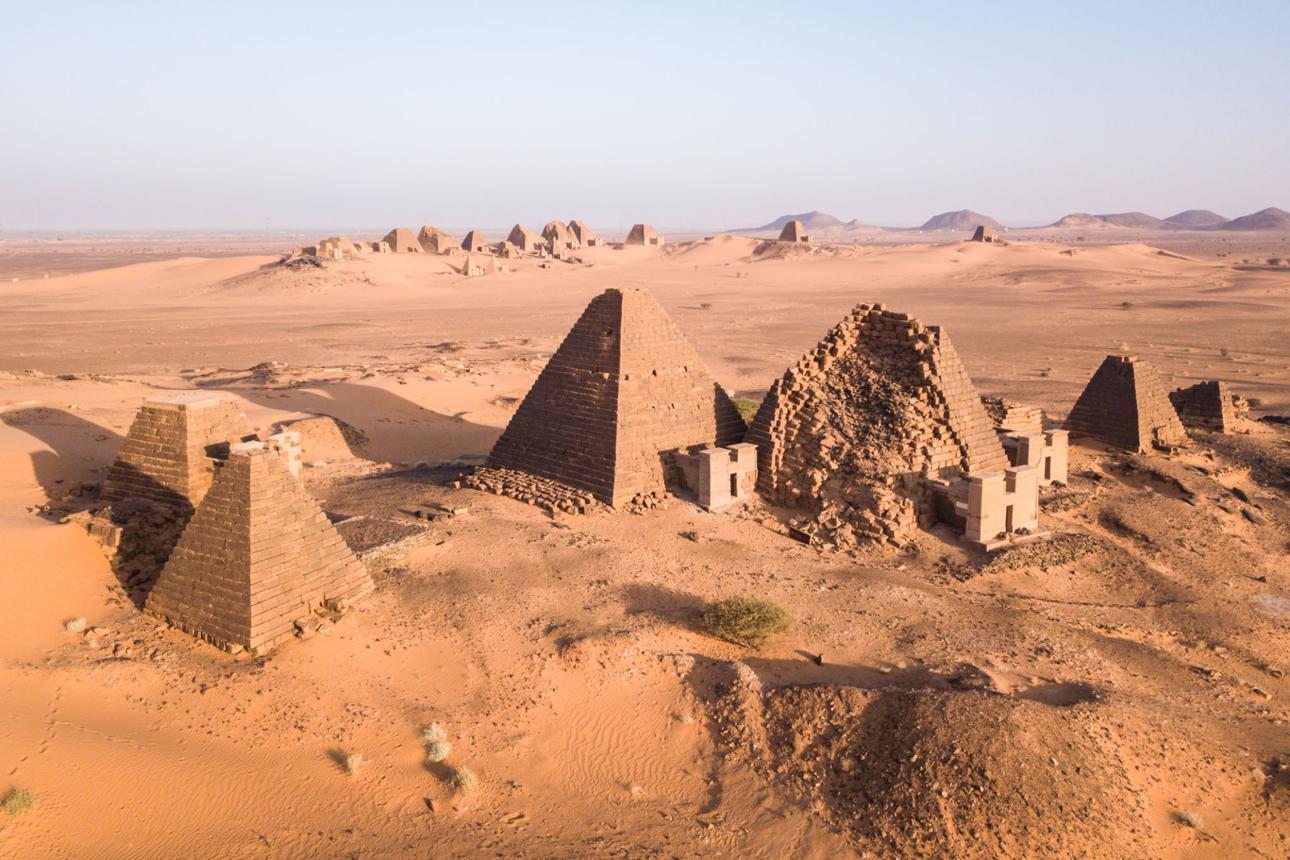
Kush became a major power in northeastern Africa. UNESCO identifies the archaeological sites of Meroe as the heartland of the Kingdom of Kush, which became a major power from approximately the eighth century BCE to the fourth century CE. The archaeological landscape includes royal pyramids, temples, domestic structures, and evidence of sophisticated water management.
Kush was not simply a peripheral society that existed in Egypt’s shadow.
At one point, Kushite rulers conquered Egypt and established the Twenty-Fifth Dynasty. The Kushite kings ruled a territory extending across the Nile Valley, creating a political connection between regions that are today separated by national borders.
The civilization later developed its own distinctive traditions, particularly around Meroe.
The pyramids of Meroe are among the most recognizable remains of Kushite civilization. Although they resemble Egyptian pyramids in broad form, their proportions and architectural characteristics developed within Kushite traditions.
This is an important reminder that cultural exchange does not necessarily mean cultural imitation.
African civilizations borrowed, adapted, transformed, and reinvented ideas according to their own circumstances.
Meroe and the Power of Ironworking
Meroe became particularly important as a center of Kushite political and economic life.
Its location helped connect different regions of northeastern Africa, while its agricultural and technological systems supported a substantial population.
Evidence associated with the Meroitic civilization includes monumental architecture, temples, royal burials, and industrial activity.
Ironworking is especially important in discussions of Meroe, although claims about the scale and exact organization of its iron industry should be treated carefully because archaeological interpretation continues to develop.
What is clear is that Kush possessed substantial technological capabilities and participated in long-distance exchange networks.
The Meroe archaeological landscape also demonstrates something broader about ancient African history: civilizations could develop sophisticated urban and political systems without following the exact path taken by societies elsewhere in the ancient world.
Carthage: Africa’s Mediterranean Power
Farther west, on the coast of present-day Tunisia, another major African civilization emerged.
Carthage was founded by Phoenicians in the ninth century BCE and eventually became a major commercial and political power in the Mediterranean. UNESCO describes Carthage as a major trading empire from the sixth century BCE onward and an important center of Punic civilization.
Carthage is particularly significant because it demonstrates the importance of North Africa in ancient Mediterranean history.
Its location on the Gulf of Tunis gave it access to maritime routes connecting North Africa with other Mediterranean regions.
The city developed sophisticated commercial networks and became involved in competition with Rome.
The most famous chapter of Carthaginian history involves the Punic Wars.
One of its most celebrated figures was Hannibal Barca, the Carthaginian military commander who famously led forces, including war elephants, across the Alps during the Second Punic War.
Carthage was eventually defeated by Rome and destroyed in 146 BCE.
Yet its destruction did not erase its importance.
The archaeological remains demonstrate that the city had been part of a complex Mediterranean world involving commerce, military power, cultural exchange, agriculture, technology, and urban development.
Carthage therefore belongs firmly within the history of ancient Africa as well as the wider history of the Mediterranean.
Nok Culture and Early West African Complexity
Moving into West Africa, archaeological evidence reveals another important story.
The Nok culture, associated with present-day central Nigeria, is particularly well known for its terracotta sculptures and evidence of early ironworking.
Nok communities existed centuries before the rise of some of West Africa’s better-known medieval empires.
Their terracotta figures are especially remarkable. Human heads and figures display distinctive artistic styles, elaborate hairstyles, facial features, and other details that provide clues about the society that produced them.
But Nok should not be presented simply as an isolated “mystery civilization.”
Archaeologists continue to investigate the relationship between Nok settlements, technological development, environmental change, and later societies in the region.
The broader lesson is more important than trying to force Nok into a simplistic category.
West Africa had deep histories of settlement, agriculture, craft production, technological experimentation, and social organization long before European colonialism.
Ancient African Civilizations Were Not Confined to the North
One of the biggest problems in popular discussions of African history is the tendency to divide the continent into “civilized” northern Africa and an allegedly undeveloped sub-Saharan Africa.
Archaeology does not support such a simplistic picture.
Across the continent, researchers have identified evidence of complex societies developing under different environmental and historical conditions.
In West Africa, communities developed agricultural systems, metalworking traditions, settlements, and political institutions.
In eastern Africa, societies participated in Red Sea and Indian Ocean networks.
In central Africa, communities developed their own agricultural, technological, and political traditions.
In southern Africa, later complex societies constructed large settlements and participated in long-distance trade.
Civilization did not have one African birthplace.
It developed through multiple regional histories.
Aksum: A Kingdom at the Crossroads of Continents
In the highlands of present-day northern Ethiopia and Eritrea, the Kingdom of Aksum became one of the most important states of ancient eastern Africa.
Aksum flourished from roughly the first centuries CE and became a major power connecting Africa with Arabia, the Red Sea, and the wider Mediterranean and Near Eastern worlds.
UNESCO describes Aksum as the heart of ancient Ethiopia and notes that the kingdom became a major power between the Eastern Roman Empire and Persia. Its strategic position connected Africa, Arabia, and the Greco-Roman world.
Aksum’s importance was closely connected to trade.
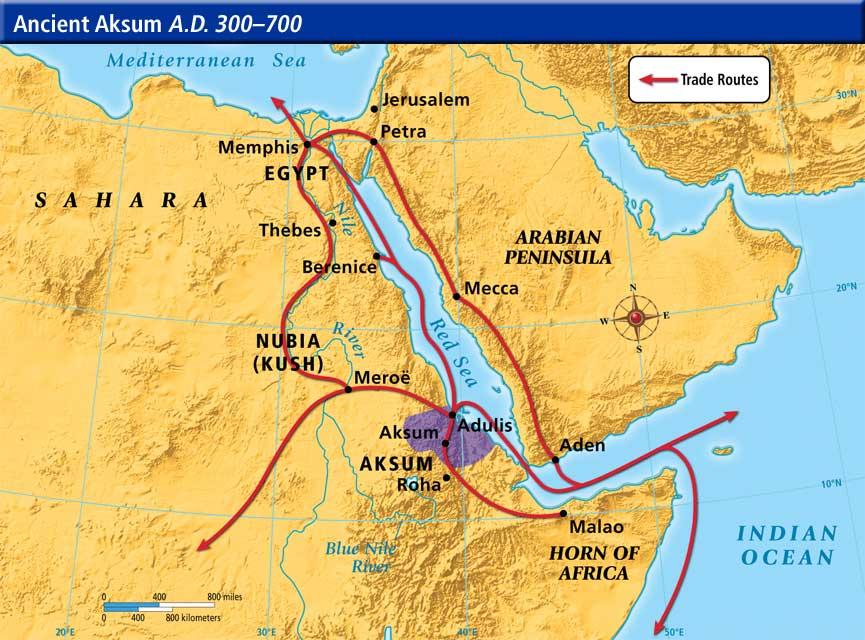
Its rulers controlled or influenced routes linking inland areas with the Red Sea port of Adulis. Goods such as ivory moved through these networks, connecting the African interior with international markets.
The monuments of Aksum remain among the most impressive reminders of this civilization.
Huge stone stelae, royal tombs, palace remains, inscriptions, and other archaeological evidence demonstrate the sophistication of Aksumite society.
Aksum also developed its own writing tradition using Ge’ez.
Inscriptions provide particularly valuable evidence because they allow historians to study aspects of political authority, religion, language, and international connections.
The Importance of Writing and Oral Tradition
When discussing ancient African civilizations, it is tempting to measure historical complexity by the amount of surviving written documentation.
That approach can be misleading.
Written records are extremely valuable, but their survival depends on environmental conditions, political institutions, writing materials, preservation, archaeological discovery, and many other factors.
Some African societies preserved knowledge primarily through oral traditions.
Specialists, elders, religious authorities, praise singers, genealogists, storytellers, and other knowledge holders could transmit historical information across generations.
Oral traditions should not simply be treated as inferior versions of written history.
At the same time, historians must evaluate oral accounts carefully, just as they evaluate written sources.
Archaeology, linguistics, oral history, inscriptions, environmental evidence, architecture, material culture, and written documents can all contribute to reconstructing Africa’s past.
This multidisciplinary approach is particularly important because ancient African history covers enormous geographical and chronological territory.
Trade Connected Ancient African Societies
Trade was one of the major forces shaping ancient African history.
The continent’s geography created opportunities for exchange between regions.
The Sahara could be a formidable barrier, but it was never an absolute wall. Routes crossed it, connecting North Africa with communities farther south.
The Nile connected northeastern Africa.
The Red Sea connected eastern Africa to Arabia.
The Mediterranean linked North Africa with Europe and the Near East.
Later, Indian Ocean networks connected eastern African coastal societies with Arabia, Persia, India, and other regions.
Trade moved more than commodities.
It also moved technologies, artistic influences, religious ideas, languages, political concepts, and cultural practices.
This is why ancient African history cannot be understood simply by studying individual kingdoms in isolation.
A civilization’s development was often influenced by its relationships with neighboring societies and distant trading partners.
Cities, Kingdoms, and Complex Societies
The word “civilization” can sometimes create the impression that ancient societies needed enormous stone monuments to qualify as advanced.
That is not how historians should approach the subject.
Civilization can involve many forms of social complexity.
These include:
- organized political authority;
- permanent or semi-permanent settlements;
- agricultural production;
- specialized crafts;
- trade;
- social institutions;
- religious systems;
- technological knowledge;
- systems for managing resources;
- artistic traditions;
- and mechanisms for transmitting knowledge.
Different societies developed these characteristics in different combinations.
Some created enormous monuments.
Others built settlements using materials that survived poorly.
Some left inscriptions.
Others preserved knowledge primarily through oral traditions.
Some developed centralized states.
Others created decentralized political systems that could still coordinate large communities.
Ancient Africa therefore presents historians with an extraordinary range of political and cultural models.
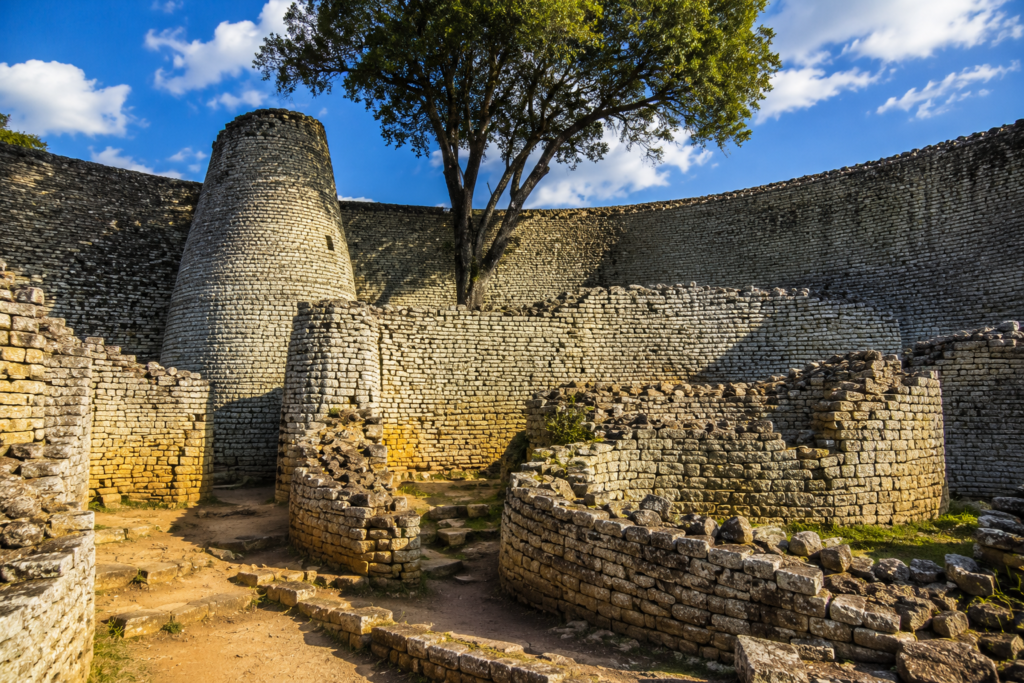
Great Zimbabwe and the African Past Beyond Antiquity
Although Great Zimbabwe belongs primarily to the medieval rather than the earliest ancient period, it is useful when discussing the broader historical misconception that complex African societies appeared only after outside influence.
Located in present-day Zimbabwe, Great Zimbabwe developed between approximately the 11th and 15th centuries CE.
UNESCO describes it as an important center of the Shona civilization and a major trading center. Its monumental stone structures include the Great Enclosure, Hill Ruins, and Valley Ruins.
The site demonstrates the importance of southern African societies in regional and long-distance commerce.
Its inclusion in the wider story is important because Africa’s history did not suddenly become complex in the nineteenth century, nor did sophisticated African societies depend upon European colonial administration to emerge.
Great Zimbabwe represents one part of a much longer sequence of African political, economic, architectural, and cultural development.
What Archaeology Has Changed About African History
For generations, African history was often written through perspectives that placed European exploration and colonialism at the center of the continent’s story.
Modern archaeological research has helped broaden that picture.
Excavations have uncovered settlements, tools, pottery, metalworking sites, burial grounds, monumental structures, inscriptions, agricultural remains, and trade goods.
These discoveries allow researchers to reconstruct aspects of African societies that were not adequately represented in older historical narratives.
UNESCO’s General History of Africa itself represents a major effort to develop a continent-wide historical framework involving hundreds of historians and specialists, with African scholars playing a major role in its development.
This does not mean that every archaeological question has been solved.
Far from it.
There are still enormous gaps in the historical record.
Some sites remain poorly excavated. Some ancient languages remain difficult to interpret. Some oral traditions require careful comparison with archaeological and linguistic evidence. Environmental changes have also destroyed or concealed evidence.
The absence of evidence should therefore not automatically be interpreted as evidence that nothing existed.
Why Africa’s Ancient Civilizations Matter Today
Studying ancient African civilizations is not simply an exercise in looking backward.
The ancient past continues to influence modern Africa.
Modern communities inherit languages, artistic traditions, religious practices, agricultural knowledge, architectural traditions, political memories, oral histories, and cultural identities that developed through long historical processes.
Archaeological sites also contribute to modern debates about heritage preservation.
Who owns ancient artifacts?
Where should archaeological objects be displayed?
How should museums represent civilizations whose descendants still live in the surrounding regions?
How should African countries balance tourism with the protection of fragile archaeological sites?
These questions connect ancient history directly to modern cultural politics.
They also demonstrate why African history should not be treated as an exotic subject separated from contemporary life.
The past remains part of the present.
Beyond the Myth of a “Lost” African Civilization
Another misleading phrase sometimes used in popular culture is the idea of a single “lost African civilization.”
Africa did not have one mysterious civilization that disappeared and left the continent empty.
It had many civilizations and societies, some of which declined, transformed, merged with neighboring societies, migrated, or continued in new political forms.
Civilizations do not always disappear completely when their political structures collapse.
Languages survive.
Religious practices change.
Artistic styles evolve.
Communities move.
Trade routes shift.
Political institutions transform.
New states emerge from older cultural landscapes.
The end of a kingdom is therefore not necessarily the end of its people or its cultural influence.
This perspective allows African history to be understood as a continuous process rather than a series of disconnected rises and falls.
A Continent of Many Histories
Perhaps the most important lesson from Africa’s ancient civilizations is that there was never one single African experience.
The Nile Valley had its own historical trajectory.
Nubia developed its own political traditions.
Carthage became a Mediterranean power.
West African communities developed distinctive agricultural, artistic, and technological traditions.
Aksum connected eastern Africa to international networks.
Southern African societies later created complex centers such as Great Zimbabwe.
Other societies whose names are less familiar today also contributed to the continent’s long history.
Some left magnificent monuments.
Some left artistic traditions.
Some are known through archaeological fragments.
Others are remembered through oral traditions.
Together, they form a much larger picture.
The African Past Was Never Empty
Before European colonial rule, Africa was not a continent waiting to be “discovered.”
It was a continent inhabited by societies with their own histories, ambitions, conflicts, technologies, economies, spiritual systems, artistic traditions, and intellectual traditions.
Ancient Egypt built one of the world’s most enduring civilizations along the Nile.
Kush developed powerful states farther south and left the remarkable archaeological landscape of Meroe.
Carthage became a major Mediterranean trading power.
Nok communities produced distinctive terracotta art and participated in early technological developments in West Africa.
Aksum became a major power linking Africa with Arabia and the wider ancient world.
And centuries later, Great Zimbabwe demonstrated the architectural and commercial achievements of southern African societies.
These histories did not exist in isolation.
They were shaped by migration, environmental change, commerce, warfare, diplomacy, technology, religion, and cultural exchange.
Understanding them therefore requires moving beyond the idea that African history begins with European contact.
It begins much earlier.
And it is much bigger.
The civilizations of ancient Africa were not footnotes to somebody else’s history. They were part of the development of human societies across the continent and beyond.
Their monuments, artifacts, languages, traditions, archaeological sites, and historical memories continue to provide evidence of that remarkable past.
