


The Fabric Everyone Claims and No One Fully Owns
Walk into almost any African fashion market — from Lagos’s Balogun Market to Nairobi’s textile stalls to Johannesburg’s boutiques — and you will encounter Ankara: bold, wax-printed cotton fabric bursting with saturated colors and dramatic geometric or pictorial patterns. It drapes market women’s wrappers, tailors’ bespoke suits, wedding aso-ebi (coordinated group attire), and increasingly, international runway collections. Ask most people across West Africa what Ankara is, and they will confidently call it African. Yet Ankara’s actual history is a remarkable, complicated story of global trade, colonial commerce, Indonesian batik technique, Dutch industrial manufacturing, and African creative reappropriation — a story that complicates simple notions of “authentic” tradition while simultaneously demonstrating something equally important: that African identity and creativity can transform even an imported commodity into an unmistakably African cultural expression.
This article traces Ankara’s surprising origins, its technical production, its explosive popularity across the continent, its deep integration into contemporary social and ceremonial life, and its ongoing evolution as African designers increasingly reclaim, reinterpret, and even manufacture the fabric on their own terms — situating Ankara as perhaps the most vivid case study in how African fashion has evolved from imported curiosity to global cultural force.
An Unexpected Origin Story: From Java to West Africa
Ankara’s story begins not in Africa but in nineteenth-century Indonesia, specifically with the intricate wax-resist dyeing tradition known as batik, a sophisticated Javanese craft involving the application of hot wax to cloth in detailed patterns before dyeing, with the waxed areas resisting the dye to create pattern through contrast — a technique conceptually related to, though technically distinct from, the resist-dye principles seen in Adire, explored in the previous article in this series.
During the colonial period, Dutch traders and colonial administrators, operating within the Dutch East Indies (present-day Indonesia), became familiar with batik cloth and recognized its commercial potential. European manufacturers, particularly in the Netherlands, developed mechanized processes attempting to replicate batik’s visual effect at industrial scale and lower cost, using wax-resin resist printing techniques applied via rollers and, later, more advanced printing technology, producing cloth intended initially for sale back into the Indonesian market.
However, the machine-printed cloth, while visually similar to hand-drawn batik, contained telltale “crackle” effects and irregularities resulting from the industrial wax-resist process — imperfections that Indonesian consumers, accustomed to the precision of genuine hand-drawn batik, largely rejected as inferior imitation. Facing limited success in the originally intended Southeast Asian market, Dutch trading companies, along with British and other European commercial interests operating along West African coastal trade routes, began marketing this wax-print cloth to West African consumers during the nineteenth and early twentieth centuries.
West African traders and consumers, notably including West African women traders who became crucial intermediaries in the cloth’s distribution and marketing, responded to the fabric enthusiastically, appreciating its bold colors, durability, and the very “imperfections” that had limited its success in Indonesia, incorporating it into local dress traditions and gradually establishing it as a distinctly West African commodity, despite its Indonesian technical origins and European industrial manufacturing.
 Establishing an African Identity: Vlisco and the Rise of Wax Print Culture
Among the most historically significant manufacturers in this story is Vlisco, a Dutch textile company founded in the mid-nineteenth century that became deeply intertwined with West African wax print culture over subsequent generations. Vlisco and similar manufacturers developed close, sustained commercial relationships with West African markets, working with local traders — again, predominantly women, echoing the female-centered trade networks discussed in relation to Adire — who not only sold the cloth but actively shaped design preferences, communicating back to European manufacturers which patterns, colors, and motifs resonated with West African consumers and cultural contexts.
This feedback loop proved crucial to wax print’s African integration. Patterns increasingly incorporated motifs, proverbs, and visual references specifically resonant with West African cultural contexts, and specific patterns began acquiring local names, proverbial associations, and social meanings remarkably similar in structure to the named-pattern traditions seen in Kente and Adire, despite Ankara’s entirely different technical and geographic origins. Certain patterns became associated with specific proverbs, social messages, or even, in some documented cases, communicated between women particular social commentary — a pattern nicknamed to reference a saying about rivalry between co-wives, for example, or another named for its association with a specific celebrity, political event, or popular saying, illustrating how thoroughly West African consumers and traders had absorbed and reshaped this imported commodity into a locally meaningful visual language, much as described in the opening article on the broader language of African dress.
Over the twentieth century, wax print cloth became so thoroughly integrated into West African, and subsequently broader African, dress culture that many consumers — and indeed, much of the general public across the continent and internationally — came to regard it as an authentically indigenous African textile, a perception that persists widely today despite the historically documented Indonesian-Dutch industrial origins. This apparent contradiction is, in fact, central to Ankara’s cultural significance: it demonstrates a broader pattern in African cultural history of transformative reappropriation, wherein imported goods, technologies, or influences are absorbed, reshaped, and imbued with entirely new local meaning until they become inseparable from local identity — a process visible across many domains of African cultural and material history beyond textiles alone.
What Makes Ankara “Ankara”: Naming and Terminology
The name “Ankara” itself carries an interesting linguistic history, with the term becoming particularly widely used in Nigeria specifically, though the broader wax-print cloth family carries other regional names across the continent, including “Dutch wax,” “Hollandais,” “java print,” and various local terms in different countries and languages. The specific etymology of “Ankara” as applied to this fabric remains somewhat debated among researchers, though the name’s widespread adoption within Nigeria and its subsequent international popularization has made it, for many contemporary consumers, particularly younger generations and international audiences, the default term for this broader category of African wax-print cotton fabric.
Technically, genuine “Dutch wax” or high-grade wax-print cloth involves a more sophisticated and expensive production process than lower-cost imitation “fancy prints,” which use simpler printing techniques without the wax-resist process, resulting in a fabric that shows pattern clearly on only one side (the printed side) rather than penetrating through to both sides of the cloth, as genuine wax-resist processes achieve. This distinction between “real wax” and “fancy print” carries commercial and, for some, cultural significance, similar to the authenticity concerns discussed regarding handwoven Kente versus machine-printed imitations, and hand-dyed Adire versus mass-manufactured imitation prints.
 Ankara in Everyday and Ceremonial Nigerian Life
Regardless of its complex origins, Ankara’s social integration into contemporary Nigerian and broader West African life is total and unmistakable. It appears across the full spectrum of social contexts: casual everyday wear tailored into simple, comfortable garments; formal office attire cut into professional silhouettes; and, perhaps most prominently, ceremonial and celebratory dress, particularly in the distinctly West African tradition of aso-ebi — coordinated group attire worn by family members, close friends, and community members at weddings, funerals, chieftaincy events, and other significant social occasions.
Aso-ebi culture, deeply significant within Nigerian and broader West African social life, typically involves a specific Ankara pattern (or, at times, other coordinated fabric) being selected for a particular event, with attendees purchasing and tailoring the same fabric into individually styled garments, creating a visually unified group presence that simultaneously signals communal solidarity, celebrates the honoree, and, often, serves as a marker of social and economic participation within one’s community network. The economic dimensions of aso-ebi culture are significant, generating substantial demand for Ankara fabric and supporting extensive networks of fabric traders, tailors, and designers throughout the region.
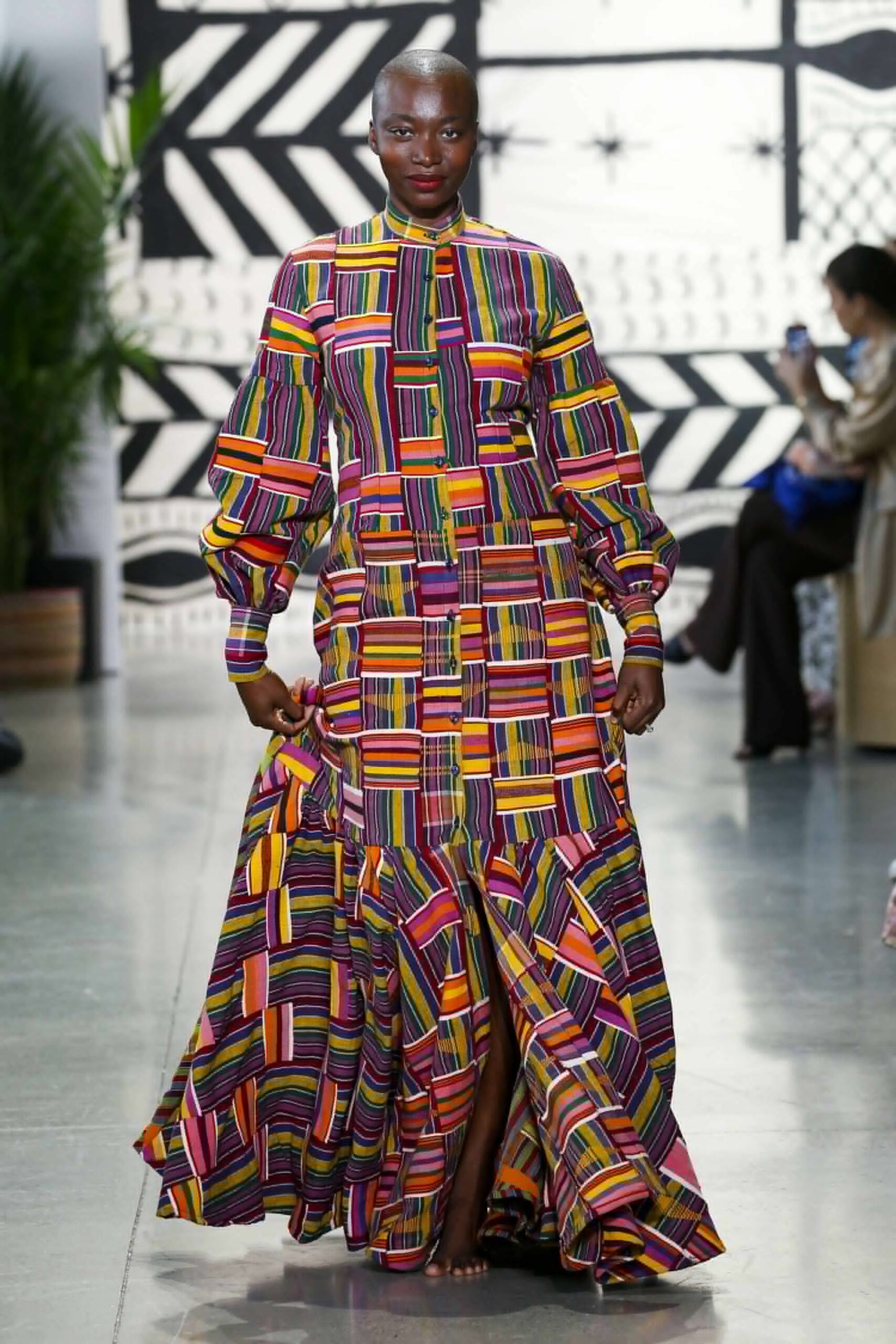
Beyond aso-ebi, Ankara features prominently in national and cultural celebrations, religious festival attire, and increasingly, in professional and even bridal fashion, with contemporary Nigerian designers producing sophisticated Ankara-based formal wear, including elaborate wedding gowns, tailored suits, and evening wear that blend the fabric’s bold visual identity with contemporary global fashion silhouettes and construction techniques.
The Rise of the Nigerian and West African Tailor
Central to Ankara’s cultural integration is the enduring, highly skilled tradition of bespoke tailoring across Nigeria and West Africa more broadly. Unlike much of the ready-to-wear-dominated fashion culture common in many Western contexts, Ankara fashion has historically, and continues today, to rely heavily on skilled local tailors who take individual measurements and construct custom garments to a client’s specific preferences, whether replicating a design from a fashion magazine, a photograph, or the tailor’s own creative interpretation.
This bespoke tailoring tradition supports enormous creative diversity in how Ankara fabric is styled, cut, and constructed, resulting in an endlessly varied visual landscape of Ankara fashion even when many individuals are wearing fabric from the same limited range of popular patterns. Skilled tailors are often held in high esteem within their communities, and reputation for quality, precision, and creative styling can support substantial and respected local businesses — a craft-based economic model echoing, in structure if not in specific technique, the artisan reputation systems discussed in relation to Kente weavers and Adire dyers.
Ankara’s Global Fashion Moment
Beginning notably in the 2000s and accelerating significantly through the 2010s and beyond, Ankara experienced a dramatic expansion in international visibility, moving well beyond its traditional West African markets into global fashion consciousness. International designers, both of African descent and otherwise, began incorporating Ankara and Ankara-inspired prints into international runway collections, and African diaspora communities worldwide embraced the fabric as an expression of heritage pride, similar in spirit to the diaspora Kente adoption discussed previously, though Ankara’s specific colonial-industrial origin story adds additional layers of complexity to conversations about authenticity and appropriation in its global reception.
This international attention brought both opportunity and controversy. On one hand, it significantly expanded economic opportunities for African designers, tailors, and fabric traders, and elevated global recognition of African fashion creativity and aesthetic sensibility. On the other hand, it generated substantial debate — sometimes quite pointed — regarding cultural appropriation, given documented instances of major international fashion houses and designers incorporating Ankara-style prints into collections without appropriate acknowledgment, collaboration, or compensation directed toward African designers, manufacturers, or the broader cultural and economic ecosystems from which the fabric’s contemporary significance derives, even accounting for its complicated non-African technical origins.
These controversies have prompted increasingly vocal advocacy from African designers and cultural commentators for greater recognition, collaboration, and equitable economic participation in Ankara’s global commercial success, alongside growing efforts to expand African-owned textile manufacturing capacity, historically dominated by non-African companies like Vlisco, so that a greater share of the economic value generated by the fabric’s global popularity flows back to African-owned businesses and communities.
Contemporary African Ownership and Innovation
In recent years, a notable and significant trend has emerged: increased African-owned textile manufacturing and design innovation directly engaging with, and in some cases directly competing with, the historically dominant European wax-print manufacturers. African entrepreneurs and established textile companies across several countries have expanded local wax-print and related fabric production capacity, aiming to capture a greater share of the substantial economic value generated by African fashion’s global popularity, while African fashion designers increasingly experiment with Ankara in innovative ways — combining it with other traditional African textiles discussed throughout this series, incorporating it into contemporary streetwear and avant-garde fashion silhouettes, and using the fabric as a canvas for explicitly contemporary artistic and political statements addressing themes ranging from identity and pan-Africanism to environmental and social commentary.
This contemporary innovation phase represents, in many respects, a natural continuation of the pattern-naming, social-commentary tradition already well-established within wax-print culture historically, now extended into explicitly contemporary fashion design contexts, gallery exhibitions, and international fashion week presentations that position African designers not as recipients of external fashion trends but as active, innovative contributors shaping global fashion conversation on their own terms.
Conclusion: Ownership Through Transformation
Ankara’s remarkable journey — from Javanese batik technique, through Dutch industrial reproduction, into deep West African cultural and economic integration, and finally onto global runways — offers perhaps the most instructive case study within this series regarding the fluid, dynamic, and often surprising nature of cultural authenticity and identity. Rather than diminishing Ankara’s significance as African dress, its complicated origin story arguably illuminates something equally important about African cultural resilience and creativity: the capacity to take an imported commodity and, through generations of active reinterpretation, naming, styling, ceremonial integration, and creative reappropriation, transform it into an unmistakable, deeply meaningful marker of African identity, celebration, and contemporary creative expression.
As this series continues to explore traditions rooted in ancient legend, colonial resistance, pastoral identity, and desert survival, Ankara stands as a reminder that African fashion’s story is not solely one of preserving unbroken ancient tradition, but equally one of continuous, confident transformation — absorbing global influence and rendering it thoroughly, unmistakably African.
