


There is a well-known proverb shared, in various forms, across many African cultures:
“However far a stream flows, it does not forget its source.”
Few statements capture more precisely the central tension explored in this article — the relationship between Africa’s deep artistic traditions and the sweeping, often disorienting forces of modernity that have reshaped how that art is made, valued, sold, displayed, and understood over the past century and a half. Colonialism, Christian and Islamic missionary activity, urbanization, global art markets, formal art education, and, more recently, digital technology have all pressed against the continent’s artistic traditions — sometimes disrupting them violently, sometimes transforming them into unexpected new forms, and sometimes simply running alongside them, largely unacknowledged by the wider world.
This piece traces that complicated, ongoing encounter — from the colonial-era looting and misclassification of African art as mere “curiosity” or “primitive artifact,” through the emergence of modern African art movements and towering individual artists who reshaped global perceptions, to the contemporary reality of African art fairs, auction houses, diaspora influence, and the still-unresolved questions of ownership, value, and voice that continue to define the field today.
Colonial Contact and the Reclassification of African Art
Before sustained European colonial contact, African sculptural, textile, and decorative traditions were understood within their own societies not as “art” in the narrow, Western aesthetic sense that would later be applied to them, but as integrated components of religious practice, political authority, social organization, and daily life. A Yoruba ibeji twin figure, a Dogon ancestral sculpture, or a Benin bronze plaque was never created to be admired in isolation on a pedestal; it was created to function — to house spiritual presence, to communicate political legitimacy, to participate actively in ritual and social life.
European colonial contact, beginning in earnest from the late fifteenth century and intensifying dramatically during the “Scramble for Africa” in the late nineteenth century, brought a profound reclassification of these objects. Colonial administrators, missionaries, soldiers, and early anthropologists frequently viewed African sculptural and decorative traditions through a deeply distorted lens shaped by prevailing European racial theories of the era — theories that generally placed African societies at the bottom of a supposed hierarchy of civilization. African art objects were consequently often labeled “primitive,” “fetish,” or “curio” — terminology that stripped these objects of their original spiritual and social significance and reframed them as either evidence of supposed cultural inferiority or, paradoxically, as exotic decorative curiosities suitable for European drawing rooms and early ethnographic museum displays.
This period also saw the mass removal of African art objects from the continent, frequently through outright looting during colonial military campaigns — the 1897 British punitive expedition against Benin City, resulting in the seizure of thousands of bronze and ivory objects now scattered across museums and private collections worldwide, remains the most widely cited and continually contested example, though far from the only one. Countless other objects were acquired through deeply unequal trade relationships, coercive colonial administrative pressure, or straightforward theft, entering European and American museum and private collections where they would remain for well over a century, largely divorced from the communities and contexts that gave them original meaning.
The Paradox of European “Discovery”
In one of art history’s more uncomfortable ironies, it was precisely during this period of colonial disruption and looting that African art began to profoundly influence the trajectory of European modern art. In the early twentieth century, artists including Pablo Picasso, Henri Matisse, and other figures central to the emergence of Cubism and related modernist movements encountered African sculpture — much of it looted or extracted through the colonial trade described above — in Parisian ethnographic museums, curio shops, and private collections. These artists were struck by the formal boldness of African sculptural traditions — the abstraction, the stylized proportion, the departure from strict naturalistic representation that had dominated European academic art for centuries.
Picasso’s 1907 painting Les Demoiselles d’Avignon, widely regarded as a foundational work of modernist art history, drew directly and explicitly on African mask forms the artist had encountered, particularly from Central African traditions. This moment is frequently celebrated within conventional Western art historical narratives as a pivotal turning point in the birth of modernism — yet it is rarely discussed with equal weight that the African objects providing this inspiration were, in the vast majority of documented cases, acquired through colonial extraction, displayed without any attribution to the specific cultures, communities, or individual artists who created them, and virtually never accompanied by any form of compensation or acknowledgment flowing back to their originating communities. European modernism, in a very real sense, was partly built on the uncredited creative labour of African artists whose names, in almost every documented instance, were never even recorded by the colonial collectors who removed their work.
Missionary Impact and the Disruption of Traditional Practice
Alongside colonial administration, Christian and, in certain regions, Islamic missionary activity exerted significant pressure on traditional African artistic practice, particularly where art was closely bound to religious and spiritual function. Missionaries frequently viewed masks, ancestral figures, and shrine objects as instruments of what they characterized as “idol worship” or “paganism,” actively encouraging — and in some documented cases, enforcing through considerable social and economic pressure — the destruction, abandonment, or sale of traditional ritual objects by converted communities.
This missionary pressure had a genuinely disruptive effect on the transmission of certain artistic traditions in specific regions, particularly those most closely tied to indigenous religious practice rather than purely secular decorative or utilitarian function. Communities that abandoned or concealed traditional religious practice under missionary and colonial pressure often saw associated artistic knowledge — the specific carving techniques for a particular mask type, the ceremonial protocols surrounding its creation and use — gradually fade from active practice, surviving in some cases only in fragmentary oral memory or in the physical objects that had, ironically, already been removed to distant museum collections, preserved materially even as the living knowledge required to understand and recreate them diminished at home.
Formal Art Education and the Rise of Modern African Art Movements
Paradoxically, the colonial and early post-colonial period also gave rise to formal art education initiatives that would help launch some of Africa’s most significant modern art movements, often through institutions established by colonial or missionary authorities but subsequently reclaimed and redirected by African artists and educators toward distinctly African artistic and political purposes.
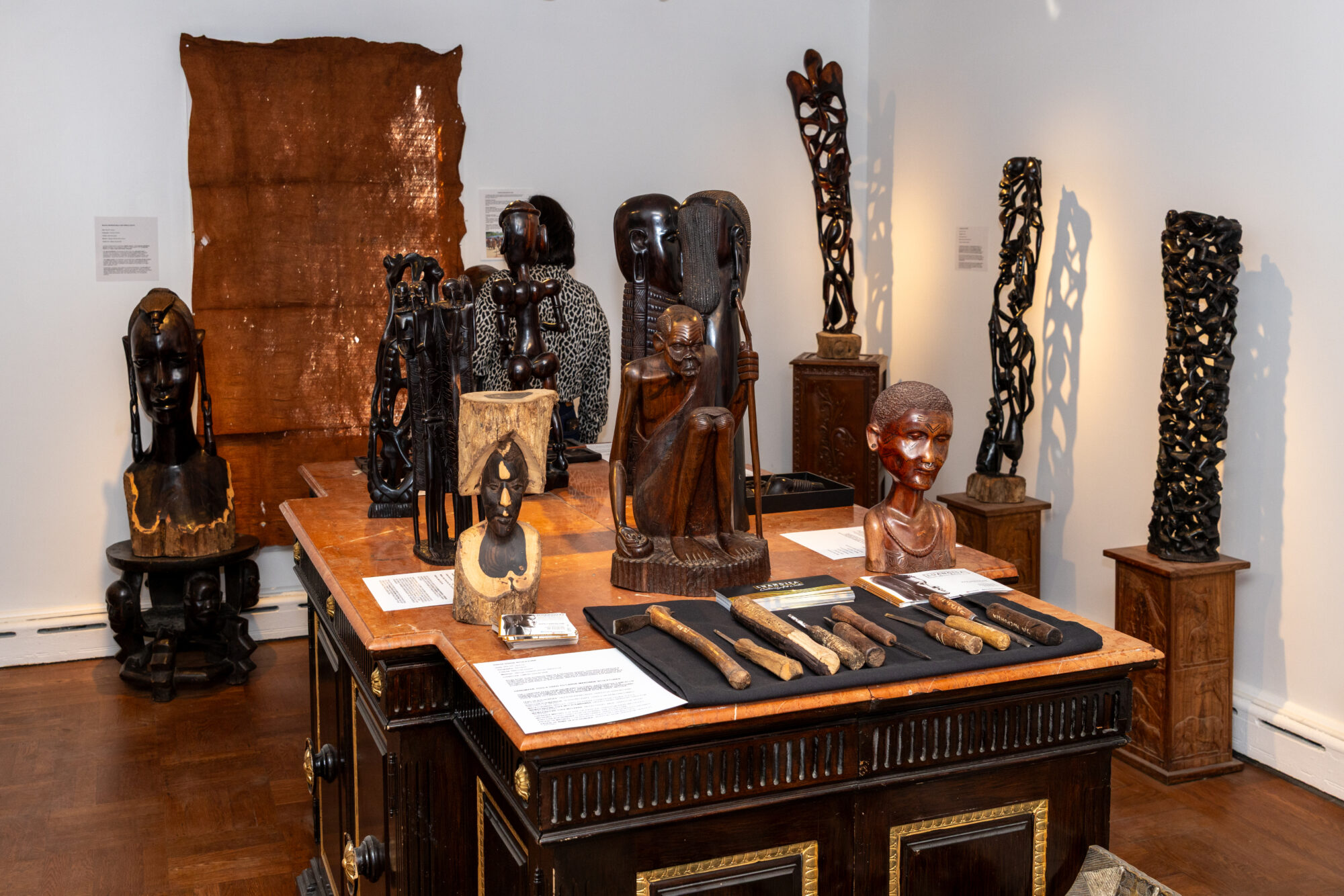 In Nigeria, the Zaria Art Society, formed in the late 1950s by a group of art students at the Nigerian College of Arts, Science, and Technology — including figures who would become towering names in modern African art, such as Uche Okeke, Demas Nwoko, and Bruce Onobrakpeya — rejected the purely Western academic curriculum imposed by their British colonial-era instructors, instead developing what they termed “Natural Synthesis,” a deliberate artistic philosophy calling for the fusion of traditional Nigerian artistic idioms — Uli linear design from Igbo tradition, Yoruba narrative imagery, and other indigenous visual languages — with modern materials, techniques, and formal training. This movement directly anticipated Nigeria’s political independence in 1960, functioning as both artistic and nationalist statement, an assertion that African artists could claim modern artistic training while refusing to simply mimic European models.
Similarly, the Nsukka group, associated with the University of Nigeria, Nsukka, and closely linked to the later work of internationally celebrated artist El Anatsui (though Ghanaian by birth, closely associated with this Nigerian institution for decades), developed further explorations of Uli-derived abstraction, cementing Nsukka’s place as one of the most significant sites of modern African art education and innovation.
Across the continent, similar dynamics played out in different national contexts — the Négritude cultural and literary movement, articulated by figures including Léopold Sédar Senghor of Senegal and Aimé Césaire of Martinique, provided intellectual and philosophical scaffolding for a broader affirmation of African cultural and artistic dignity, directly informing visual artists seeking to reclaim African aesthetic traditions from colonial-era denigration and reposition them as sophisticated, valuable, and thoroughly modern.
Towering Figures of Modern and Contemporary African Art
Modern and contemporary African art has produced numerous internationally celebrated figures whose work continues to reshape global understanding of African artistic achievement. Ben Enwonwu of Nigeria, active from the mid-twentieth century onward, became one of the first African artists to achieve significant recognition within elite Western art institutions, his sculptural and painted work blending Yoruba and Igbo artistic sensibility with formal European training, including a notable royal portrait commission of Britain’s Queen Elizabeth II — a striking symbolic inversion of the colonial power dynamic that had shaped so much of the continent’s earlier art historical relationship with Europe.
El Anatsui, working from his base in Nsukka, Nigeria, has achieved extraordinary international acclaim for large-scale sculptural installations constructed from thousands of flattened bottle caps and other discarded metal fragments, woven together into shimmering, textile-like wall hangings that simultaneously evoke traditional Ghanaian kente cloth patterning and offer pointed commentary on consumption, waste, and the historical legacy of the transatlantic trade in goods including alcohol. His work now commands significant prices at major international auction houses and has been exhibited at the most prestigious global institutions, including the Venice Biennale.
Yinka Shonibare, a British-Nigerian artist, has built a celebrated career interrogating colonial history, identity, and cultural hybridity through sculptural and installation work frequently incorporating vividly patterned “Dutch wax” batik fabric — itself a materially complicated symbol, originally manufactured in the Netherlands in imitation of Indonesian batik techniques, then marketed and adopted widely across West Africa, where it eventually became closely associated with “authentic” African textile identity despite its complicated, transcontinental colonial-era origin.
Sokari Douglas Camp, a Nigerian-British sculptor working primarily in welded steel, has produced significant work addressing themes including the environmental and social impact of oil extraction in the Niger Delta, demonstrating how contemporary African artists continue to use their platforms to address pressing political and environmental issues facing the continent today, extending the tradition of art as social commentary that has deep roots in indigenous African artistic practice.
The Global Art Market and African Art Fairs
Over the past two decades, the global commercial art market’s engagement with African art — both historical and contemporary — has expanded dramatically. Major international art fairs dedicated specifically to African and African diaspora art, most notably 1-54 Contemporary African Art Fair, founded in London in 2013 and subsequently expanded to additional cities including New York and Marrakech, have created significant new platforms for contemporary African artists to reach international collectors, curators, and museums.
On the continent itself, the Dakar Biennale (Dak’Art), established in Senegal in 1992, has become one of Africa’s most significant contemporary art events, drawing artists, curators, and collectors from across Africa and the wider world, while deliberately centring African curatorial perspectives and priorities rather than positioning African art as a peripheral category within a Western-dominated global art discourse.
Major international auction houses, including Sotheby’s and Christie’s, have established dedicated African art departments and sale categories, and contemporary African artists — El Anatsui prominent among them — now regularly achieve auction prices in the hundreds of thousands to millions of dollars, a dramatic shift from earlier eras when African art was frequently undervalued or categorized primarily within “ethnographic” or “tribal art” sale categories that implicitly positioned it outside the category of “fine art” proper, a distinction increasingly, and rightly, challenged by contemporary curators, scholars, and artists alike.
Tourism, the “Airport Art” Economy, and Questions of Authenticity
Alongside the high end of the contemporary art market, a vast, economically significant informal market for African art and craft objects has developed around tourism, sometimes referred to, not always generously, as “airport art” or “tourist art” — mass-produced or semi-mass-produced sculptural, textile, and decorative objects created explicitly for sale to foreign visitors, often in styles referencing but not strictly replicating specific traditional forms.
 This market provides genuine, significant economic livelihood for large numbers of craftspeople across the continent, particularly in urban centres and popular tourist destinations. It has also generated ongoing debate among scholars, cultural custodians, and artists themselves regarding questions of authenticity, artistic integrity, and the relationship between commercially oriented production and the deeper spiritual and cultural functions traditional art forms historically served. Some scholars caution against overly rigid distinctions between “authentic” traditional art and “inauthentic” tourist art, noting that African artistic traditions have always evolved in response to changing economic and social circumstances, and that contemporary craftspeople producing work for tourist markets are engaged in a legitimate, evolving continuation of much older traditions of art produced for trade and exchange with outside communities.
Digital Technology and the Newest Frontier
The most recent chapter in African art’s encounter with global modernity involves digital technology — including social media platforms that have allowed contemporary African artists unprecedented direct access to international audiences without reliance on traditional gallery gatekeeping structures, digital photography and documentation projects working to catalogue and preserve historical art objects and traditional craft techniques, and, more recently, experimentation with blockchain-based digital art markets, including non-fungible token (NFT) platforms, which some African digital artists have used to reach new international collector bases and retain greater direct control over sales and royalties than traditional gallery and auction structures have historically afforded.
This digital dimension has also opened new possibilities for diaspora engagement, allowing African artists on the continent to collaborate directly with diaspora curators, collectors, and fellow artists across considerable geographic distance, and enabling younger generations within the African diaspora — often several generations removed from direct connection to specific ancestral artistic traditions — to research, engage with, and draw creative inspiration from historical and contemporary African art in ways simply not accessible to earlier generations.
Repatriation Debates and the Question of Return
No discussion of African art’s encounter with modernity is complete without addressing the increasingly prominent international debate over repatriation — the question of whether, and how, art objects removed from Africa during the colonial period, frequently through documented looting or profoundly unequal circumstances, should be returned to their countries and communities of origin. This debate gained substantial momentum following a landmark 2018 report commissioned by French President Emmanuel Macron and authored by scholars Felwine Sarr and Bénédicte Savoy, which recommended the systematic restitution of African cultural objects held in French public collections that had been acquired without the consent of their original owners.
Since that report, several European nations and individual museums have begun, cautiously and unevenly, to return specific objects — Germany’s return of a number of Benin bronzes to Nigeria, France’s return of royal treasures to Benin (the modern republic, distinct from the historical Benin Kingdom located in present-day Nigeria), and various smaller-scale returns by individual institutions and private collectors. These developments remain contested and incomplete; the vast majority of African art objects removed during the colonial era remain in European and American collections, and debates continue regarding the legal, logistical, and ethical frameworks that should govern future restitution efforts, including difficult questions about which specific communities, governments, or institutions within Africa should serve as the appropriate recipients of returned objects, and how looted objects should be documented, cared for, and displayed once returned.
These repatriation debates carry significance well beyond the specific objects involved. They represent a broader reckoning with the colonial-era power dynamics that shaped, and continue to shape, global understanding and valuation of African art — a slow, still-unfinished process of shifting authority over African cultural heritage back toward African hands, institutions, and interpretive frameworks, rather than leaving that authority concentrated within the same Western museums and collections that benefited from the original colonial-era extraction.
African Museums and the Growth of Continental Cultural Infrastructure
Alongside international repatriation debates, African nations have increasingly invested in developing their own world-class museum and cultural infrastructure, creating institutions capable of housing, researching, and displaying both returned historical objects and contemporary African art on the continent itself, rather than requiring African and international audiences to travel to Europe or North America to encounter major collections of African artistic heritage.
Notable examples include the Museum of Black Civilizations in Dakar, Senegal, opened in 2018 with an explicit mission to showcase African and African diaspora art and cultural history from an African curatorial perspective; the Zeitz Museum of Contemporary Art Africa (Zeitz MOCAA) in Cape Town, South Africa, opened in 2017 within a dramatically repurposed former grain silo and now recognized as one of the world’s most significant contemporary art museums; and Nigeria’s long-anticipated Edo Museum of West African Art, planned for Benin City with the explicit goal of providing an appropriate, world-class home for returned Benin bronzes and related historical artifacts.
These institutions represent more than simple exhibition space — they signal a broader continental ambition to reclaim narrative and curatorial authority over African art history, training a new generation of African art historians, curators, and conservators, and creating cultural and economic infrastructure capable of supporting sustained artistic production, scholarship, and public engagement with African art on African soil, for African audiences first, rather than treating the continent primarily as a source of raw artistic material to be exported, studied, and displayed elsewhere.
The relationship between African art and the forces of global modernity has never been a simple story of destruction or straightforward preservation — it is a far more complicated, ongoing negotiation, marked by genuine loss and disruption alongside remarkable adaptation, innovation, and, increasingly, a reclaiming of narrative control by African artists, curators, and institutions themselves. From the colonial-era looting that stripped countless objects of their original context and meaning, through the formal art education movements that reasserted African artistic identity on Africa’s own terms, to the contemporary global market finally beginning to value African art according to its genuine artistic significance rather than reductive ethnographic categorization, the story continues to unfold.
As the proverb reminds us, however far the stream has travelled — through colonial disruption, missionary pressure, global market forces, and now digital transformation — it has not forgotten its source. Contemporary African artists, whether working with traditional carving techniques, welded steel, discarded bottle caps, or digital code, continue to draw, consciously and unconsciously, on the deep well of artistic knowledge, symbolism, and creative philosophy explored throughout this series, carrying it forward into forms their ancestors could never have imagined, yet would very likely still recognize as unmistakably, authentically their own.
