


The Cloth Born of Resistance and Dye
In the bustling markets of Abeokuta and Ibadan in southwestern Nigeria, bolts of deep blue cloth patterned with intricate white motifs have been bought, sold, worn, and treasured for generations. This is Adire — a Yoruba word that translates literally to “tie and dye,” a name that describes its foundational technique but barely hints at the depth of artistry, symbolism, and social history woven into every piece. Adire is not simply a fabric; it is a centuries-old craft tradition developed and sustained predominantly by Yoruba women, whose skill in manipulating indigo dye and resist techniques transformed plain cotton into wearable art carrying proverbs, spiritual meaning, and social commentary.
Unlike Kente’s association with male royal weavers, Adire’s history is inseparable from female entrepreneurship, artistic innovation, and, in various periods, quiet acts of economic and cultural resilience in the face of colonial disruption and shifting textile markets. This article explores Adire’s origins, its production techniques, the symbolic universe encoded in its patterns, its social and economic role among Yoruba women, and its ongoing evolution in contemporary Nigerian and global fashion.
Origins and Historical Development
Indigo dyeing traditions run deep across West Africa, and the Yoruba people’s specific engagement with the craft appears to stretch back many centuries, drawing on locally cultivated indigo plants (primarily Lonchocarpus cyanescens, known locally as elu) that thrive in the region’s climate. While the precise origins of Adire as a distinct named tradition are difficult to date with certainty due to the primarily oral and craft-based transmission of the technique, historical and anthropological research places significant developments in Adire production in towns such as Abeokuta, Ibadan, and Oshogbo from at least the nineteenth century onward, with the craft expanding significantly in the early twentieth century.
Abeokuta, in particular, became closely associated with Adire production and remains, to this day, one of the most significant centers of the craft, sometimes referred to informally as an “Adire capital.” The town’s association with the trade grew alongside broader regional trade networks, and Adire cloth became an important commodity not only for local wear but for trade across Yoruba territories and beyond, carried along established West African trade routes.
The craft’s development is closely tied to women’s economic activity. Traditionally, Adire production — from dye preparation through pattern application to the final dyeing process — was predominantly the domain of Yoruba women, who developed and passed down techniques through informal apprenticeship, often within family lines or through structured guild-like associations of dyers. This female-centered production model gave Adire a distinct social character: it functioned not only as a craft but as a significant source of female economic independence and status within Yoruba society, at a time and in contexts where women’s formal economic opportunities were often constrained.
The Two Core Techniques: Eleko and Oniko
Traditional Adire production encompasses several distinct techniques, each producing characteristically different visual effects, though all rely on the fundamental principle of resist-dyeing: applying a substance to cloth that prevents dye from penetrating specific areas, thereby creating pattern through contrast between dyed and undyed (or less-dyed) regions once the resist material is removed.
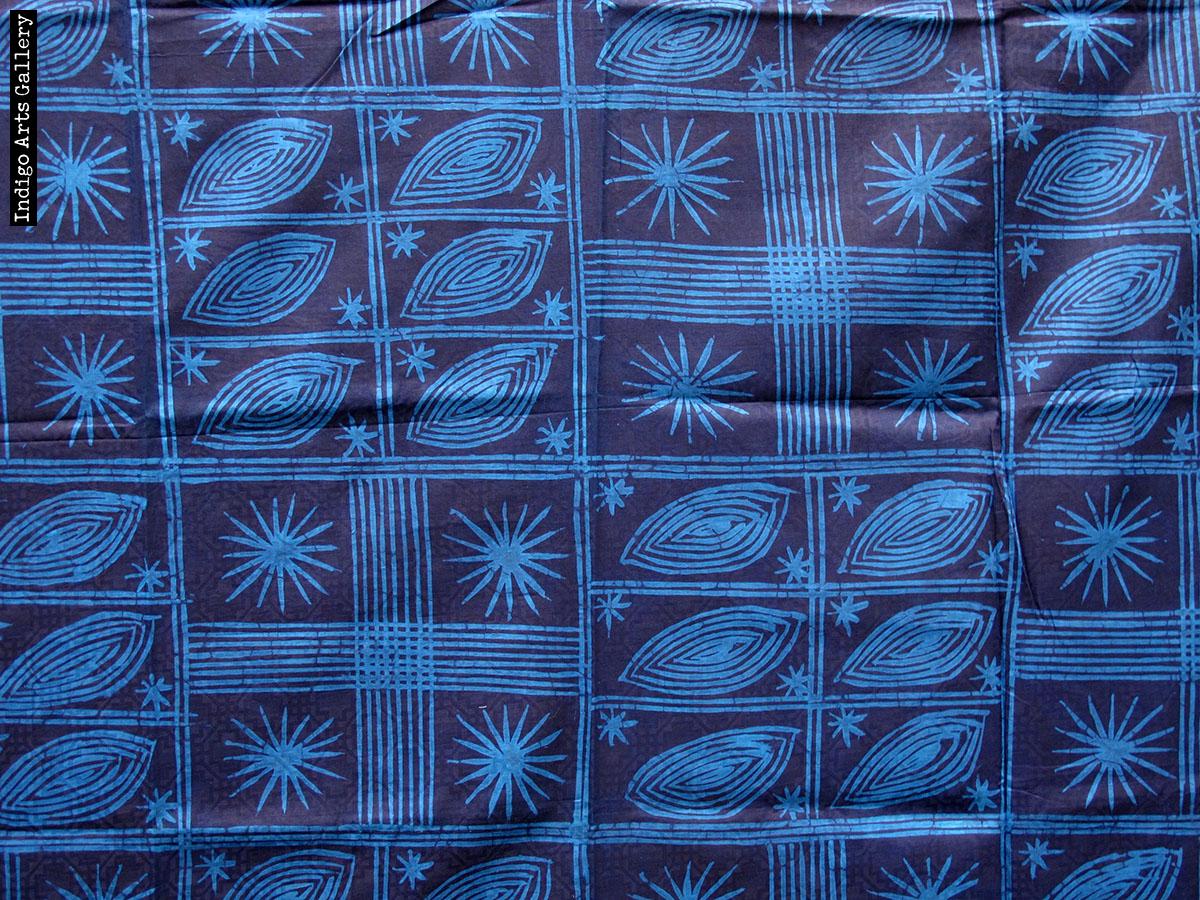
Adire Eleko involves applying a paste made from cassava starch (or, in some formulations, a mixture including rice starch) directly onto the cloth in intricate designs, either freehand using a feather, thin stick, or metal stencil, or through the use of carved calabash or metal stencils that allow for repeated, precise pattern application across a length of cloth. Once the starch paste dries and hardens, the cloth is dipped into the indigo dye vat. The areas covered by the starch paste resist the dye, remaining lighter in color, while the exposed areas absorb the deep blue indigo. After dyeing, the dried starch is scraped or washed away, revealing the finished pattern in crisp contrast against the indigo background. This technique allows for extraordinarily detailed and precise motifs, and historically, certain highly skilled artists became renowned specifically for their eleko pattern artistry, with individual master dyers developing recognizable personal styles.
Adire Oniko relies on a different resist principle: rather than applying paste, the cloth is tightly bound, stitched, folded, or wrapped with raffia, thread, or string in specific patterns before dyeing. The tightly bound areas resist dye penetration, while the exposed fabric absorbs the indigo fully. Once dyeing is complete and the bindings are removed, the pattern emerges as lighter, often circular or linear, shapes against the blue background, with the exact effect depending on the specific folding, tying, or stitching technique used. Sub-techniques within this broader category include various methods of pleating, knotting cloth around seeds or small objects to create circular resist patterns, and stitching techniques (sometimes categorized separately as Adire Alabere) that use running stitches gathered tightly before dyeing to produce fine linear resist patterns.
Both techniques require significant skill, patience, and an intimate understanding of how the indigo dye will interact with the resist material, cloth type, and dyeing duration, since the depth and evenness of the final blue color depends on multiple dips and careful management of the fermenting indigo vat, itself a skill requiring considerable expertise, as natural indigo dyeing relies on maintaining specific chemical conditions within the vat to achieve proper color development.
 The Indigo Dye Vat: Chemistry as Craft
The indigo dyeing process itself represents a remarkable intersection of traditional chemistry and craft knowledge, refined over generations without the benefit of modern scientific instrumentation, relying instead on careful sensory judgment and accumulated experiential wisdom. Traditional indigo dye vats are prepared using fermented indigo leaves, often combined with wood ash, lime, or other alkaline substances to create the proper chemical environment for the indigo to become soluble and capable of bonding with cotton fibers.
The dyeing process is not a single quick dip but typically a multi-stage process involving repeated dipping, oxidation (where the cloth, upon exposure to air, undergoes a chemical transformation that develops the characteristic deep blue color as the indigo compound oxidizes), and further dipping to achieve the desired depth of color. Master dyers develop an intimate sensory understanding of the vat’s readiness, judging factors such as smell, the foam that forms on the vat’s surface (sometimes called the “indigo flower” or “bloom,” an indicator of a healthy, active fermentation), and visual color cues to determine when cloth should be dipped and for how long.
This dyeing expertise historically distinguished master dyers from less experienced practitioners, and specific dyeing compounds, ratios, and techniques were often closely guarded knowledge passed down within specific families or lineage groups, contributing to the reputation of specific towns, families, or individual artisans for producing especially rich, even, and long-lasting indigo coloration.
Reading the Patterns: Symbolism in Adire Motifs
As with the broader African textile tradition explored in the companion article on the language of African dress, Adire patterns are rarely arbitrary decoration. Many established motifs carry specific names and associated meanings, drawing on Yoruba proverbs, cosmology, historical references, and observations of everyday life and nature.
Common motifs include depictions of everyday objects and symbols imbued with cultural significance: the Ibadandun pattern, referencing the city of Ibadan and its associations, or motifs incorporating stars, believed by some interpretations to reference aspiration, destiny, or the vastness of divine creation within Yoruba cosmological understanding. Cowrie shell motifs appear frequently, referencing wealth, femininity, and, in some historical contexts, currency, since cowrie shells served as a form of currency in West African trade for extended historical periods.
Other patterns reference significant historical events, political figures, or social commentary — a function that intensified notably during and after the colonial period, when some Adire artisans incorporated motifs referencing colonial administrators, contemporary political developments, or objects of colonial-era modernity such as bicycles, cars, or specific consumer goods newly introduced to Yoruba society, effectively using the cloth as a form of social documentation and, at times, subtle commentary on rapidly changing social conditions. This practice demonstrates that Adire, much like Kente’s incorporation of contemporary historical references discussed in the previous article, functions as a living, responsive tradition capable of absorbing and commenting on current events rather than existing solely as a repository of fixed ancient symbolism.
Geometric and abstract patterns are equally significant, with specific arrangements of lines, circles, and grid patterns each carrying names and, in many cases, proverbial associations recognized within Yoruba cultural understanding, allowing knowledgeable observers to “read” a cloth’s specific pattern much as one might recognize a familiar saying or reference.
 Adire and Yoruba Women’s Economic Power
Perhaps the most socially significant dimension of Adire’s history is its role in Yoruba women’s economic and social empowerment. Adire production, trade, and sale historically provided Yoruba women with a significant avenue for economic independence, allowing accomplished dyers and traders to accumulate wealth, status, and influence within their communities largely through their own skill and enterprise, operating substantially outside of male-dominated economic structures.
Successful Adire traders and producers, sometimes referred to by titles reflecting their status within trading associations, could achieve considerable social standing, and the craft’s guild-like structures — with recognized master dyers training apprentices and maintaining quality standards — provided structured pathways for women to build reputations, businesses, and multi-generational family enterprises centered on the craft. This economic dimension adds an important layer to Adire’s significance beyond its visual and symbolic content: it represents a documented historical example of African women’s entrepreneurship and craft-based economic agency, predating and continuing through the colonial period despite the broader economic disruptions colonialism imposed on indigenous trade networks.
Colonial Disruption and Adaptation
Like much of the traditional dress and craft discussed throughout this series, Adire production faced significant disruption during the colonial period. The introduction of cheaper, machine-manufactured imported textiles created significant market competition for handmade Adire, and shifting colonial-era fashion preferences, particularly among Westernized urban elites, at times diminished demand for traditional cloth in favor of imported fabrics and Western-style clothing associated with colonial notions of modernity and status.
In response, Adire producers demonstrated notable adaptability, incorporating new synthetic dyes that became available during the twentieth century alongside or in place of labor-intensive traditional natural indigo, and adjusting pattern styles and cloth formats to remain commercially competitive within a changing marketplace. Some scholars and cultural historians view this adaptive capacity as evidence of the tradition’s resilience rather than its decline — a craft community actively negotiating survival and relevance rather than passively fading before external pressure.
The mid-to-late twentieth century saw renewed interest in and appreciation for traditional Adire, paralleling the broader post-independence resurgence of pride in traditional African dress discussed in the previous articles in this series, with Adire increasingly appearing in fine art contexts, cultural exhibitions, and as a marker of specifically Yoruba and Nigerian cultural identity on both national and international stages.
Adire in Contemporary Nigerian Fashion
Today, Adire enjoys a significant and, by many accounts, growing presence within contemporary Nigerian fashion. Nigerian designers, both those working within traditional craft frameworks and those blending Adire techniques and aesthetics with contemporary fashion design sensibilities, have brought the fabric into runway collections, ready-to-wear lines, and high-profile public visibility, including adoption by Nigerian celebrities, musicians, and public figures who wear Adire garments as visible expressions of cultural pride and aesthetic appreciation.
This contemporary revival has also brought renewed economic opportunity to Adire-producing communities, with increased demand supporting continued craft transmission and, in some cases, innovative approaches that blend traditional hand-dyeing techniques with contemporary garment construction, color palettes extending beyond traditional indigo blue into other dye colors while retaining the core resist-dye technique, and export markets that bring Adire to international fashion consumers increasingly interested in authentically sourced, artisan-produced textiles as an alternative to mass-manufactured fashion.
Nonetheless, as with Kente, Adire producers and cultural advocates have raised concerns about imitation products — machine-printed fabrics mimicking the visual appearance of hand-dyed Adire without the underlying craft process — that can undercut the market for genuine handmade cloth and, some argue, dilute broader public understanding of the skill and cultural significance embedded in authentic production.
Preservation, Education, and the Future of Adire
Various initiatives within Nigeria have sought to document, preserve, and promote Adire craftsmanship, including efforts by cultural institutions, academic researchers, and craft cooperatives working to train new generations of dyers, document traditional pattern names and their meanings before that knowledge is lost to time, and connect traditional Adire producers with expanded domestic and international markets that value and appropriately compensate authentic handmade work.
Abeokuta in particular continues to serve as a living center of the craft, with visitors able to observe dyeing processes firsthand, and local markets continuing to offer both traditional and contemporary Adire products, sustaining the craft’s economic viability within its historical home region even as the fashion’s broader visibility expands well beyond southwestern Nigeria’s borders.
Conclusion: Blue Threads of Memory and Enterprise
Adire stands as a powerful testament to the sophistication, artistry, and economic significance of Yoruba women’s craft traditions, demonstrating how a resist-dye technique using locally sourced indigo could develop into a rich visual language carrying proverbs, historical commentary, and spiritual symbolism, all while providing a documented pathway to female economic empowerment across generations. From the careful chemistry of the indigo vat to the precise application of cassava paste or tightly bound thread, from motifs referencing cowrie shells and stars to patterns commenting on colonial-era modernity, Adire embodies the broader themes explored throughout this series: African traditional clothing as a language, a craft, a marker of identity, and a living tradition capable of continuous adaptation and renewal.
As this series continues, Adire’s story — rooted in a specific craft technique, closely tied to women’s economic agency, and successfully navigating both colonial disruption and contemporary global fashion interest — offers an important complement to Kente’s royal, male-weaver-centered narrative, illustrating the rich diversity of production models, social structures, and symbolic systems that together constitute the broader language of African traditional dress.
