

Introduction: The Changing Political Landscape
In the middle of the nineteenth century, much of Africa remained under the authority of African kingdoms, states, communities, and political systems. Within a few decades, that political landscape changed dramatically. European powers expanded their territorial control across the continent, establishing colonies, protectorates, and spheres of influence.
This period became known as the Scramble for Africa. It was one of the most consequential transformations in African history. By the early twentieth century, European governments controlled most of the African continent through military conquest, unequal treaties, economic pressure, and political manipulation.
However, colonialism did not mean Europeans simply took an “empty” continent. Africa already contained powerful states, trading networks, and decentralized societies. European expansion meant confronting existing political authorities—some African rulers negotiated, others sought diplomacy or alliances, and many fought military campaigns for years before being defeated. The story of the Scramble is simultaneously a story of European imperial ambition and African political agency.
What Was the Scramble for Africa?
The Scramble for Africa refers to the rapid territorial expansion of European powers—primarily Britain, France, Germany, Belgium, Portugal, Italy, and Spain—across Africa during the late nineteenth century.
- Economic Drivers: Industrialization created an immense European demand for raw materials and direct control over primary production sites.
- Ideological Justifications: Missionaries and explorers promoted Christianity and Western education. These efforts were often framed as humanitarian justifications, though colonial rule relied on coercion and resource extraction.
- Official Perspective: The U.S. Office of the Historian notes that European industrial powers viewed Africa and Asia primarily as sources of raw materials, labor, and territory during this era.
Africa Before the Scramble
Before European conquest, Africa was politically diverse and organized under sophisticated governance systems, taxation, diplomacy, and trade:
- Centralized Empires & Kingdoms: Sokoto Caliphate, Ethiopian Empire, Asante Empire, Kingdom of Dahomey, Kingdom of Benin, Oyo Empire, Zulu Kingdom, Buganda Kingdom, and the Kongo kingdoms.
- Decentralized Societies: Autonomous federations, city-states, emirates, sultanates, and communities organized through lineage systems, clans, and village councils.
European conquest was not the creation of political order where none existed; it was an attempt to replace or subordinate existing African political authority.
Catalysts of European Penetration
For centuries, European influence was largely restricted to coastal trading posts. In the nineteenth century, key technological advances enabled deep inland expansion:
| Technology | Impact on Expansion |
| Steamships | Allowed navigation upstream along major African river networks. |
| Quinine | Provided effective treatment against malaria, reducing European mortality rates. |
| Advanced Firearms | Repeating rifles and Maxims provided decisive military superiority. |
| Telegraph & Railways | Accelerated real-time communication, troop movements, and resource extraction. |
The Metropolitan Museum of Art notes that increased exploration coincided with growing European industrial demand, fueling competition for direct territorial control rather than standard coastal trade.
Imperial Competition & Diplomacy
The Role of Explorers and Missionaries
Explorers like David Livingstone and Henry Morton Stanley generated maps, resource reports, and geographical intelligence that paved the way for military annexation. Concurrently, Christian missionaries established schools and medical stations. While some defended African rights, missionary networks frequently reinforced European cultural dominance.
The Berlin Conference (1884–1885)
Organized by German Chancellor Otto von Bismarck, European powers met in Berlin to set rules for claiming African territory without fighting one another:
- Established international guidelines for commercial access in the Congo Basin.
- Introduced the Principle of Effective Occupation, requiring powers to deploy actual administrators, soldiers, and treaties to claim land legally.
- Critical Absence: No African representatives were invited or present to participate in partitioning their own continent.
Regional Impacts & Resistance Case Studies
1. Central Africa: The Congo Free State
King Leopold II of Belgium established personal control over the Congo, masking commercial extraction under humanitarian rhetoric.
- Extensive Exploitation: To supply global demand for rubber, the administration enforced forced labor, hostage-taking, bodily mutilation, and mass executions.
- Outcome: International outcry over severe population decline forced the Belgian state to take over direct control from Leopold in 1908.
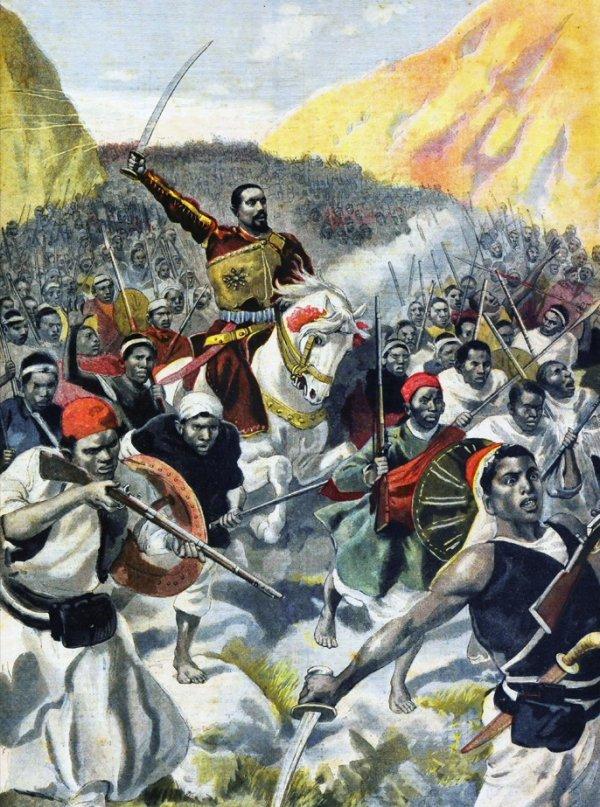
2. East Africa: Ethiopia’s Victory at Adwa (1896)
Under Emperor Menelik II, Ethiopia preserved its independence against Italian invasion:
- Strategy: Combined skillful diplomacy, balancing rival European powers, and acquiring modern European firearms.
- Battle of Adwa (1896): Ethiopian forces decisively defeated the Italian army, proving European military superiority was not absolute.
3. West Africa: Military & Women-Led Resistance
- Samori Touré: Built an organized military state in West Africa, manufacturing and acquiring modern weaponry to resist French expansion for years.
- Yaa Asantewaa (Asante Empire): Led the War of the Golden Stool (1900) against British aggression, becoming an enduring symbol of African female leadership.
4. Southern Africa: Zulu Kingdom & German Brutality
- Battle of Isandlwana (1879): The Zulu Kingdom handed the British army a massive tactical defeat before eventually being overwhelmed by superior British military logistics.
- Herero and Nama Genocide (1904–1908): In present-day Namibia, German forces under General Lothar von Trotha suppressed indigenous uprisings through mass expulsions, forced starvation in deserts, and concentration camps.
Colonial Systems of Governance
Administrative Strategies
- Indirect Rule: Used heavily by Britain, relying on existing traditional structures to collect taxes and enforce order cheaply. This often distorted local leadership, giving non-compliant rulers less authority and co-opted rulers unconstrained power.
- Direct Rule: Favored by France, replacing indigenous structures with European central bureaucracies and promoting assimilation or association policies.
Economic Extraction & Infrastructure
- Resource Reorientation: Economies were restructured around cash crops (cocoa, coffee, cotton, palm oil) and mineral extraction (gold, diamonds, copper).
- Targeted Infrastructure: Roads and railways were constructed almost exclusively to connect inland mines and plantations directly to coastal ports for export, rather than integrating local internal markets.
Anti-Colonial Movements & The Path to Independence
Urbanization and the Educated Elite
Colonialism fostered rapid growth in port cities, capital hubs, and mining towns. Mission and state education created a new professional class—lawyers, teachers, journalists, civil servants, and union organizers—who used European political concepts to demand political representation, civil rights, and eventual self-determination.
World Wars as Catalysts
- World War I & II: Millions of African soldiers served in European armies and supply chains.
- Shift in Global Power: Returning veterans challenged colonial justifications. Weakened European economies after 1945, combined with support for self-determination from the UN, US, and Soviet Union, accelerated decolonization between 1945 and 1960.
Enduring Legacies of the Scramble
- Arbitrary Territorial Borders: Modern African state boundaries match those drawn by European powers, often dividing unified ethnic groups or grouping historically distinct communities.
- Economic Vulnerability: Many post-independence economies remain heavily reliant on raw material exports and vulnerable to international commodity price shocks.
- Linguistic Legacies: European languages (English, French, Portuguese, Spanish) remain official languages in many nations, facilitating international trade while presenting challenges for domestic educational access.
- Resilience of African Agency: The historical record demonstrates that African responses to imperialism were dynamic, ranging from armed conflict and formal diplomacy to economic adaptation and civil resistance.
