

Timkat: Ethiopia’s Celebration of Faith and Tradition
Introduction and Historical Foundations
In the high-altitude plateaus and historic sanctuaries of Ethiopia, where ancient Christian kingdoms carved their devotion into granite mountains and royal stone enclosures, few cultural celebrations command the awe, spiritual depth, and visual magnificence of Timkat. Known formally in the Ge’ez liturgical tongue as the celebration of the Epiphany, Timkat stands as the absolute crown jewel of the Ethiopian Orthodox Tewahedo Church’s festive calendar. Occurring annually on the eleventh day of Terr in the traditional Ethiopian calendar, Timkat transforms the nation’s towns, ancient cities, and rural riverbanks into a sea of pure white cotton, shimmering gold brocade, and ecstatic communal celebration. Recognized by UNESCO as an Intangible Cultural Heritage of Humanity, this multi-day festival represents a living bridge spanning nearly two millennia of unbroken African Christian civilization.
To truly understand Timkat, one must look beyond the surface of its vibrant public processions and explore the deep theological roots of the Horn of Africa. While Western Christian traditions celebrate Epiphany primarily to mark the arrival of the Biblical Magi at the manger in Bethlehem, the Ethiopian Orthodox Tewahedo Church centers its celebration almost exclusively on the baptism of Jesus Christ in the Jordan River by John the Baptist. In the Ethiopian tradition, this baptism is not viewed merely as a historical moment of washing, but as the supreme revelation of the Holy Trinity. It marks the moment where the divine voice of the Father spoke from the heavens, the Spirit descended as a dove, and the Son was manifested to the world as the redeemer. Thus, Timkat is an annual re-enactment of divine revelation, a national renewal of baptismal vows, and a profound public affirmation of faith that unites millions of believers across generational, linguistic, and regional boundaries.
The history of Timkat is intertwined with the foundational narratives of the Ethiopian state itself. According to national tradition and historical chronicles, Ethiopia’s relationship with monotheism dates back to the time of King Solomon and the Queen of Sheba, whose union brought the Ark of the Covenant to the ancient city of Axum. When Christianity was formally adopted as the state religion in the early fourth century under the reign of King Ezana of the Axumite Empire, ancient indigenous water rites, covenant ceremonies, and royal court protocols were seamlessly integrated into the Christian liturgical framework. Over the centuries, through the rise and fall of dynasties—from the Axumite kings to the rock-carving Zagwe rulers of Lalibela and the imperial court of Gondar—Timkat evolved into both a sacred sacrament and the ultimate assertion of Ethiopian national identity.
Throughout periods of foreign pressure, isolation, and rapid political change across the African continent, Timkat remained an untouchable sanctuary of cultural independence. It preserved classical Ge’ez poetry, ancient architectural forms, hereditary textile arts, and complex liturgical music that date back to the late antiquity period. Far from being a static museum piece or a ritual frozen in the past, Timkat is a dynamic, living phenomenon. It breathes through the voices of young deacons chanting in ancient tongues, the hands of master weavers who create traditional ceremonial garments, and the steps of thousands of pilgrims who march through the night to gather around sacred waters. It is a testament to an African Christian heritage that flourished independently, cultivating its own distinct theological, artistic, and social expressions long before Western influences reached the continent.
Theological Foundations and the Sacred Centrality of the Tabot
At the absolute spiritual heart of the Timkat celebration lies a sacred object whose presence transforms ordinary geography into holy ground: the Tabot. To the uninitiated visitor, Timkat may appear to be a festival centered around water, but to the Ethiopian Orthodox faithful, the entire physical and spiritual momentum of the three-day holiday revolves around this mysterious, heavily guarded altar tablet. The Tabot is a consecrated slab of hardwood or carved stone that represents the Tablets of Law containing the Ten Commandments, given by God to Moses on Mount Sinai. In Ethiopian Orthodox ecclesiology, a church building is not merely a place where believers gather; it is a sanctuary built specifically to house the Tabot. Without the presence of a properly consecrated Tabot inside its innermost sanctuary, no church can perform the Holy Eucharist or function as a true house of God.
The Tabot resides permanently within the Holy of Holies, the innermost circular or square chamber of the church building, accessible exclusively to ordained priests and bishops. Under normal circumstances, lay believers never see or come into close physical proximity with this sacred object. Timkat represents the single time in the entire liturgical year when the Tabot leaves the darkness of the inner sanctuary and is brought out into the public world to dwell among the people. This act carries profound theological symbolism, mirroring the incarnation of Christ—the Word becoming flesh and taking up residence within the human community.
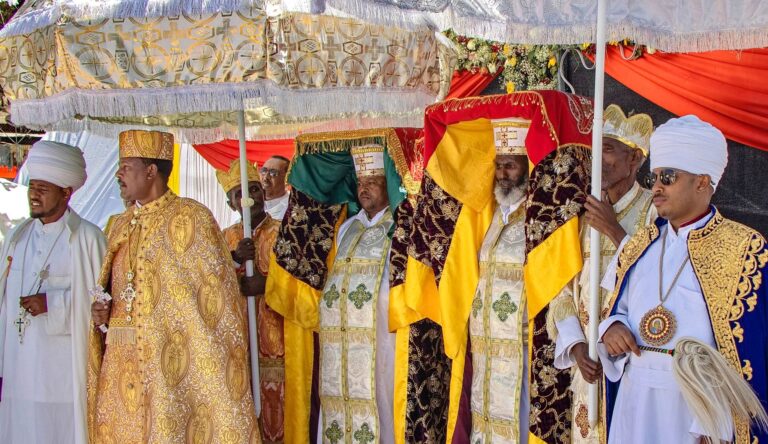
Out of extreme reverence and a deep sense of sacred mystery, the physical wood or stone of the Tabot is never left bare to human eyes. When it is removed from the altar, senior priests wrap the tablet in layers of gold-embroidered velvet, heavy silk brocade, and hand-woven cloths. The priest then lifts the wrapped Tabot onto his head, carrying it with balanced, reverent posture while walking beneath the shade of massive, hand-decorated ceremonial umbrellas. These umbrellas, adorned with metallic fringes, sparkling sequins, and icons of the saints, serve as physical symbols of the divine canopy, protecting the sacred object while signaling its royal dignity to the surrounding crowds.
As the Tabot emerges from the church gates, the surrounding atmosphere shifts instantly from quiet waiting to overwhelming spiritual joy. The crowds fall to their knees or bow deeply, pressing their foreheads to the earth as the sacred tablet passes by. Mothers lift their young children onto their shoulders to catch a glimpse of the velvet-wrapped shape, while elderly men and women weep tears of devotion, whispering ancient prayers of gratitude for being spared to witness another year’s Epiphany. The movement of the Tabot transforms the public avenues of modern Ethiopian cities and the dirt paths of rural villages into sacred procession routes, where every footstep taken by the clergy is treated as an act of high worship.
The theological link between the Tabot and the waters of baptism during Timkat is deeply intentional. By bringing the Tabot—which represents the Old Covenant of the Law—down to the water’s edge to sanctify the baptismal pool of Christ—which represents the New Covenant of Grace—the Ethiopian Church visually presents the fulfillment of Biblical history. The journey of the Tabot to the water mimics the journey of the Israelites carrying the Ark of the Covenant across the Jordan River into the Promised Land. Through this rich tapestry of symbolism, Timkat connects the contemporary believer directly to the ancient narratives of the Old and New Testaments, creating a seamless spiritual reality where time and space are collapsed into a single moment of divine encounter.
The Three-Day Liturgical Cycle
The celebration of Timkat is structured across a careful three-day chronological progression that moves from solemn departure and nocturnal monastic vigils to explosive public joy and triumphant return. The first phase of this sacred journey begins on the eighteenth day of January, known universally as Ketera, the Eve of Timkat. The word Ketera derives from the Ge’ez verb meaning to dam up or hold back water, referencing the historical practice of blocking local streams and rivers weeks in advance to create deep, quiet pools suitable for the upcoming baptismal rites. Early in the afternoon on Ketera, thousands of believers gather at their neighborhood parish churches, dressed in their finest traditional pure white garments.
As the hour of departure approaches, the church bells begin to toll, their deep metal tones ringing across the rooftops and valleys. Inside the sanctuary, the clergy perform the final preparatory prayers before lifting the wrapped Tabots from their altars. The procession emerges through the parish gates led by Sunday school children clad in white robes, who wave palm fronds and sing joyful spiritual hymns. Behind them follow the deacons carrying silver censers that spill thick, fragrant clouds of frankincense into the afternoon air. Then come the senior priests, stepping slowly under the weight of the Tabots resting on their heads, flanked by fellow clergymen who rotate brilliant ceremonial umbrellas to shade the sacred tablets from the sun.
The procession moves through the streets toward a designated body of water, known as the Jan Meda or Timkete Bahir. In large metropolitan areas, dozens of separate parish processions converge along main thoroughfares, merging into massive rivers of white robes, gold-trimmed vestments, and colorful banners. The air vibrates with the deep pulse of the kebero drum and the sharp, metallic shimmer of the tsenatsil, accompanied by the high-pitched joy cries of women echoing from balconies and roadside embankments. Upon reaching the water site, temporary silk and canvas tents are erected along the bank to serve as a makeshift sanctuary. The Tabots are placed inside these tents under heavy guard, while the surrounding grounds turn into an enormous, peaceful encampment where thousands of pilgrims prepare to spend the night under the stars.
As twilight fades into dark, the second phase of the festival begins: the nocturnal monastic vigil. While the crowds outside gather around small fires, sharing flatbread and hot tea, the clergy inside the sanctuary tents begin an unbroken night of prayer, liturgical chanting, and scriptural readings. Far from resting, the priests and deacons maintain a continuous spiritual watch through the cold midnight hours, led by the rhythmic vocal patterns of Saint Yared’s classical music system. The nocturnal air is filled with the low, hypnotic cadence of Ge’ez prayers, punctuated by the rhythmic striking of wooden prayer sticks against the ground, keeping the sleepy body alert to the spiritual work taking place.
At around two o’clock in the morning, the formal Divine Liturgy begins inside the tent sanctuary. For several hours, the clergy perform the ancient prayers of consecration, preparing the bread and wine for the Holy Communion. As the sky begins to soften with the first pale light of dawn—around five o’clock in the morning—the Patriarch, local bishops, and senior priests emerge from the tent sanctuary and process down to the water’s edge. The surrounding thousands wake from their sleep and crowd around the banks, holding lit wax candles whose flickering flames cast a warm glow across the misty water surface. The clergy read the Gospel accounts of John the Baptist, standing in the cold morning air as the crowd listens in hushed, reverent silence.
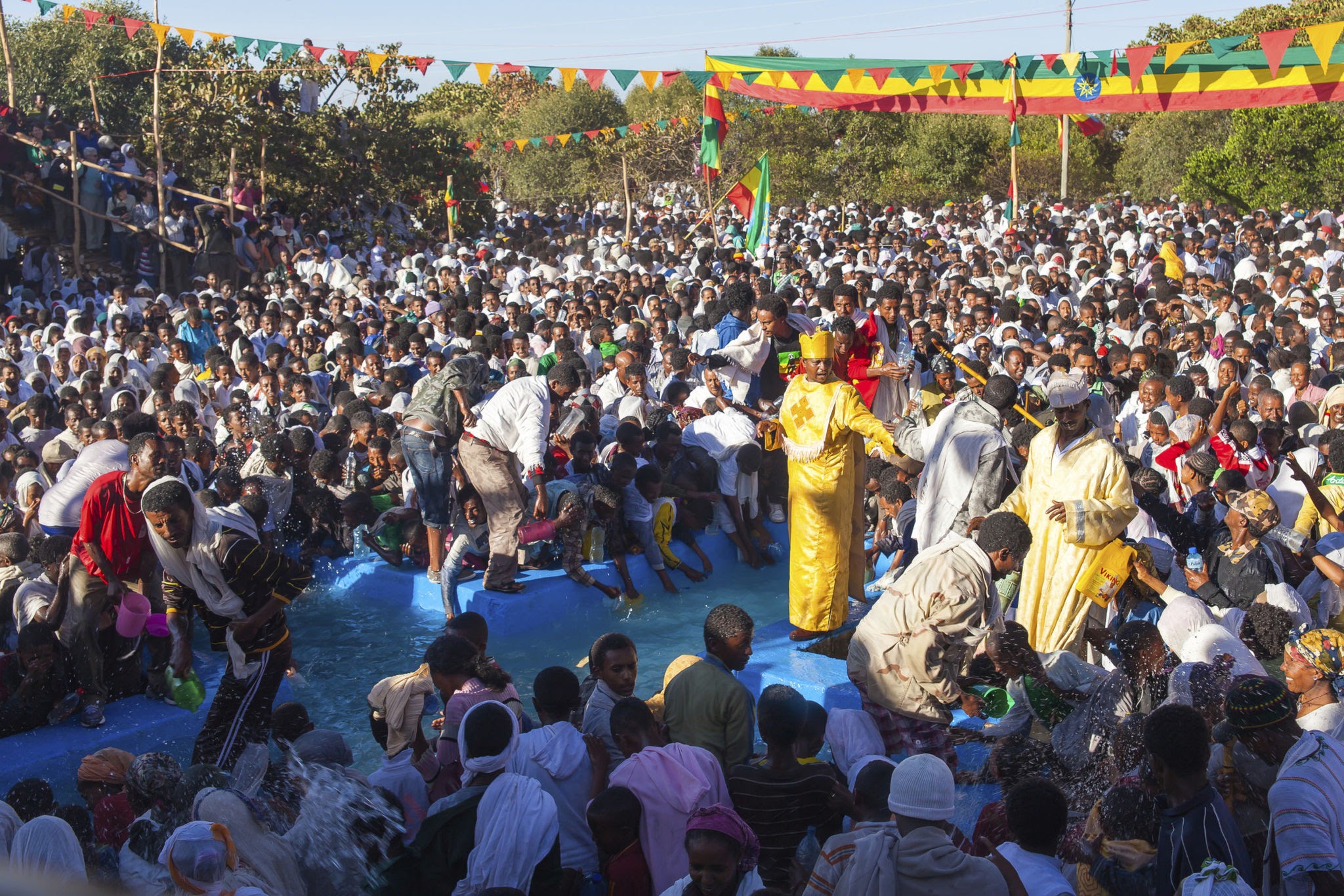
Then comes the pivotal liturgical moment of the festival: the blessing and sanctification of the water. The senior officiating prelate takes a heavy golden or wooden hand cross and plunges it three times into the deep pool, symbolizing Christ entering the waters of the Jordan. Consecrated holy oil is poured into the pool alongside lit candles, invoking the presence of the Holy Spirit to transform the ordinary water into a source of healing, purification, and spiritual rebirth. The priest then takes a spray nozzle or a simple wooden bowl and begins vigorously splashing the blessed water over the assembled crowds.
This act of splashing triggers a glorious, joyful chaotic release. Thousands of believers—men, women, children, and elderly pilgrims—reach out their hands, lifting their faces to catch the falling droplets. Many jump fully clothed into the cool pool, diving beneath the surface to submerge themselves completely, symbolically washing away the sins of the past year and renewing their baptismal covenant with God. Young men splash each other playfully, while parents fill plastic bottles and glass jars with the blessed water to carry home to sick relatives or sprinkle over their crops, homes, and livestock. The air fills with triumphant shouting, joyous singing, and laughter, as the cold morning water brings a sense of spiritual purity and physical renewal.
With the water rites completed and the morning sun rising high into the sky, the festival transitions into its third phase: the return procession, known as the Melaash. On the afternoon of the nineteenth of January, the Tabots are raised from their temporary resting places along the water’s edge to begin their journey back to their permanent home altars. If the procession on Ketera was marked by solemn anticipation, the return journey on Timkat day is an explosion of physical movement, rhythm, and public joy. The clergy lead the way, but they are surrounded by organized groups of young people, church choirs, and neighborhood associations who perform elaborate, synchronized dances through the dusty streets.
The young men execute traditional high-jumping displays, leaping into the air in time with the driving beat of the kebero drums, while young women perform fluid shoulder dances, their white garments fluttering in the breeze. The procession moves at a slow pace, stopping every few hundred yards to allow different choir groups to perform specialized songs of praise. The entire route is lined with carpets, grass cuttings, and decorative archways made of palm leaves and ribbons, constructed by local youth during the preceding weeks. The Tabots enter their respective parish grounds late in the afternoon, where they are returned to the Holy of Holies amid a final, deafening crescendo of drumbeats, trumpet blasts, and communal prayers.
The final phase of the festival takes place on the twentieth day of January, dedicated specifically to the Archangel Michael, one of the most beloved heavenly intercessors in Ethiopian Orthodox tradition. While most Tabots return to their churches on the second day, any Tabot dedicated to Saint Michael remains at the water site for an extra night. On this third day, a specialized celebration takes place, featuring its own distinct processions, feasts, and musical performances. When the Tabot of Saint Michael finally returns to its sanctuary late on the afternoon of January twentieth, the official three-day cycle of Timkat comes to a peaceful close, leaving the community spiritually cleansed, socially reunited, and renewed for the year ahead.
Regional Epicenters and Architectural Stages
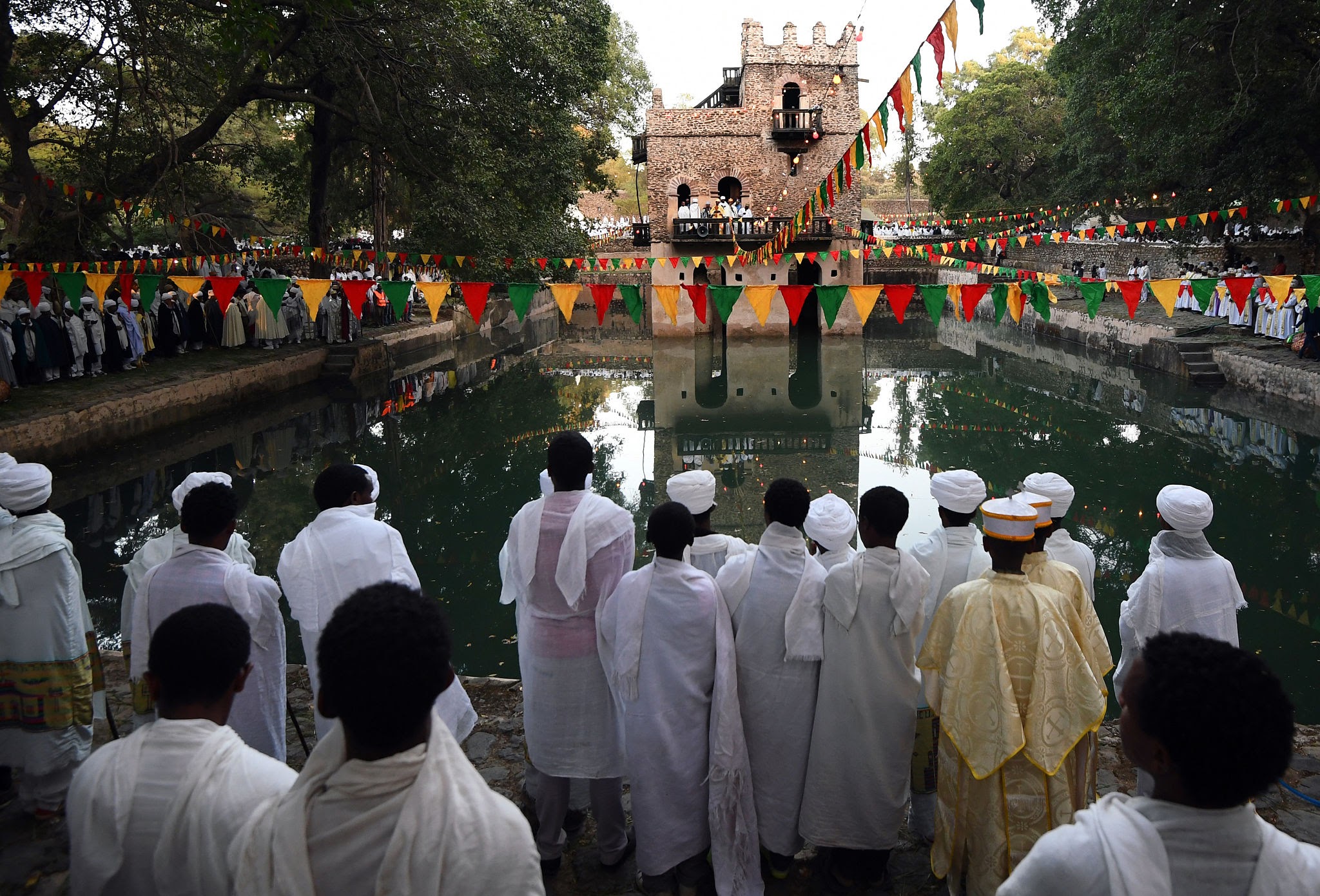
While Timkat is celebrated with fierce devotion in every village, mountain parish, and urban neighborhood across Ethiopia, certain historic regional epicenters offer extraordinary architectural and historical settings that elevate the festival into an unforgettable global spectacle. Chief among these epicenters is the historic royal city of Gondar, located in the northern highlands. Gondar serves as the site of what is widely recognized as the most visually dramatic Timkat celebration in the world, centered at the seventeen-century Fasilides’ Bath. Built during the reign of Emperor Fasilides as a royal summer retreat and spiritual sanctuary, this architectural masterpiece consists of a two-story stone palace surrounded by a massive, sunken rectangular stone basin, enclosed within a fortified wall anchored by ancient banyan trees whose thick roots weave through the stone masonry.
In the days leading up to Timkat, local workers divert water from a nearby river to fill the vast stone bath of Fasilides. On the night of Ketera, thousands of pilgrims from across the globe descend upon Gondar, packing the stone battlements, climbing into the branches of the ancient trees, and camping along the surrounding grassy hillsides. As dawn breaks over the stone palace, the sight of hundreds of believers launching themselves from the ancient stone walls into the dark, cold pool below—their white robes ballooning on the water’s surface—creates an image that seamlessly fuses medieval history with living faith. The stone architecture of the Solomonic emperors becomes an active liturgical stage, where history is not merely remembered, but physically inhabited.
Further east, in the sacred mountain town of Lalibela, Timkat takes on a deeply mystical and contemplative character. Renowned worldwide for its twelve-century monolithic churches carved directly out of solid red volcanic rock, Lalibela provides a landscape where the boundary between earth and heaven feels exceptionally thin. During Timkat, the processions of the Tabots wind through narrow, hand-carved stone trenches, subterranean passages, and rock-cut courtyards that connect the ancient churches. The sound of Saint Yared’s sacred chants echoes off the towering volcanic rock walls, creating a haunting auditory experience that resonates through the deep earth.
In Lalibela, the water rites take place along the banks of the local river, named the River Jordan by King Lalibela when he built the town to serve as a New Jerusalem for African pilgrims unable to cross the desert to the Holy Land. Thousands of pilgrims, clad in white cotton shawls, line the high rock edges overlooking the riverbed. As the priests bless the stream below, the sight of white-robed figures descending down ancient rock staircases in the early morning light evokes the feeling of an unbroken, ancient monastic world, far removed from the pressures and technologies of modern life.
In contrast to the medieval stone settings of Gondar and Lalibela, the national capital of Addis Ababa offers a Timkat celebration defined by modern urban scale, vast crowds, and national unity. The center of the capital’s festivities is Jan Meda, an enormous open-air racecourse and parade ground located in the heart of the city. On the afternoon of Ketera, dozens of Tabots from churches across every sub-city of Addis Ababa process toward Jan Meda, creating an incredible convergence of distinct parish communities.
At Jan Meda, a massive city of colorful canvas tents springs up overnight to house the various Tabots and their accompanying clergy. Hundreds of thousands of city residents, government officials, foreign diplomats, and rural visitors gather across the vast field. The water blessing takes place at a constructed central concrete basin, where high-powered water hoses are used alongside traditional sprayers to reach the vast sea of believers. The Addis Ababa celebration demonstrates the adaptability of Ethiopian Orthodox traditions within a rapidly modernizing metropolis, proving that ancient religious heritage can remain the central organizing force of a modern capital city.
In the ancient northern city of Axum, the historical cradle of Ethiopian civilization and the traditional resting place of the original Ark of the Covenant, Timkat connects directly to classical antiquity. The water rites in Axum are conducted at Mai Shum, a vast, rock-cut reservoir popularly known as the Bath of the Queen of Sheba. Surrounded by towering granite stelae and ancient archaeological sites, the celebration in Axum carries a quiet, solemn authority. The clergy of Axum, who consider themselves the guardians of the kingdom’s most sacred relics, process with an air of deep dignity, carrying Tabots whose lineages trace back to the earliest centuries of African Christianity. In Axum, Timkat is an explicit reminder that Ethiopia’s Christian identity was established not through foreign missionization, but as an ancient royal heritage that has endured for centuries.
Sacred Music, Performance Arts, and Material Culture
The sensory brilliance of Timkat is governed by a classical system of sacred music, ritual performance, and specialized craftsmanship that has been meticulously preserved and passed down through generations. The auditory foundation of the entire festival relies on the sacred chant system known as Zema, created in the sixth century by Saint Yared, a visionary composer and religious scholar from Axum. Saint Yared is credited with inventing a complex system of musical notation—utilizing Ge’ez characters and symbolic accent marks written above liturgical texts—centuries before similar musical notation systems appeared in Europe.
Saint Yared’s musical universe is divided into three distinct vocal modes, each carrying its own specific emotional, spiritual, and seasonal quality. The first mode, known as Ge’ez, is characterized by a plain, direct, and unadorned vocal delivery used for standard liturgical readings and basic prayers. The second mode, Ezel, is slow, heavy, and deeply resonant, invoking feelings of solemnity, divine awe, and repentance; it dominates the nocturnal vigils and early morning prayers of Timkat. The third mode, Araray, is bright, sweet, and plaintive, featuring rising melodic lines that evoke intense spiritual joy, gratitude, and divine victory; it becomes the dominant vocal mode during the afternoon return processions as the crowd celebrates the renewal of baptism.
The execution of Saint Yared’s music is entrusted to the Dabtara, an elite class of unordained ecclesiastical musicians, scholars, and poets who undergo decades of rigorous training in church schools. During Timkat, the Dabtara stand in long, face-to-face lines wearing white cotton robes wrapped in embroidered sashes. They hold two essential liturgical implements: the Meqamiya and the Tsenatsil. The Meqamiya is a T-shaped wooden prayer stick, roughly six feet long, topped with an ivory, brass, or carved wooden handle. During the long hours of the nocturnal vigil, the Dabtara lean on the Meqamiya for physical support; during the daytime processions, however, the prayer stick transforms into a percussion instrument, struck vertically against the ground in precise unison to establish the physical cadence of the sacred dance.
Alongside the prayer stick plays the Tsenatsil, an ancient brass or silver sistrum featuring small metal discs sliding on thin crossbars. Held in the right hand and shaken with subtle wrist movements, the Tsenatsil produces a bright, metallic shimmering sound that cuts through the deep rumble of vocal chants and drumbeats. The primary rhythmic engine of the performance is the Kebero, a large, double-headed drum crafted from a hollowed wooden log or copper shell, covered at both ends with cowhide or goat leather tightly laced together with leather thongs. The drum master wears the Kebero slung across his chest with a woven strap, striking the wider, lower-pitched drumhead with his right hand to produce a booming bass tone, while his left hand strikes the smaller, higher-pitched head to generate sharp, syncopated counter-rhythms.
The movement of the clergy and the Dabtara during Timkat is not random jumping, but a highly formalized, liturgical dance language known as Aquaquam. Standing in neat, organized rows, the Dabtara move their bodies in slow, rhythmic swaying motions that mimic the movement of waves on water or the swaying of branches in the wind. As the tempo of the Kebero increases, the movements become more dynamic: the line of musicians steps forward and backward in complete unison, bowing deeply toward the Tabot before executing sharp, vertical lifts, raising their prayer sticks high into the air. This sacred choreography is a physical expression of prayer, where every movement of the foot, tilt of the head, and strike of the prayer stick is dedicated to honoring the divine presence resting upon the Tabot.
The visual palette of Timkat is equally rich, anchored by a unique heritage of hand-woven textiles, metalwork, and leathercraft. The universal dress code for the lay community is the traditional Habesha Kemis, an ankle-length dress made of lightweight, hand-woven white cotton, worn by women alongside the Netela, a matching white cotton shawl draped gracefully over the head and shoulders. What elevates these garments into works of art is the Tibeb, a wide, intricate border pattern woven directly into the edges of the fabric using brilliant gold, red, green, blue, and black threads. These geometric motifs feature traditional Ethiopian crosses and symbolic patterns that communicate regional identity, social status, and personal taste.
In sharp contrast to the pure white cotton worn by the general populace, the clergy appear in a dazzling array of brilliant colors and heavy textures. Senior priests and bishops wear grand, floor-length velvet and silk capes, heavily embroidered with metallic gold thread, silver filigree, and depictions of angels and saints. Their heads are crowned with high, cylindrical turbans or golden ceremonial crowns, while their hands hold intricate silver or brass hand crosses used to bless the passing crowds. The contrast between the vast sea of white robes worn by the crowd and the deep reds, purples, emerald greens, and golds of the clerical retinue creates a striking visual harmony, reflecting the theological distinction between the humble, earthly seeker and the radiant, heavenly glory of the divine court.
Social Cohesion, Economic Vitality, and Heritage Preservation
While Timkat is celebrated as a deeply spiritual religious festival, its impact on Ethiopian society extends far beyond the realm of church liturgy. Timkat serves as a powerful engine of social cohesion, family reunion, community reconciliation, and cultural preservation. In a country characterized by diverse regional identities, languages, and ethnic traditions, Timkat acts as a universal national touchstone that brings people together around a shared historical heritage.
In the weeks leading up to the festival, local communities organize neighborhood committees to prepare the procession routes. Young people take the lead in these civic efforts, clearing trash from the streets, repairing damaged footpaths, painting roadside curbs, and erecting decorative arches wrapped in palm fronds, eucalyptus branches, and ribbons colored in the green, yellow, and red of the Ethiopian flag. They collect money from local households to purchase rolls of red carpet to lay down before the passing Tabots, working late into the night with a sense of pride and shared purpose. This collaborative labor fosters a deep sense of civic responsibility and intergenerational solidarity, passing the traditions of community service down to the youngest members of society.
Timkat is also a time of intense hospitality, homecomings, and social reconciliation. Family members who live in distant cities or abroad in the global diaspora make every effort to travel back to their ancestral homes for the holiday. Old disputes between neighbors are set aside, and families open their doors to relatives, guests, and total strangers alike. The traditional festive feast prepared for Timkat is a masterwork of Ethiopian culinary art, centered around Doro Wat, a rich, slow-cooked spicy chicken stew simmered for hours with red pepper paste, clarified spiced butter, and hard-boiled eggs, served atop wide sheets of sourdough Injera flatbread. Families brew traditional beverages, such as Tella, a dark, smoky home-brewed sorghum beer, and Tej, a sweet, potent honey wine served in round, long-necked glass flasks.
The economic vitality generated by Timkat is substantial, providing critical livelihoods for thousands of artisans, weavers, farmers, and hospitality workers across the nation. The demand for traditional clothing during the holiday season keeps master weavers working their handlooms continuously for months leading up to Terr. Livestock farmers bring cattle, sheep, and goats from rural provinces to urban markets to supply the holiday feasts, while local transportation operators, hotel owners, and street vendors experience their busiest and most profitable period of the year.
Furthermore, Timkat plays a crucial role in safeguarding ancient traditional crafts that might otherwise face decline in the modern global economy. The continuous production of hand-carved wooden prayer sticks, hand-forged brass sistrums, hand-bound leather drums, and hand-woven silk umbrellas relies directly on the purchasing power and liturgical requirements of the Ethiopian Orthodox Church and its millions of believers. By maintaining these high aesthetic and material standards for its sacred celebrations, the Church ensures that master craftsmen can continue to practice their heritage trades, keeping ancient techniques of woodworking, metallurgy, leather tanning, and textile design alive and economically viable in the twenty-first century.
In the contemporary era, Timkat faces both new opportunities and complex modern challenges. The rapid growth of urban infrastructure, road construction, and real estate development in cities like Addis Ababa occasionally encroaches upon historical procession routes and traditional open-air water sites. Additionally, expanding international tourism requires careful management to ensure that the sacred, spiritual integrity of the festival is not compromised or reduced to a mere commercial performance for foreign cameras.
State cultural institutions, heritage scholars, and church leaders work closely together to protect historic Timkat sites, document ancient liturgical traditions, and establish sustainable guidelines for international visitors. By securing UNESCO recognition for Timkat as an Intangible Cultural Heritage of Humanity, Ethiopia has asserted the global importance of this ancient celebration, ensuring that international heritage frameworks support its preservation.
Ultimately, Timkat endures because it is rooted not in external compulsion, but in the living heart of a community’s faith and identity. As the sound of the kebero drum echoes across the highland hills, as the fragrant smoke of frankincense rises into the cool morning air, and as thousands of white-robed believers step together into the sanctified waters, Timkat continues to perform its ancient miracle. It washes away the burdens of the past year, reknits the fabric of communal life, and proclaims to the modern world the enduring strength, beauty, and majestic dignity of Ethiopia’s ancient heritage.
