

There is a Shona proverb that says,
“Chinokanganwa idemo, chitsiga hachikanganwe”
The axe forgets, but the tree stump never does. It is a saying about memory, about the marks that history leaves behind even when the tools that made them are long gone. Few places on the African continent embody this idea as powerfully as Great Zimbabwe, the vast stone city whose ruins still rise from the hills of southeastern Zimbabwe, more than five centuries after its last rulers walked its corridors. For decades, colonial authorities insisted that such a sophisticated structure could not possibly have been built by African hands, attributing it instead to Phoenicians, Arabs, or a “lost white civilization.” Great Zimbabwe stands today as one of the most powerful rebuttals in the entire heritage record to that colonial myth — a stone stump that refuses to forget what the axe of prejudice tried so hard to erase.
This article, the third in a ten-part series on Africa’s heritage sites, tells the story of Great Zimbabwe: how it rose, how it was built, what it meant to the people who called it home, why colonial scholars fought so hard to deny its African origins, and what it means today as both a UNESCO World Heritage Site and the namesake of an entire modern nation.
What Is Great Zimbabwe?
Great Zimbabwe is the largest and most elaborate of more than two hundred similar stone-walled sites scattered across the plateau region of modern Zimbabwe, eastern Botswana, and parts of Mozambique, collectively known to archaeologists as “Zimbabwe culture” sites. The name “Zimbabwe” itself is believed to derive from the Shona phrase dzimba dza mabwe, meaning “houses of stone,” or alternatively from dzimba woye, meaning “venerated houses,” both interpretations pointing to the same essential fact: this was a civilization defined by its extraordinary mastery of stone construction. So central was this site to Zimbabwean national identity that when the country gained independence from British colonial rule in 1980, its leaders chose to rename the nation itself after these ruins, a powerful act of reclaiming a heritage that colonial authorities had spent nearly a century trying to disassociate from African achievement.
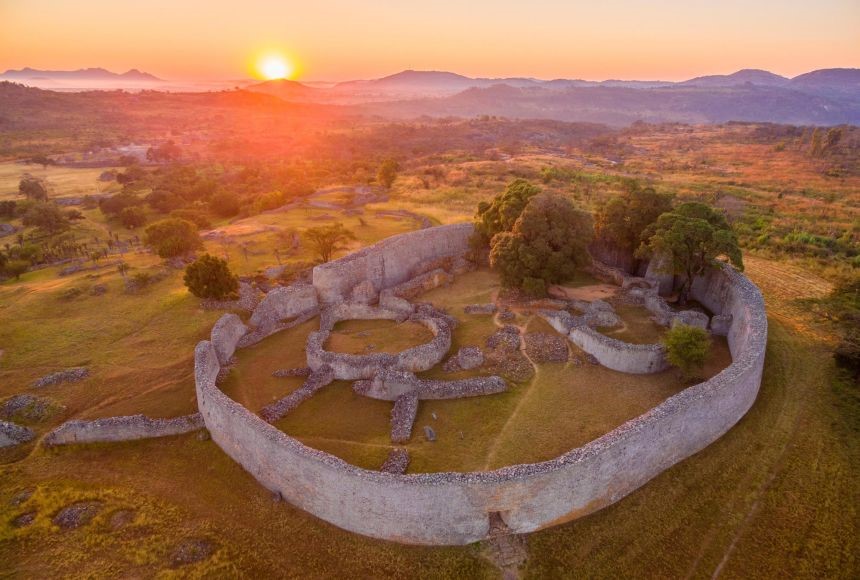
The ruins occupy a sprawling site of approximately seven hundred and twenty hectares, though the most architecturally significant structures are concentrated in three main areas: the Hill Complex, believed to have served as the spiritual and possibly earliest royal residence; the Great Enclosure, the most famous and best-preserved structure at the site; and the Valley Complex, a lower-lying area containing the remains of numerous house structures where much of the city’s population likely lived.
Origins and Rise
Great Zimbabwe’s construction began around the eleventh century CE and continued through several phases of expansion and modification until the site was largely abandoned in the fifteenth century, at the height of its power supporting a population estimated by some archaeologists at up to eighteen thousand people, an extraordinary figure for a pre-colonial African settlement and one that rivalled the largest cities in medieval Europe at the time.
The city’s rise was driven primarily by control over regional and long-distance trade. Great Zimbabwe sat astride important trade routes connecting the interior of southern Africa to the Indian Ocean coast, through which gold, ivory, and cattle from the interior were exchanged for imported goods including Chinese porcelain, Persian pottery, and glass beads from as far afield as India and the Islamic world. Archaeological excavations at the site have recovered substantial quantities of these imported items, providing clear physical evidence of Great Zimbabwe’s integration into a vast Indian Ocean trading network stretching from the African interior to ports in East Africa, the Arabian Peninsula, and beyond.
This trade wealth, combined with the region’s abundant cattle herds — cattle serving as both a primary economic asset and a marker of social status in many Bantu-speaking societies of the region — allowed the rulers of Great Zimbabwe to accumulate the resources, labour, and political authority necessary to undertake monumental stone construction on a scale unmatched elsewhere in the African interior south of the Sahara during this period.
 The Architecture of Great Zimbabwe
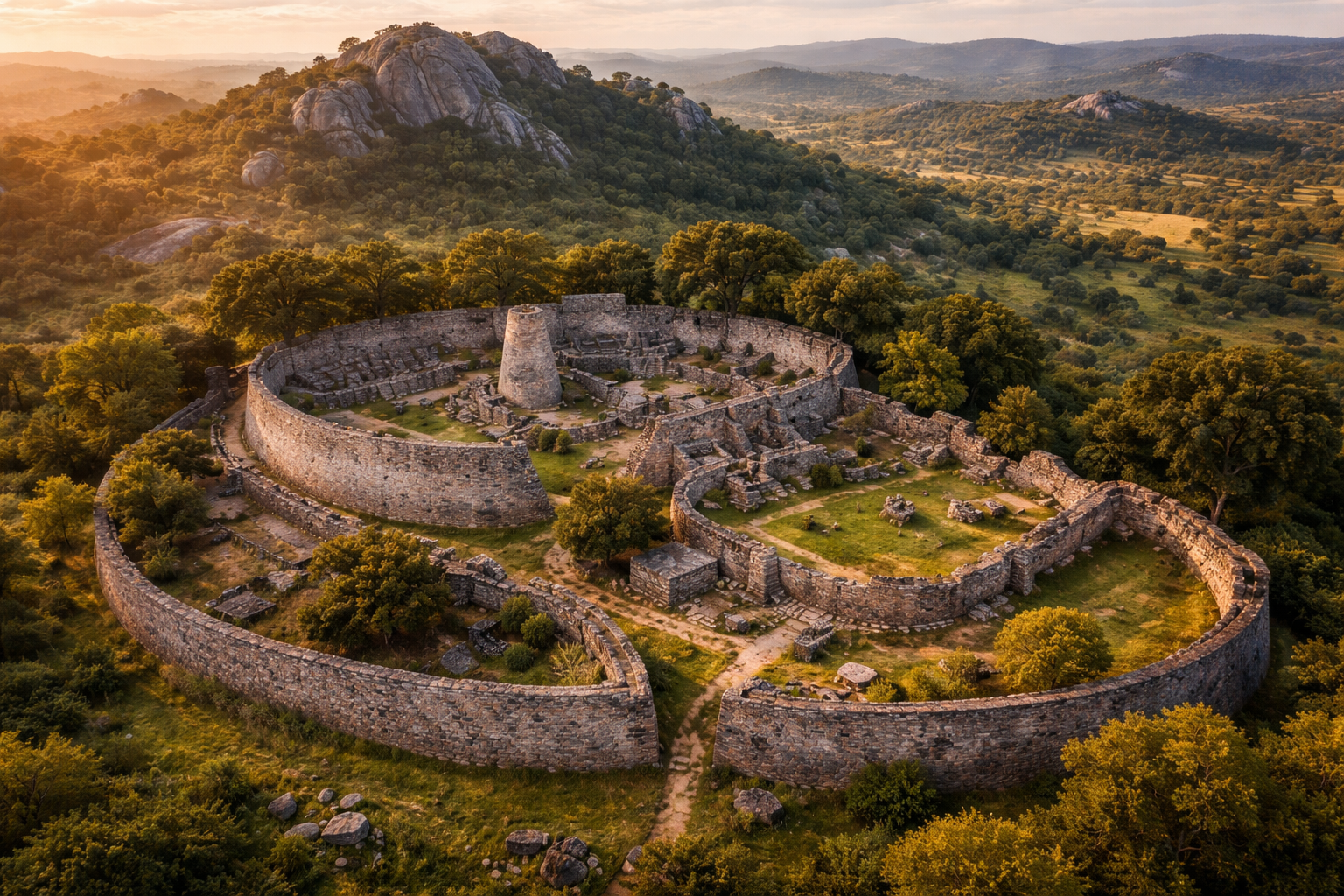
What sets Great Zimbabwe apart from countless other African settlements of comparable age is its stone architecture, built using a technique known as dry-stone construction, in which precisely shaped granite blocks are stacked without any mortar or binding material whatsoever, relying entirely on the skill of the builders and the precision of the stone-cutting to create structures capable of standing for centuries.
The Great Enclosure, the most iconic structure at the site, consists of a massive outer wall reaching heights of up to eleven metres and a thickness of five metres at its base, constructed from an estimated one million granite blocks. The wall encloses an area within which stands a solid, tapering stone tower known as the Conical Tower, whose precise function remains debated among archaeologists, with theories ranging from a symbolic representation of a grain bin, signifying agricultural abundance and the ruler’s role in ensuring prosperity, to a phallic fertility symbol, to a more general marker of royal and spiritual authority.
The granite used throughout the site was sourced locally from the surrounding hills, where natural exfoliation of the region’s granite bedrock produces slabs that split relatively easily along natural planes when heated and then rapidly cooled, a technique the builders of Great Zimbabwe appear to have exploited skilfully to produce the large quantities of uniformly shaped building blocks required for construction on this scale. The absence of mortar meant that wall stability depended entirely on the precision of the stonework and the skill involved in creating a slight inward batter, or lean, to the walls, a technique that significantly increased structural stability and allowed some sections of wall to survive largely intact for over half a millennium despite the total absence of any binding material.
Decorative elements at the site include chevron patterns worked into some sections of walling, herringbone and check patterns, and monoliths and carved soapstone birds that once adorned various structures across the complex, several of which have become important national symbols, with the Zimbabwe Bird now featured on the country’s national flag and currency, a direct visual link between the modern nation and its medieval predecessor.
Society, Governance, and Belief
Great Zimbabwe functioned as the capital of a powerful kingdom, generally referred to by historians as the Kingdom of Zimbabwe, ruled by a king who held both political and spiritual authority. The physical layout of the site itself reflects this social structure, with the Hill Complex generally interpreted as having housed the ruling elite and served important ceremonial and religious functions, while the Valley Complex accommodated the broader population in more modest dwellings constructed from mud and pole rather than stone, indicating a clear social hierarchy expressed through architecture and access to stone construction, a resource and skill evidently reserved for royal and elite use.
Religious and spiritual life at Great Zimbabwe appears to have centred on ancestor veneration and belief systems that would later evolve into or influence the Mwari religious tradition still practised by some communities in the region today, in which a supreme deity is understood to communicate through ancestral spirits and designated spiritual mediums. Several sites within the ruins, particularly within the Hill Complex, show evidence of having served ritual and ceremonial functions, reinforcing the interpretation of Great Zimbabwe as not merely a political and economic capital but a significant spiritual centre for the wider region.
Decline and Abandonment
By the mid-fifteenth century, Great Zimbabwe had entered a period of decline, and the site was largely abandoned by around 1450, though the precise causes remain a subject of ongoing archaeological debate. Leading theories include environmental factors such as soil exhaustion and overgrazing resulting from supporting a large population and extensive cattle herds over an extended period, climatic shifts that may have reduced agricultural productivity, the depletion of local resources including timber and salt, and shifting trade patterns that saw commercial activity move toward new centres of power, including the rising Kingdom of Mutapa to the north, which some historians consider a political successor to Great Zimbabwe, founded in part by migrants or dynastic descendants from the original capital.
Whatever combination of factors ultimately led to its abandonment, Great Zimbabwe’s decline did not represent a collapse of the broader stone-building tradition it exemplified. Smaller Zimbabwe-culture sites, including Khami and Naletale, continued to be built and occupied for generations afterward, carrying forward architectural and cultural traditions rooted in the original capital even as political power shifted elsewhere across the region.
Colonial Denial and the Fight for Recognition
Perhaps no aspect of Great Zimbabwe’s story is as significant, or as revealing of the broader politics of African heritage, as the sustained campaign by colonial-era authorities and scholars to deny that African people had built the site at all. When European explorers and prospectors, drawn by rumours of ancient gold workings, began arriving at the ruins in significant numbers during the late nineteenth century, many refused to accept that local Shona-speaking communities were responsible for such sophisticated stone architecture, instead promoting theories attributing the site to Phoenician traders, the biblical Queen of Sheba, Arab merchants, or a vaguely defined “lost civilization” of non-African origin.
These theories were not simply innocent scholarly errors; they were actively promoted and enforced by the colonial government of Rhodesia, as the territory was then known under British colonial administration, which had a direct political interest in denying African achievement at the site in order to justify continued white minority rule over a population portrayed as historically incapable of such sophistication. Archaeologists who conducted rigorous scientific excavations and concluded, correctly, that Great Zimbabwe was built by the ancestors of the local Shona people faced significant professional and political pressure, with some having their findings suppressed or their careers damaged for reaching conclusions that contradicted the colonial narrative.
It was not until well into the twentieth century, and particularly following Zimbabwe’s independence in 1980, that the African origins of Great Zimbabwe achieved full and unambiguous scholarly and official recognition, though the episode remains a stark case study in how heritage interpretation can be, and historically has been, deliberately distorted for political ends. The renaming of the newly independent nation after the ruins was, in this light, not merely a gesture of national pride but a deliberate and pointed act of historical correction.
Great Zimbabwe as a Modern Symbol
Today, Great Zimbabwe occupies a central place in Zimbabwean national identity, appearing on the country’s flag, currency, and coat of arms through the depiction of the Zimbabwe Bird, and lending its name to the nation itself. The site was inscribed as a UNESCO World Heritage Site in 1986, in recognition both of its outstanding architectural achievement and its significance as physical testimony to a major indigenous African civilization that flourished independently of outside influence or direction.
Beyond its symbolic and touristic significance, Great Zimbabwe continues to serve as an active site of ongoing archaeological research, with new excavations periodically refining scholarly understanding of the site’s chronology, trade connections, and social organisation. It also remains a site of spiritual significance to some in the surrounding community, illustrating once again the dual living and historical character that runs through so much of African heritage.
The Wider Zimbabwe Culture Network
Great Zimbabwe did not exist in isolation. It was the largest and most elaborate expression of a much broader architectural and cultural tradition that archaeologists refer to collectively as “Zimbabwe culture,” encompassing more than two hundred related stone-walled sites scattered across the plateau regions of modern Zimbabwe, eastern Botswana, and parts of Mozambique and South Africa. Sites such as Khami, which flourished after Great Zimbabwe’s decline and became the capital of the Kingdom of Butua, and Naletale, known for its particularly elaborate decorative stonework, demonstrate that the building traditions pioneered at Great Zimbabwe spread widely and evolved regionally over several centuries, adapting to local political circumstances even as core construction techniques and symbolic vocabulary remained recognisably continuous.
This network of related sites is significant for understanding Great Zimbabwe not as an isolated anomaly but as the flagship achievement of a much broader and longer-lived regional tradition of stone architecture, political organisation, and long-distance trade that shaped Southern Africa’s social and economic landscape for several centuries, from roughly the eleventh century through to the arrival of Portuguese traders and, later, European colonial powers in the region.
Trade Goods and the Story They Tell
The imported artifacts recovered from excavations at Great Zimbabwe provide some of the clearest physical evidence available anywhere in the African interior for the sheer reach of pre-colonial trade networks. Fragments of Chinese celadon and blue-and-white porcelain, Persian faience, and glass beads manufactured in India and along the East African coast have all been recovered from the site, alongside imported cloth remnants and coins from as far away as the Kilwa Sultanate on the Swahili coast. In exchange, Great Zimbabwe’s rulers exported gold panned and mined from the surrounding plateau region, ivory harvested from the abundant elephant populations of the interior, and other goods that made their way through Swahili coast intermediary ports such as Kilwa and Sofala, and from there into the broader Indian Ocean trading world connecting East Africa to Arabia, Persia, India, and ultimately China.
This trade network is a crucial piece of evidence against another persistent misconception about pre-colonial Africa: the idea that African societies south of the Sahara existed largely in isolation from global trade and intellectual exchange prior to European arrival. The archaeological record at Great Zimbabwe tells a very different story, one of an African kingdom fully integrated into, and actively shaping, one of the great trading systems of the medieval world, with goods and, presumably, ideas flowing in both directions across the Indian Ocean for centuries before the first Portuguese ships rounded the Cape.
Interpreting a Site Without Written Records
Unlike Egypt, with its extensive hieroglyphic inscriptions, or Timbuktu, with its wealth of Arabic-language manuscripts, Great Zimbabwe left behind no contemporary written records produced by its own inhabitants, meaning that virtually everything known about the site’s political structure, religious beliefs, and daily life must be reconstructed through archaeological excavation, comparison with related Zimbabwe-culture sites, and careful, respectful engagement with the oral traditions and historical memory of Shona-speaking communities in the region, for whom the site continues to hold cultural and, for some, spiritual significance.
This absence of a written record has, historically, made Great Zimbabwe particularly vulnerable to external misinterpretation and, as discussed above, deliberate colonial-era distortion, precisely because there was no inscription on the wall itself to definitively silence alternative theories. It also places a special responsibility on modern archaeology and heritage interpretation to work carefully and collaboratively with descendant communities, ensuring that the site’s story is told in a way that respects both the scientific evidence and the living cultural memory still associated with these ruins today, rather than allowing outside experts alone to dictate the final narrative, as occurred so damagingly during the colonial period.
Legacy in Contemporary Zimbabwean Culture
Beyond its formal status as a heritage site and national symbol, Great Zimbabwe continues to exert a quiet but persistent influence on contemporary Zimbabwean cultural and artistic life. The stylised silhouette of the Zimbabwe Bird appears not only on official state symbols but throughout the country’s broader visual culture, from craft markets to contemporary art, serving as a recurring reference point for artists exploring questions of national identity, historical memory, and the legacy of colonial distortion discussed earlier in this article. Stone sculpture, a craft tradition with deep roots in the region, has flourished in modern Zimbabwe partly in conscious dialogue with the country’s ancient stone-building heritage, with many contemporary Zimbabwean sculptors explicitly citing Great Zimbabwe’s legacy of masterful stonework as a source of artistic inspiration and national pride.
The site also continues to feature prominently in Zimbabwean education, with the story of Great Zimbabwe’s construction, its wrongful colonial-era attribution to non-African builders, and its eventual vindication forming a central case study through which Zimbabwean students are introduced to broader themes of pre-colonial African achievement and the politics of historical interpretation, ensuring that each new generation encounters not only the physical ruins but the fuller, more contested story of how those ruins came to be properly understood and credited to their rightful builders, in many cases by the same families and communities who have lived in the shadow of these walls for generations, long before any foreign expert ever set foot on the plateau.
Conclusion
Great Zimbabwe stands as one of the most compelling and consequential heritage sites on the African continent, not only for the extraordinary skill embodied in its dry-stone architecture but for what its very existence, and the decades-long battle over its interpretation, reveals about the politics of history itself. The stump, as the Shona proverb reminds us, does not forget, no matter how forcefully an axe might wish it to. Great Zimbabwe’s granite walls have outlasted the empire that tried to deny their origins, standing today as one of the clearest and most physically undeniable testaments to the sophistication, ambition, and enduring achievement of pre-colonial Southern African civilization.
As the next chapters of this series will show, Great Zimbabwe is far from alone in this regard. From the rock-hewn churches of Lalibela to the scholarly archives of Timbuktu, the pattern recurs again and again across the continent: monuments of extraordinary sophistication, built by African societies on their own terms, whose full recognition has too often had to wait for the world, and sometimes for Africans themselves, to unlearn imposed doubts about what African civilizations were capable of achieving. Great Zimbabwe’s granite stump stands as proof that, however long it takes, the truth carved in stone eventually outlasts the axe.
