


Durbar Festivals: Horses, Royalty, and Northern Nigerian Heritage
Introduction and Historical Foundations
In the vast semi-arid plains and historical urban centers of Northern Nigeria, where the southern reaches of the Sahara meet the Sudanian Savanna, few cultural institutions embody the grandeur, political sophistication, and military history of the region like the Durbar Festival. Known locally across Hausaland as Hawan Sallah (the Riding of Sallah), Hawan Daushe, or Hawan Sarki, the Durbar is an extraordinary, multi-day celebration of Islamic faith, equestrian mastery, royal statecraft, and martial power. Occurring twice annually to coincide with the major Islamic celebrations of Eid al-Fitr (marking the end of the holy month of Ramadan) and Eid al-Adha (the festival of sacrifice), the Durbar transforms historic emirates—such as Kano, Katsina, Zaria (Zazzau), Sokoto, Bauchi, Bida, and Daura—into living, thundering canvases of color, sound, and historical memory.
To understand the Durbar is to understand the deep political and military history of Northern Nigeria. Long before the festival took on its contemporary form as a public celebration and cultural spectacle, it served an indispensable, pragmatic purpose within the sovereign Hausa city-states and the later Sokoto Caliphate. The event originated as a periodic military parade, troop inspection, and mobilization drill. In an era when cavalry was the supreme strike force capable of projecting state power, securing long-distance trans-Saharan trade routes, and defending fortified city walls (Bani) against rival powers, an Emirate’s survival depended directly on the combat readiness of its horse-mounted warriors.
Through these grand assemblies, traditional rulers (Emirs) systematically evaluated the strength, health, discipline, and equipment of their standing armies and vassal forces. Local district heads (Hakimai), noble titleholders, and military commanders (Sarakunan Yaki) were required to march their specialized cavalry units to the royal capital. This served not only as a rigorous military assessment but also as a public renewal of political allegiance, fealty, and vassal obligations to the central throne.
The term “Durbar” itself carries a fascinating linguistic and diplomatic history. While the indigenous Hausa nomenclature centers on the verb Hawa (to ride), the word “Durbar” was introduced to the Nigerian lexicon during the era of British colonial rule in the late nineteenth and early twentieth centuries. Derived from the Persian word darbar, which historically referred to a sovereign’s court, noble audience, or official executive council, the term had been widely adopted by British imperial administrators in colonial India to describe elaborate formal gatherings and state pageants designed to demonstrate imperial authority and organize local princely rulers.
When the British Lugardian administration established indirect rule over the Northern Nigeria Protectorate following the conquest of the Sokoto Caliphate, they observed the traditional Hawan Sallah processions and recognized their utility as a public instrument of governance. The colonial authorities adopted the Persian-Indian terminology, organizing official “Durbars” to honor visiting British monarchs, governors, and foreign dignitaries—most notably during the royal visit of the Prince of Wales in 1925 and the grand Durbar of 1956 in Kaduna organized for Queen Elizabeth II.
However, despite this colonial linguistic overlay and occasional administrative manipulation, the core identity, spiritual resonance, and performative mechanics of the West African Durbar remained fiercely indigenous. The festival retained its profound connections to the Islamic calendar, its structural ties to traditional chieftaincy institutions, and its deep roots in the military heritage of the Hausa, Fulani, Kanuri, and Nupe peoples. Far from being a colonial invention, the Durbar adapted to colonial and post-colonial realities, surviving as an authentic expression of African royal pageantry, institutional continuity, and historical pride.
The Sacred Union: Islam, Royalty, and the Calendar
The Durbar Festival does not exist in isolation as a mere secular display or seasonal carnival; rather, it is inextricably bound to the spiritual rhythms of Islam and the sacred calendar of the Muslim world. The institution of traditional rulership in Northern Nigeria is fundamentally dual in nature: the Emir serves not only as the supreme traditional executive authority (Sarki) but also as the Amir al-Mu’minin (Leader of the Faithful) within his domain. Consequently, the Durbar is a profound public demonstration of the synthesis between temporal royal power and Islamic spiritual leadership.
The festival sequence begins at the break of dawn on Sallah day (Eid). The entire city awakens to an atmosphere of solemn anticipation and spiritual devotion. Before the equestrian displays commence, the primary obligation is the performance of the congregational Eid prayers (Sallahar Eid). Tens of thousands of citizens—men, women, and children dressed in their finest new garments—stream out from the historic city quarters toward the open-air praying grounds (Masallacin Eid) located on the outskirts of the town walls.
The Emir emerges from his palace (Gidan Sarki) in a solemn, dignified procession, often mounted on a majestic stallion or seated in an open state vehicle, surrounded by his immediate personal guard, senior counselors, and religious scholars (Ulama). The air is quiet, filled only with the soft recitations of the Takbirat (“Allah is Great”), as the community gathers in neat, aligned rows across the expansive prayer ground. The Emir prays alongside his subjects, symbolizing the equality of all believers before the Divine, before listening to the sermon (Khutbah) delivered by the Chief Imam, which emphasizes peace, moral integrity, charity, and social justice.
Once the spiritual obligations are concluded, the atmosphere shifts dramatically from quiet contemplation to exuberant royal celebration. The Emir returns to the palace, and the formal sequence of Hawa (riding processions) commences over the next several days. While specific itineraries vary between different emirates, the structure of the festivities generally follows a traditional four-part sequence: Hawan Sallah (the main ride from the praying grounds), Hawan Daushe (the royal palace salute), Hawan Tsafi or Fanisau (visits to outlying historical districts), and Hawan Doki (the final consolidated parade).
The first phase, Hawan Sallah, involves the Emir’s grand procession back from the Eid praying ground to the palace. As the royal retinue traverses the historic avenues, thousands of spectators line the roads, roofs, and ancient mud walls to catch a glimpse of their ruler and receive his traditional blessings (Gaisuwa).
The second phase, Hawan Daushe, occurring on the second day of Sallah, is widely considered the most visually spectacular and culturally rich segment of the festival. Originating as a special court tribute where royal princes, district heads, and military commanders pay direct homage to the Emir, Hawan Daushe takes place right outside the main palace gates (Kofar Kudu in Kano or Kofar Soro in Katsina). It is during Hawan Daushe that the most daring equestrian maneuvers, elaborate musical performances, and intense royal salutes take place.
The third phase, Hawan Tsafi (or Hawan Fanisau / Hawan Nassarawa in various regions), involves the Emir riding out to visit outlying historical districts, royal cemeteries, or government houses to extend festive greetings to regional administrative officials and community elders, thereby reinforcing the state’s geopolitical unity.
Finally, Hawan Doki (The Riding of the Horses) or Hawan Kofar concludes the festival week with a consolidated parade of all participating cavalry units, titleholders, and musical guilds, providing a final public display before the horses are returned to their royal stables and normal civic life resumes.
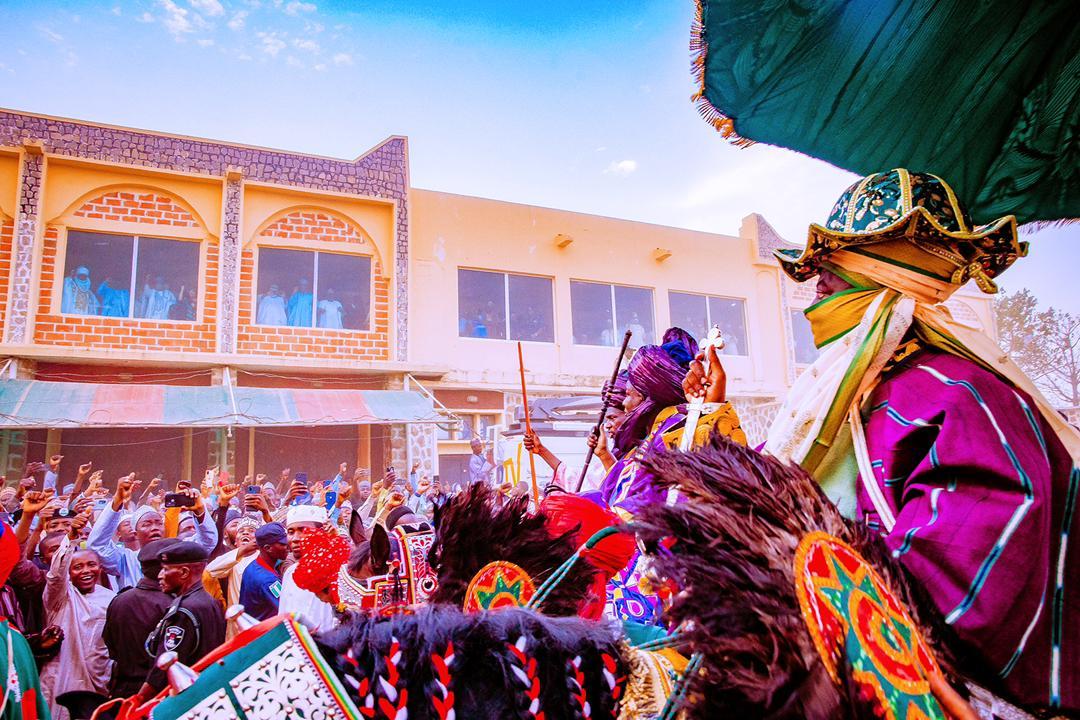
Throughout these sequential rides, the Emir remains the absolute focal point of the celebration. His physical appearance is carefully orchestrated to project supreme dignity, serenity, and ancient royal authority. He is enveloped in multi-layered, hand-woven silk and cotton robes (Babban Riga), adorned with delicate gold and silver embroidery featuring classic Islamic geometric motifs. His head is wrapped in an imposing, immaculate white turban (Rawani), with decorative fabric flaps (Kasa) framed expertly around his chin and face—a traditional style that signifies nobility, modesty, and spiritual reserve.
As the Emir moves through the city, he sits atop an exquisitely groomed stallion whose harness is studded with polished silver, hand-carved leather, and brass fittings. Directly behind the Emir, a royal attendant carries the massive, hand-embroidered State Umbrella (Rumfa). Made of heavy velvet and silk, this ceremonial canopy is continuously rotated and pumped up and down over the ruler’s head in a rhythmic motion. This practice is far more than a practical shade against the West African sun; the Rumfa is an ancient symbol of sovereign protection, political legitimacy, and royal shelter over the populace.
Equestrian Culture: Armor, Regalia, and the Jahi Charge
At the core of the Durbar’s identity is the horse (Doki). In Hausa culture and northern Nigerian history, the horse is not merely a domestic beast of burden; it is a noble companion, a signifier of aristocratic lineage, an instrument of war, and an object of deep aesthetic devotion. The equestrian traditions of the region were heavily influenced by trans-Saharan trade with North Africa, the import of Arabian and Barb horse breeds, and the development of specialized local breeding programs capable of producing heavy warhorses known for stamina, intelligence, and courage in battle.
During the Durbar, the presentation of both horse and rider represents an extraordinary convergence of textile artistry, leatherworking, metal craft, and martial engineering. The preparation of a single Durbar horse begins weeks before the festival. The horse is meticulously groomed, its hooves oiled, its mane braided, and its body conditioned for the high-energy demands of the parade ground.
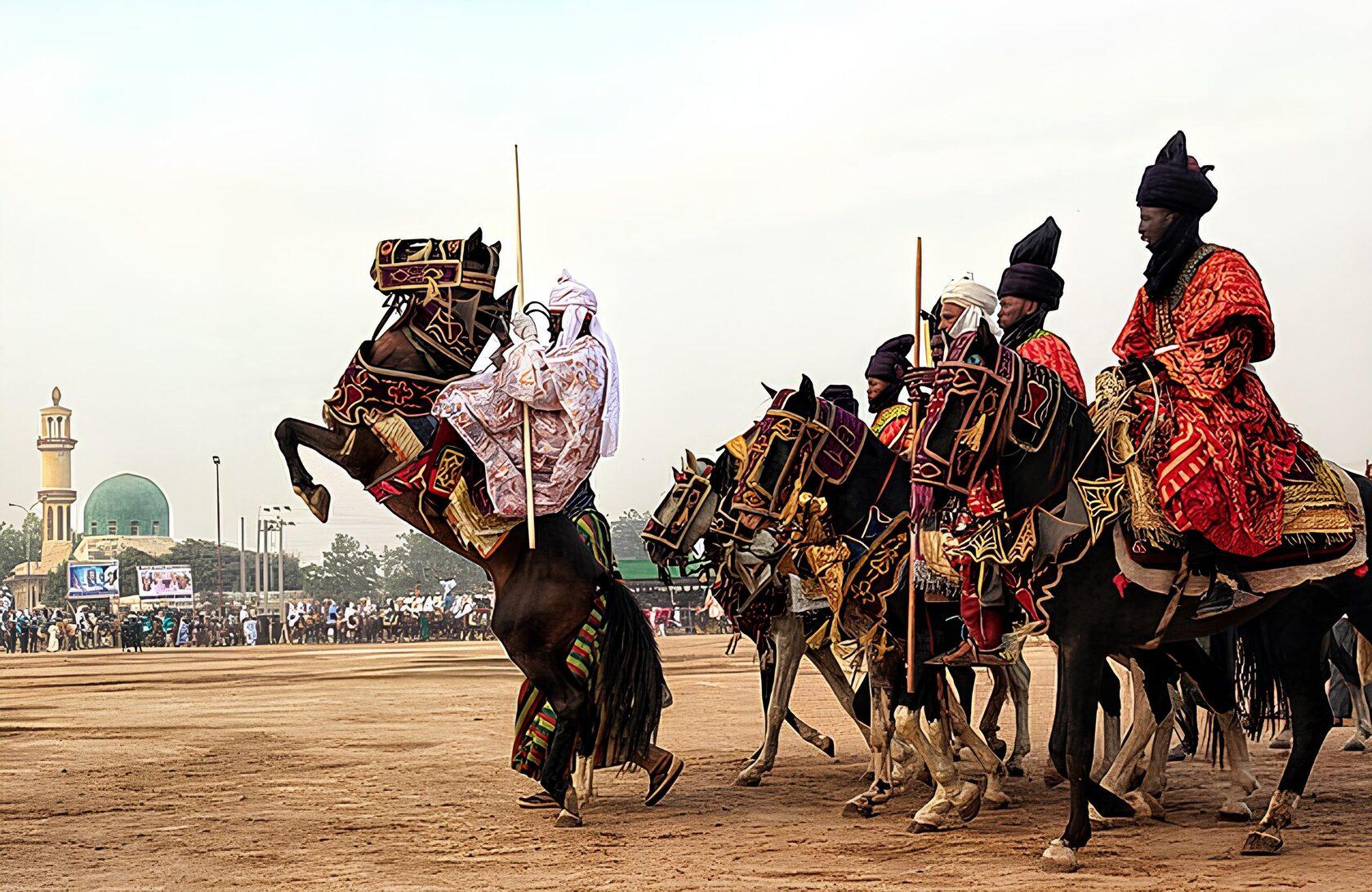
The regalia worn by a noble rider and his mount is a multi-layered testament to historical defensive warfare and status display. The horse’s saddle (Sirdi) is a masterpiece of traditional craftsmanship, featuring a high wooden pommel and cantle wrapped in fine, hand-tooled goatskin leather, velvet, or brass sheeting. Beneath the saddle rest multiple thick, colorful blanket pads (Lifidi or Gidani), heavily embroidered with geometric patterns that absorb shock and protect the horse’s back.
In many emirates, particularly during historical reenactments, horses are clad in full ceremonial body armor (Lifidi). This consists of heavy, quilted cotton padding or chainmail that covers the horse’s neck, chest, and flanks, designed historically to deflect arrows and spear thrusts. The horse’s head is protected by a metallic headpiece (Kwamari or Chakmaki), often forged from brass, iron, or polished silver, featuring protective eye plates and stylized spikes or plumes.
The rider’s attire is equally formidable. Noblemen, district heads, and royal guards wear heavy, padded robes, under which historical figures wore coats of chainmail (Sarkuki) imported from North Africa or forged by local blacksmiths. Over these protective garments, riders layer multiple brightly colored Babban Riga gowns in contrasting shades of indigo, crimson, emerald green, and gold.
Their heads are wrapped in heavy turbans that extend around the neck and mouth (Lappani), leaving only the eyes visible—a functional military practice designed to protect warriors from desert sand, flying debris, and recognition during battle. They carry traditional weapons that reflect the cavalry arms of the Sokoto Caliphate: long, silver-tipped steel lances (Tsando), heavy iron swords (Kagari) housed in hand-carved leather scabbards, ornate daggers strapped to the forearm, and hide shields (Gunguma) crafted from the thick skin of hippopotamuses or elephants.
The absolute climax of the entire Durbar Festival—the moment that encapsulates the fierce martial spirit, precision, and loyalty of northern cavalry—is the Jahi Charge. Taking place in the main parade square directly before the seated Emir and his assembly of dignitaries, the Jahi is a breathtaking, heart-stopping display of equestrian mastery.
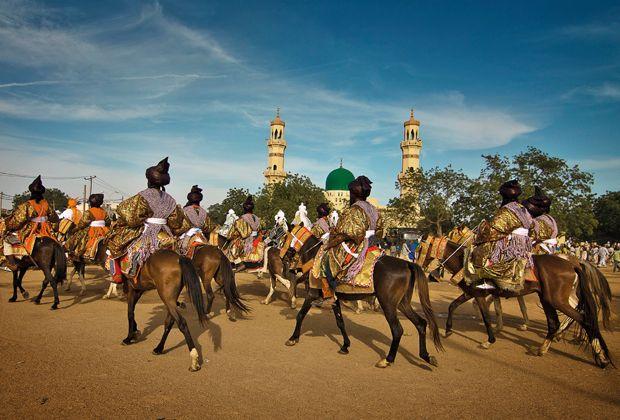
Regiments of horsemen, organized by family lineages, administrative districts, or specialized royal military units, line up at the far edge of the square, hundreds of yards away from the royal dais. The riders sit erect, their horses stomping and snorting with pent-up energy. At a sudden signal—often the sharp, piercing blast of a royal horn or the strike of a kettle drum—the entire line of cavalry breaks into a full, thundering gallop directly toward the Emir.
As the horses accelerate, the ground vibrates beneath their hooves, creating a cloud of dust that engulfs the charging riders. The horsemen raise their lances, swords, and spears high into the air, shouting ancient war cries and brandishing their weapons with terrifying speed and energy. To an unfamiliar observer, it appears as though an unchecked, unstoppable cavalry charge is about to crash directly into the royal pavilion.
Then, in a display of incredible reflexes, strength, and horsemanship, the riders reach a designated marker just feet away from the Emir’s feet. Simultaneously, the horsemen pull back hard on their severe ring-bits, bringing their massive warhorses from a breakneck 30-mile-per-hour gallop to a complete, sudden halt.
The horses rear up on their hind legs, hooves pawing the air, eyes bright and muscles straining. The riders hold their positions, raise their right fists or weapons high above their heads, and utter the traditional Hausa salute of supreme loyalty and homage: “Ranka Ya Dade!” (“May your life be long!”).
The Emir acknowledges their salute with a slow, dignified raise of his hand or his royal horse-tail fly-whisk (Gisiri). The tension evaporates into public cheers, drumbeats, and praise-singing as the horsemen wheel their steeds around with effortless grace and trot off to make way for the next charging regiment. The Jahi charge is a profound performative ritual: it acts as a symbolic reenactment of historic battle charges, a public test of an elite warrior’s courage and control, and a dramatic, unambiguous reaffirmation of fealty to the throne.
Performing Arts, Court Music, and Sonic Landscape
The Durbar Festival is as much an auditory masterwork as it is a visual spectacle. The event serves as the premier stage for the preservation and performance of classical Northern Nigerian court music, oral poetry, praise-singing, and theatrical arts. In Hausa society, music is intimately tied to social hierarchy and political power; specific instruments, rhythms, and musical compositions are strictly reserved for royalty, noble titleholders, and historical guilds.
The primary instrument of royal authority throughout the Durbar is the Kakaki. The Kakaki is an extraordinarily long, narrow trumpet—often measuring three to four meters in length—forged from hammered brass, copper, or recycled kerosene tins. Because of its massive size and historical association with royal court announcements, the instrument can only be blown by specialized hereditary musicians attached to the Emir’s palace.
The Kakaki produces a deep, metallic, resonant tone that can carry over vast distances, penetrating through the roar of crowds and the thundering of hooves. Its blasts are not random; the player utilizes a specialized technique of breath control to produce specific pitch variations that spell out traditional praise epithets (Kirari) dedicated to the Emir. When the Kakaki sounds, the populace knows immediately that the sovereign is moving or making a formal court appearance.
Alongside the Kakaki plays the Algaita, a double-reed wind instrument constructed from wood or metal, wrapped in soft leather, and featuring a wide bell mouth. The Algaita produces a piercing, nasal, highly expressive sound similar to an oboe or shawm. Known for its continuous-breathing performance technique, the Algaita provides the driving, hypnotic melodic lines that accompany royal processions, played with relentless energy throughout the long hours of the parade.
The percussion section of the Durbar orchestra is anchored by the grand Tambari (royal kettle drums). The Tambari are sacred, large, bowl-shaped drums covered with thick cowhide, historically considered physical symbols of state sovereignty itself. In ancient times, the capture of an Emir’s Tambari by an invading army signified the total collapse of the kingdom. During the Durbar, these massive drums—often mounted on camels or heavy wooden frames—are struck with thick, curved wooden beaters, producing a heavy, booming bass rhythm that sets the cadence for the royal retinue. Supporting the Tambari are numerous smaller drums, including the Gangaa (a double-headed cylindrical drum) and various forms of talking drums (Kalangu), which translate language into rhythmic patterns to praise riders and warn crowds.
Weaving through this wall of sound are the Maroka (royal praise-singers and oral historians). The Maroka occupy a critical social position within the traditional court structure. They possess encyclopedic knowledge of regional history, royal genealogies, military victories, and family lineages. As noble riders perform their Jahi charges or process past the court, the praise-singers project their voices over the arena, chanting elaborate, poetic recitations (Kirari) that recall the noble deeds of a rider’s ancestors:
“Lion of the Savanna! Son of the conqueror of walls! Rider of stallions who knows no fear! The blood of heroes flows in your veins; your lance is sharp, and your heart is pure!”
These oral recitations are far more than empty flattery. They serve as a powerful mechanism of social accountability, moral encouragement, and historical preservation. By publicly invoking the legendary deeds of an aristocratic family’s ancestors, the Maroka challenge the modern rider to live up to those historical standards of bravery, generosity, and integrity. A rider who performs poorly or displays cowardice risks being publicly lampooned or ignored by the praise-singers—a social disgrace in a society that places supreme value on honor and lineage reputation.
In addition to royal musicians and praise-singers, the Durbar arena hosts a diverse gathering of traditional performers, itinerant entertainers, and guild representatives. Daring acrobats execute flips and human pyramids on the bare backs of trotting horses; skilled snake charmers walk through the crowds carrying massive African rock pythons around their necks; traditional wrestlers (Langa) and pugilists (Dambe) demonstrate physical conditioning; and comedic performers perform humorous satirical skits, ensuring that the Durbar remains an inclusive, multi-layered festival of popular culture.
Regional Diversity across the Northern Emirates
While the core elements of the Durbar—Islamic prayers, royal processions, court music, and equestrian salutes—are shared across Northern Nigeria, individual emirates have developed unique cultural variations, distinct historical flavors, and localized performance traditions that reflect their specific regional histories.
The Kano Durbar: Scale, Opulence, and City Wall Traditions
Kano, the historic commercial nerve center of Trans-Saharan trade and the most populous emirate, hosts what is widely regarded as the largest, most opulent, and most internationally famous Durbar in West Africa. The Kano Durbar is distinguished by its sheer numerical scale: thousands of horsemen participate in Hawan Daushe, filling the expansive square outside the grand mud-brick palace (Gidan Rumfa, constructed in the fifteenth century).
A unique feature of the Kano celebration is the historic path taken by the Emir. The royal procession traverses specific ancient city gates (Kofori), such as Kofar Kudu, Kofar Famfo, and Kofar Kabuga, connecting the living community directly to the physical architectural heritage of the ancient wall system.
The Kano Durbar is also famous for the presence of the Yan Koba (the Emir’s palace guards), who march on foot carrying antique flintlock muskets, firing blank volleys into the air to signal the movement of the sovereign, creating clouds of white smoke that add to the dramatic atmosphere of the event.
The Katsina Durbar: Pure Equestrian Precision and Royal Elegance
Katsina Emirate, long celebrated as a historical center of Islamic scholarship, poetry, and refined court culture, hosts a Durbar renowned for its sheer equestrian elegance, discipline, and high-speed precision. The Katsina Durbar takes place in front of the historic palace (Gidan Korau), one of the oldest surviving structures of royal residential architecture in the region.
Katsina horsemen are famed for their exceptional riding technique, sleek horse grooming, and the extraordinary quality of their embroidered saddlery. The Jahi charge in Katsina is widely considered the most intense and dangerously close to the royal pavilion, reflecting the emirate’s deep pride in its historic cavalry traditions.
Furthermore, Katsina places strong emphasis on the participation of young princes and junior titleholders, who are introduced to the saddle as early as five years old, ensuring that the complex art of high-speed horsemanship remains an unbroken family legacy.
The Zaria (Zazzau) Durbar: Colorful Regalia and Guild Representation
Zaria, anciently known as the Kingdom of Zazzau—famous for its legendary warrior queen, Amina—celebrates a Durbar characterized by vibrant color combinations, complex family regalia, and prominent participation by occupational guilds. The Zazzau parade routes weave through the hilly, picturesque terrain of the old city, providing vantage points for thousands of spectators.
In Zaria, the distinction between various noble houses (Gidaje) is communicated through specific, uniform color schemes worn by their respective cavalry contingents. One family lineage may ride entirely in brilliant scarlet and gold, while another processes in deep indigo and silver.
The Zazzau Durbar also features specialized displays by the traditional hunters’ guild (Yan Tauhi), who march alongside the cavalry clad in leather garments adorned with protective amulets (Laya), demonstrating their deep knowledge of bush medicine and marksman skill.
The Sokoto Durbar: Spiritual Gravity and Caliphate Heritage
In Sokoto, the historical seat of the Sokoto Caliphate founded by Sheikh Usman dan Fodio in the early nineteenth century, the Durbar takes on a distinctly spiritual, dignified, and austere character. Known as the capital of Islamic learning in the region, Sokoto’s celebration places intense focus on religious devotion, scholarly heritage, and moral reflection.
The Sultan of Sokoto (Sarkin Musulmi), who holds spiritual primacy over Muslims across Nigeria and beyond, leads processions that emphasize quiet majestic dignity over flamboyant excess. While equestrian displays and horse salutes remain central, the Sokoto Durbar is heavily integrated with public lectures on Islamic history, recitations of classic Arabic poetry composed by Caliphate scholars, and assemblies of international Islamic diplomats and religious leaders.
The Bida Durbar: Nupe Glassworking and Brass Craft
Further south in Niger State, the Nupe people of the Bida Emirate celebrate a distinct variation of the Durbar that highlights Nupe cultural heritage, riverine history, and extraordinary local craftsmanship. Known as the Bariki or Sallah Durbar, the Bida event showcases the horsemen of the Etsu Nupe (King of the Nupe).
What sets the Bida Durbar apart is the incorporation of local artisan traditions: riders and horses are adorned with heavy, hand-cast brass ornaments, silver filigree, and unique beadwork produced by the ancient brass-smithing and glass-making guilds of Bida town. The rhythm of Nupe court drumming—featuring deep-toned wooden drums distinct from Hausa styles—provides a unique musical accompaniment that reflects the rich diversity of Northern Nigeria’s Islamic emirates.
Craft Traditions, Economic Vitality, and Heritage Preservation
While the Durbar is celebrated as a major public festival, its impact extends far beyond the days of Sallah. The Durbar acts as a crucial economic engine and an indispensable preservation mechanism for a vast ecosystem of traditional crafts, skilled trades, and specialized cottage industries that would otherwise face extinction in the modern industrial age.
The primary beneficiary of the Durbar institution is the traditional leatherworking guild. A single Durbar saddle requires dozens of hours of skilled hand labor from master leatherworkers (Masu Jima). They source high-quality cow, goat, and sheep hides, tanning them using natural plant dyes—such as local indigo, pomegranate skins, and acacia pods—to produce rich shades of red, black, yellow, and deep blue.
The leather is then hand-carved, stamped with intricate geometric patterns, and stitched with metallic threads to form bridles, reins, stirrup straps, scabbards, and decorative neck tassels (Togaye). The demand for horse tack generated by hundreds of Durbar participants in every emirate keeps these ancient leather markets continuously active throughout the year.
Similarly, the festival supports the traditional textile and weaving industries. The massive, multi-layered garments worn by riders and the heavy protective blankets used on horses require vast quantities of hand-woven cotton cloth (Gwado). Master weavers operating traditional narrow-strip looms produce durable cotton strips that are sewn together and handed over to professional embroiderers (Masu Dinki).
These embroiderers spend months hand-stitching complex traditional patterns—such as the famous Aska Takwas (Eight Knives) motif—onto royal gowns. The production of fine turbans, silk veils, and hand-dyed indigo garments centered in historic dyeing pits (such as the 500-year-old Kofar Mata dye pits in Kano) relies directly on the purchasing power and aesthetic demands of Durbar titleholders.
Metalsmithing and blacksmithing guilds (Masu Bera) represent another vital link in the Durbar economy. Blacksmiths forge essential equipment, including steel stirrups (Likitani), heavy ring-bits (Lijami), iron horseshoes, and ceremonial spears. Brass-casters produce decorative harness fittings, bells, and metallic head armor. The skills required to balance, temper, and ornament these functional equestrian metal tools are passed down within hereditary smithing families, preserved specifically to satisfy the rigorous requirements of the parade ground.
Furthermore, the Durbar plays a major role in regional livestock economics, veterinary medicine, and agriculture. Maintaining elite warhorses requires substantial investment in feed, stable management, and specialized care. Stable hands, fodder suppliers, grooms, and traditional equine herbalists (Masu Maganin Doki) earn their livelihoods through the continuous maintenance of royal and noble stables. The festival stimulates inter-regional trade, as horses are bought, sold, and traded across international borders connecting Nigeria, Niger, Chad, Cameroon, and Sudan.
In an era where modern mechanical transportation has completely replaced horses in everyday transport and agriculture, the Durbar Festival serves as the single most effective cultural mechanism keeping West Africa’s equestrian knowledge, breeding stock, and associated artisan traditions alive.
Modern Challenges, Adaptation, and Future Horizons
As Northern Nigeria navigates the complex realities of the twenty-first century—characterized by rapid urbanization, economic modernization, political shifts, and evolving security landscapes—the Durbar Festival faces both significant challenges and transformative new opportunities.
One of the most pressing contemporary challenges facing the festival is the high cost of horse maintenance and regalia production. Economic pressures and inflation have made keeping large stables increasingly expensive for noble families and district heads. Acquiring a top-quality Arabian or Barb stallion, outfitting it with authentic hand-carved leather saddlery, and purchasing embroidered silk robes for multiple riders requires millions of Naira.
In response, some smaller emirates have had to scale down the number of participating horsemen or seek external financial support. To ensure the festival’s sustainability, corporate sponsorships—from telecommunication giants, national banks, and international brands—have increasingly partnered with Emirate Councils to fund event infrastructure, grandstands, media coverage, and cash prizes for equestrian competitions.
Another significant dynamic is the complex interaction between traditional Durbar practices and modern security concerns. In recent years, security challenges in parts of the Sahel and Northern Nigeria have occasionally forced Emirate Councils to shorten, modify, or temporarily suspend public Durbar processions in the interest of public safety. However, the resilience of the institution has been repeatedly demonstrated: as soon as stability is restored, communities eagerly revive the festival, viewing the return of the Durbar as a vital public symbol of peace, security, and institutional endurance.
Digital technology and global media have opened up unprecedented frontiers for the Durbar. High-definition videography, drone cinematography, and social media live-streaming platforms now transmit the sights and sounds of Hawan Daushe to millions of viewers across the global African diaspora and international cultural communities in real time.
Documentary filmmakers, digital archivists, and photojournalists are creating comprehensive visual records of rare saddlery, musical compositions, and equestrian techniques, ensuring that this heritage is preserved for future generations in digital repositories. State governments across Northern Nigeria are increasingly recognizing the Durbar as a premier asset for global cultural tourism, investing in airport infrastructure, hotel capacity, and heritage site conservation to welcome international visitors.
Importantly, the Durbar continues to evolve as a vital bridge for social cohesion, civic pride, and political dialogue in modern Nigeria. In a diverse, multi-ethnic, and multi-religious nation, the Durbar stands as a powerful, peaceful assertion of Northern Nigeria’s rich historical civilization. It provides a shared civic space where democratic political leaders, traditional rulers, religious scholars, international diplomats, and citizens of all social strata gather on equal footing to celebrate shared heritage, reflect on moral values, and express collective hope for the future.
Through the thunder of hooves during the Jahi charge, the clear metallic call of the Kakaki, the vibrant colors of hand-woven silk robes, and the serene dignity of the Emir under his state umbrella, the Durbar Festival endures. It remains a living, breathing archive of African royalty, military history, and creative genius—a majestic celebration where the past is not merely remembered, but vibrantly ridden into the present.
