

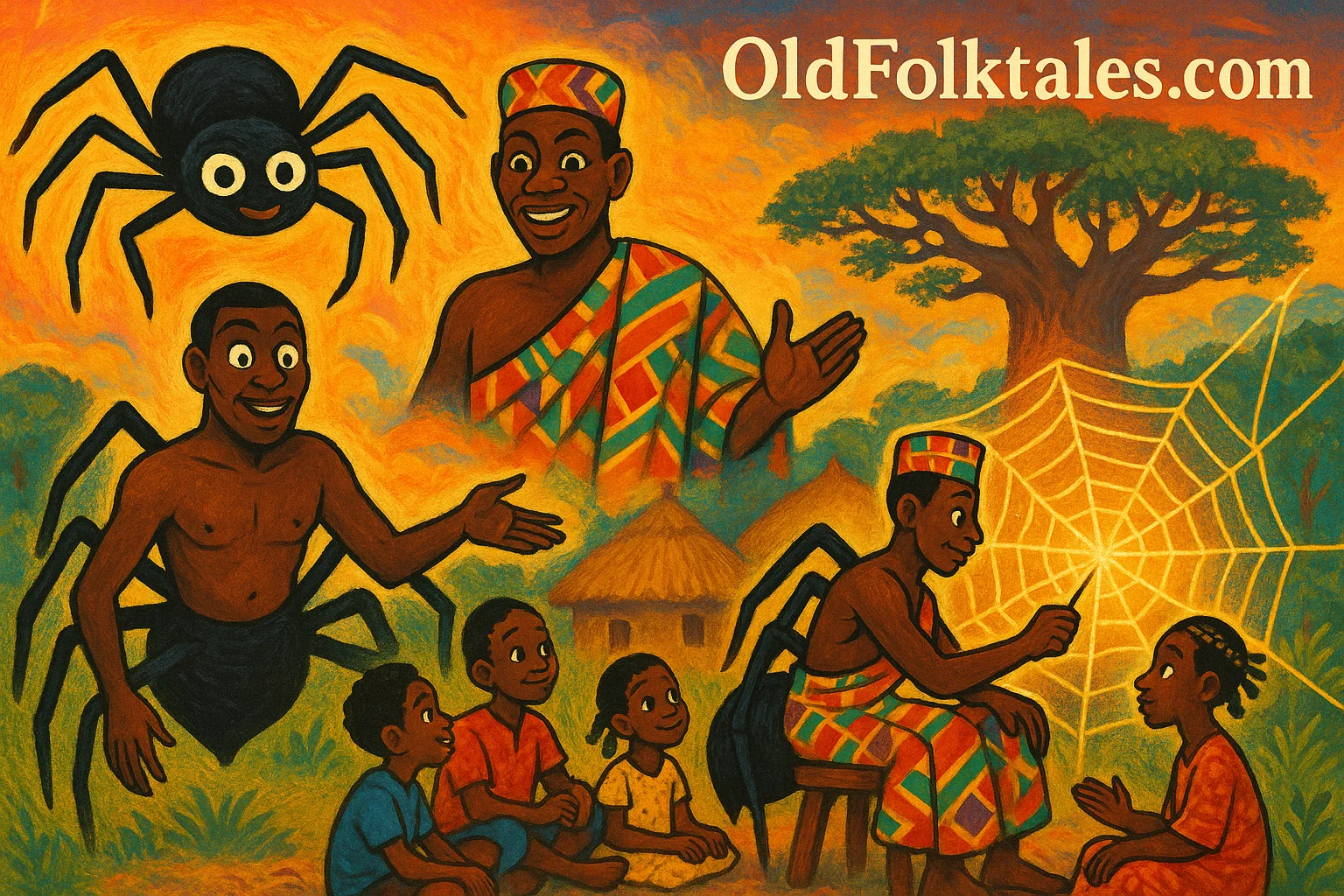
Among the vast pantheon of characters populating African oral tradition, few have achieved the lasting fame, cross-cultural reach, and sheer narrative staying power of Anansi the Spider. Originating among the Akan people of what is now Ghana, Anansi has grown from a regional trickster figure into one of the most recognizable characters in world folklore, his stories carried across oceans by the transatlantic slave trade to take root in the Caribbean, the American South, and beyond. To explore Anansi is to explore the very essence of the trickster archetype: a being whose cunning, humor, and moral ambiguity make him simultaneously a hero, a cautionary figure, and a mirror for human nature itself. Building on the previous installment of this series, which examined how oral tradition across Africa functions as a vessel of cultural memory, this piece turns to a single character who exemplifies that broader tradition perhaps more vividly than any other: a spider small enough to be overlooked, yet clever enough to outwit gods, leopards, and the very forces that once tried to keep the world’s stories locked away.
Who Is Anansi?
In Akan cosmology, Anansi occupies a fascinating dual identity. He is at once a literal spider, capable of spinning webs and scuttling into tight corners to escape danger, and a fully anthropomorphized being who walks, talks, schemes, and interacts with gods, animals, and humans alike. This duality is not treated as contradictory within the tradition; rather, it reflects a broader African storytelling convention in which animal characters seamlessly move between their natural form and humanlike behavior, allowing storytellers to explore human folly and wisdom through a non-human lens that softens direct criticism while sharpening its impact.
Anansi’s name itself derives from the Akan word for spider, and in many tellings he carries the fuller title Kwaku Ananse, incorporating a day-name common in Akan naming conventions, which assign names based on the day of the week a person is born. This detail, small as it may seem, reflects how deeply Anansi is embedded within the everyday cultural fabric of Akan society rather than existing as a distant, purely mythological figure. He is, in a sense, a member of the community, subject to its naming conventions even as he transcends its normal rules of behavior.
Physically, Anansi is often described as small, spindly-legged, and unassuming in appearance, a stark contrast to the powerful animals he regularly outwits, including elephants, hippos, lions, and even the sky god himself. This physical mismatch between Anansi’s modest form and his outsized cunning is central to his appeal. He represents the triumph of intelligence over brute strength, wit over raw power, a theme that resonates deeply in societies where the physically weak or socially marginalized must rely on cleverness to survive and thrive.
“Where the stones speak, the past whispers, and every ancient path leads us closer to the stories of Africa.”
This theme is captured succinctly in a well-known Akan proverb often invoked alongside Anansi tales: “Wisdom is like a baobab tree; no one individual can embrace it.” The proverb suggests that no single person, however clever, possesses complete wisdom, and it is fitting that this saying is so frequently paired with Anansi’s adventures, since many of his tales end with the spider learning, often the hard way, that his own cleverness has limits and that pure self-interest eventually meets its match.
Anansi’s place within Akan society extends beyond simple entertainment into the realm of everyday language and idiom. Expressions referencing Anansi’s cunning or his schemes have become embedded in everyday Akan speech, used to describe anyone displaying similar cleverness, whether admiringly or as a gentle warning against excessive scheming. This linguistic integration underscores just how thoroughly Anansi has woven himself into the cultural fabric of the Akan-speaking world, functioning simultaneously as entertainment, moral instruction, and a living part of the language itself.
The Trickster Archetype
To understand Anansi fully, it helps to situate him within the broader trickster archetype found across world mythologies, from Loki in Norse tradition to Coyote in various Native American traditions to Hermes in Greek myth. Tricksters share certain defining characteristics: they operate outside conventional moral boundaries, using deception, wit, and rule-breaking to achieve their goals; they are often catalysts for change, sometimes inadvertently bringing knowledge, fire, or other boons to humanity through their schemes; and they occupy a liminal space between order and chaos, neither fully heroic nor fully villainous.
Anansi embodies all of these qualities while adding distinctly Akan cultural texture. Unlike some trickster figures who exist primarily to cause chaos for its own sake, Anansi’s schemes are frequently motivated by very relatable, almost mundane desires: hunger, greed, jealousy, a wish to be recognized as clever, or simple self-preservation when faced with a threat. This grounding in recognizable human motivation is part of what makes Anansi stories so effective as vehicles for moral instruction. Listeners do not need to imagine an abstract cosmic force of chaos; they simply need to recognize the very human impulses that drive Anansi into his schemes, impulses that most listeners can identify within themselves.
What further distinguishes Anansi from many other trickster figures in world mythology is the sheer range of registers his stories occupy, moving fluidly from broad slapstick comedy to genuine moral gravity within a single narrative. A tale might begin with Anansi engaging in absurd, exaggerated deception that draws laughter from listeners, only to pivot toward a sobering conclusion in which his actions produce real consequences, whether for himself, his family, or the wider community of animals and spirits he interacts with. This tonal flexibility allowed storytellers considerable creative freedom, adapting individual tellings to suit the mood of a particular gathering, the age of the listeners present, or the specific lesson a parent or elder wished to impart on a given evening.
Anansi and the Sky God’s Stories
Among the most famous and foundational Anansi narratives is the tale explaining how Anansi came to own all the world’s stories. In this widely told myth, stories originally belonged exclusively to Nyame, the Akan sky god, who kept them locked away and refused to share them with the world below. Anansi, driven by a mix of ambition and genuine desire to bring stories to humanity, approached Nyame and asked to purchase the rights to these tales.
Nyame, likely expecting to deter the small spider with an impossible task, set a seemingly unachievable price: Anansi would need to capture and deliver four of the most dangerous and elusive creatures in the world — Onini the python, Osebo the leopard, the Mmoboro hornets, and Mmoatia, a mischievous fairy or dwarf spirit, depending on the specific telling. Rather than being discouraged, Anansi accepted the challenge and proceeded to outwit each creature in turn through a series of clever ruses rather than any display of physical strength.
Nyame himself occupies an important and somewhat ambiguous role across the broader corpus of Anansi tales, appearing sometimes as a stern, distant authority figure whose rules Anansi must navigate carefully, and other times as an almost indulgent patriarch who seems secretly amused by the spider’s audacity. This ambiguity mirrors the broader relationship many African cosmologies posit between a supreme creator deity and the lesser beings, spirits, and intermediaries who populate the world below, a relationship characterized by both reverence and a degree of familiar, even playful, negotiation rather than pure unquestioning submission.
To capture Onini the python, Anansi engaged the snake in a debate about whether he was truly as long as a nearby palm branch, goading Onini into stretching himself out along the branch to prove his length, at which point Anansi swiftly bound him in place. To capture Osebo the leopard, Anansi dug a deep pit disguised with leaves and branches, luring the proud leopard to fall in, then offered to help him out using his web, only to bind the leopard securely once he climbed free. The hornets were captured through an equally clever ruse involving a gourd of water and a fabricated rainstorm warning that convinced the hornets to take shelter inside a container, which Anansi promptly sealed. Mmoatia, the trickster spirit, was captured using a doll coated in sticky sap, exploiting the fairy’s own mischievous curiosity against her.
Having delivered all four creatures to Nyame, Anansi was granted ownership of the world’s stories, which from that point forward became known throughout much of West Africa as “Anansi’s stories” or “spider stories,” a naming convention that persists in oral tradition to this day. This origin myth is significant not merely as an entertaining adventure but as a meta-narrative explanation for why storytelling itself exists and why Anansi, specifically, sits at the very center of the African folkloric tradition as its patron figure.
What makes this origin myth particularly rich for analysis is its embedded commentary on the nature of intelligence itself. Anansi does not defeat any of the four creatures through direct confrontation or physical combat; in every instance, he identifies and exploits a specific psychological weakness — the python’s vanity about his length, the leopard’s pride and gratitude, the hornets’ fear of a coming storm, and the fairy spirit’s own mischievous curiosity. This pattern establishes a template followed throughout the broader Anansi corpus: victory belongs not to whoever is strongest, but to whoever best understands the psychology of their opponent. Storytellers reciting this tale to young listeners were thus not simply entertaining them with a fantastical adventure, but modeling a sophisticated approach to conflict resolution rooted in observation, patience, and psychological insight rather than aggression.
Variations of this origin story exist across different Akan-speaking communities and neighboring peoples who adopted Anansi tales into their own repertoires, with some versions substituting different creatures or adding additional trials, evidence of the living, evolving nature of oral tradition discussed in the previous chapter of this series. Despite these variations, the core structure, and the underlying message about cunning triumphing over brute force, remains remarkably consistent, suggesting a narrative core so satisfying and instructive that it has resisted significant alteration even as surface details shifted across generations and geographies.
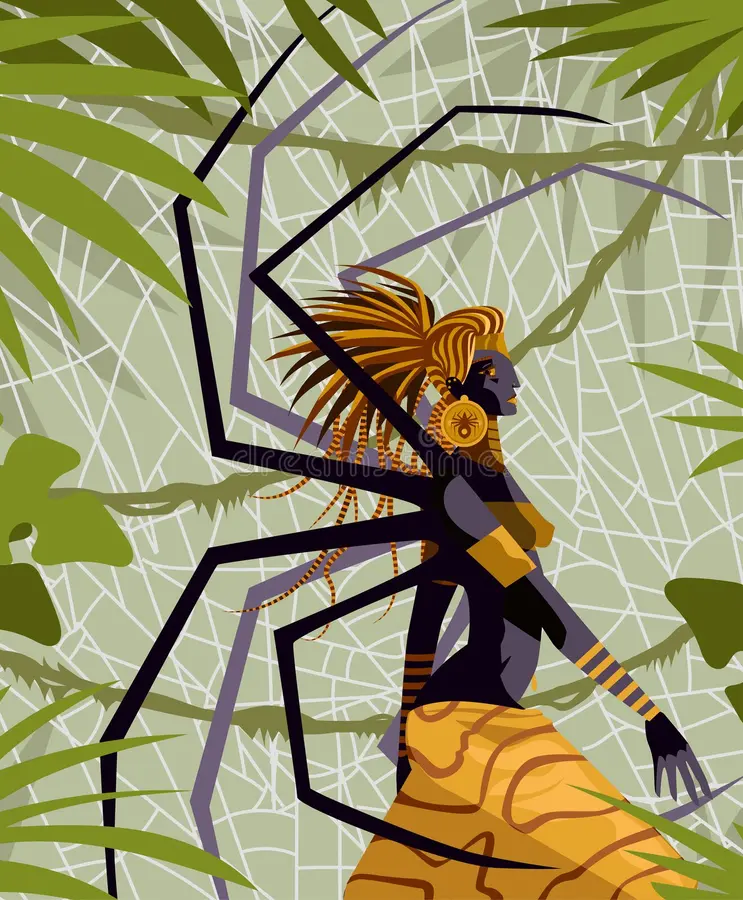 Common Themes in Anansi Tales
Across the vast body of Anansi stories collected and retold over generations, several recurring themes emerge that illuminate both the character’s function and the values his tales were meant to transmit.
The triumph of wit over strength appears in nearly every Anansi narrative, reinforcing the idea that intelligence, patience, and strategic thinking can overcome physical disadvantage. In agrarian and often precarious societies where the powerful could easily dominate the weak, these stories offered psychological validation to ordinary listeners, suggesting that cunning and resourcefulness were valuable currencies regardless of one’s social standing or physical capability.
Greed and its consequences form another persistent motif. Many Anansi tales follow a pattern in which the spider’s schemes, initially clever and successful, eventually backfire due to his own excessive greed or overreach. A frequently told example involves Anansi attempting to hoard all the world’s wisdom in a single gourd, intending to keep it away from everyone else, only to end up spilling the wisdom across the world when his own arrogance and clumsiness cause the gourd to break during an ill-advised attempt to hide it at the top of a tree. Such stories serve as pointed cautionary tales, reminding listeners that unchecked greed ultimately undermines even the cleverest schemer.
Family dynamics and community obligation also feature prominently, with numerous tales involving Anansi’s wife, Aso, and his children, who often serve as voices of reason, occasional co-conspirators, or sometimes the very targets of Anansi’s schemes when his self-interest overrides familial loyalty. These family-centered tales ground the more fantastical elements of Anansi’s adventures in recognizable domestic situations, reinforcing values around family responsibility even while entertaining audiences with Anansi’s antics.
The power of language and persuasion represents a further recurring theme woven throughout the Anansi corpus. Many of the spider’s most successful schemes rely not on physical trickery alone but on his exceptional gift for rhetoric, flattery, and persuasive argument. Anansi frequently talks his way into or out of difficult situations, using carefully chosen words to manipulate the perceptions and decisions of those around him. This emphasis on verbal cunning reflects the broader cultural value placed on eloquence and skillful speech within Akan society and many other West African cultures, where the ability to speak persuasively was, and remains, a highly respected social skill, closely associated with leadership, diplomacy, and social advancement.
Anansi’s Journey Across the Atlantic
Perhaps no aspect of the Anansi tradition illustrates the resilience and adaptability of African folklore more powerfully than the character’s survival and transformation following the transatlantic slave trade. As millions of West Africans, including many from Akan-speaking regions, were forcibly transported to the Caribbean and the Americas, they carried their oral traditions with them, preserving them as one of the few forms of cultural continuity available under the brutal conditions of enslavement.
In the Caribbean, particularly in Jamaica, Anansi stories flourished and evolved, absorbing new linguistic influences and adapting to new environmental and social contexts while retaining the character’s essential cunning and trickster nature. Anansi became known locally by variations of his name, including Anancy, and his stories took on additional layers of meaning within the context of plantation slavery, where his triumphs over larger, more powerful adversaries resonated with enslaved communities navigating their own relationships with those who held power over them. Some scholars argue that Anansi tales served a subtly subversive function in this context, allowing enslaved storytellers to encode commentary on resistance, survival, and outwitting oppressive authority within seemingly simple animal fables.
The character’s influence extended further still into the American South, where Anansi’s narrative DNA can be traced in figures such as Br’er Rabbit, another small, cunning creature who repeatedly outsmarts larger and more powerful adversaries through wit rather than strength. While Br’er Rabbit developed his own distinct identity within African American folklore, the thematic and structural echoes of the Anansi tradition remain unmistakable, testament to how deeply these West African narrative patterns embedded themselves within the broader African diaspora’s cultural imagination.
Beyond Br’er Rabbit, echoes of Anansi’s cunning problem-solving style can also be traced in other diasporic trickster figures, including certain characters within Haitian and broader Afro-Caribbean storytelling traditions, where the boundaries between distinct trickster lineages often blur as communities drew on shared West African source material while also absorbing indigenous Caribbean and European narrative influences encountered in their new environments. This cross-pollination of storytelling traditions across the diaspora represents one of the more remarkable, if often understudied, chapters in the global history of folklore, demonstrating how a single character born in the forests and villages of West Africa could seed an entire family of related narrative traditions spanning multiple continents and centuries.
The linguistic evolution of Anansi’s name itself offers a fascinating window into this process of cultural transmission and transformation. As the character moved from Akan-speaking West Africa into English and patois-speaking Caribbean societies, his name shifted phonetically while retaining clear connection to its origin, appearing as Anancy in Jamaica, Nancy or Aunt Nancy in parts of the American South, and various other regional adaptations throughout the Caribbean basin. Each of these linguistic variations tells its own small story of cultural adaptation, as communities separated from their African homeland by forced migration nonetheless worked to preserve, however imperfectly, the sounds and stories of their ancestral heritage.
Anansi in Contemporary Culture
Anansi’s remarkable journey has not ended with the historical diaspora. In the modern era, Anansi has continued to evolve as a cultural touchstone, appearing in children’s literature, animated adaptations, and even contemporary fiction aimed at adult audiences. Author Neil Gaiman’s novel “Anansi Boys” reimagined the trickster god for a contemporary literary audience, while numerous illustrated children’s books have introduced new generations, both within Africa and across its diaspora, to the spider’s clever schemes.
Ghanaian and broader West African cultural institutions have also embraced Anansi as a symbol of national and regional pride, incorporating the character into tourism branding, educational materials, and public art. Museums and cultural centers dedicated to Akan heritage frequently feature Anansi prominently, presenting him not merely as a folkloric curiosity but as a genuine cultural ambassador whose stories continue to communicate Akan values and wit to visitors from around the world. Meanwhile, digital media has opened entirely new avenues for Anansi’s continued relevance, with animated web series, podcast adaptations, and even video games drawing on the character’s rich narrative legacy to reach audiences who engage with folklore through screens rather than fireside gatherings.
This ongoing cultural relevance speaks to something essential about the trickster archetype’s enduring appeal. Anansi’s stories, though rooted in a specific Akan cultural context centuries old, continue to resonate because they speak to universal human experiences: the desire to overcome disadvantage through cleverness, the temptation and danger of greed, and the complicated, often humorous ways individuals navigate power imbalances in their daily lives.
Anansi the Spider stands as perhaps the single most influential figure to emerge from African oral tradition, a testament to the enduring power of the trickster archetype and the remarkable resilience of African storytelling in the face of historical upheaval. From his origins among the Akan people of Ghana to his transformation across the Caribbean and into American folklore, Anansi’s journey mirrors the broader story of African cultural survival and adaptation across the diaspora, carrying forward the same values of cleverness, resilience, and community wisdom explored throughout this article and echoed in the opening piece of this series on how folklore preserves cultural memory. His tales continue to entertain, instruct, and provoke reflection on the eternal human questions of power, cleverness, and consequence, ensuring that this small, unassuming spider remains one of the giants of world storytelling. In the next installment of this series, we turn from the trickster to the cosmic, exploring the rich variety of African creation myths and the many ways different peoples across the continent have imagined the origins of the world itself.
