

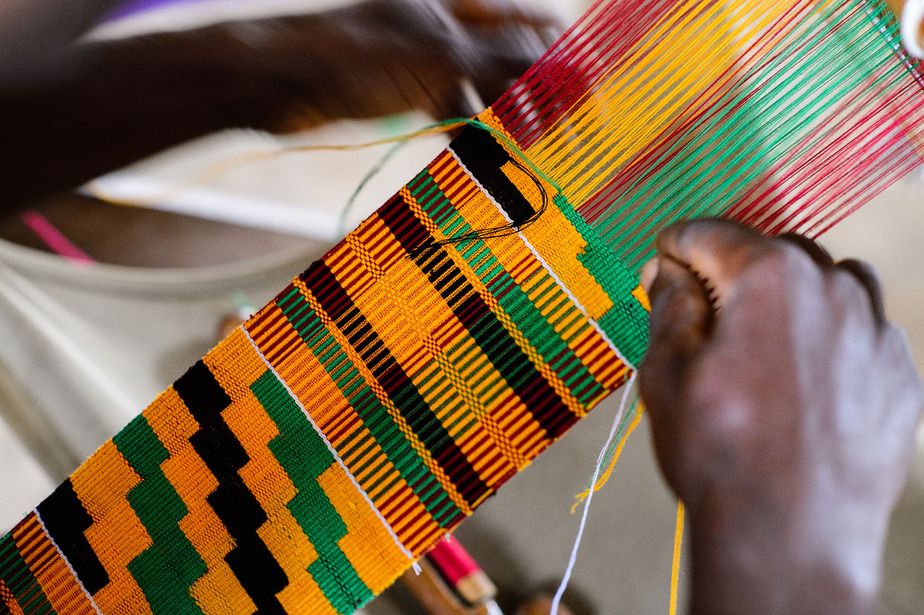
Introduction: More Than a Textile
Few African textiles have achieved the global recognition of Kente. Its bold geometric patterns and vivid color blocks have appeared on graduation stoles in American universities, red carpets in Los Angeles, and the shoulders of world leaders. Yet for all its international fame, Kente’s deepest meaning remains rooted in a specific place, a specific people, and a specific history: the Akan-speaking Ashanti (Asante) and Ewe communities of Ghana, for whom this cloth has never been mere decoration but a woven archive of philosophy, history, and royal authority.
To understand Kente only as a “colorful African print” is to miss almost everything that matters about it. Traditionally, Kente was not something one simply bought and wore. It was earned, gifted, or reserved — its patterns tied to specific chiefs, its colors coded with precise meaning, and its production a slow, skilled, almost meditative act of craftsmanship passed down through generations of male weavers. This article traces Kente from its legendary origins through its construction, its symbolism, its royal associations, and its journey onto the global stage, while examining the tensions that journey has created between commercial success and cultural preservation.
 Origins and Legend
Kente’s origins are wrapped in oral history as much as documented fact, and the most widely told origin story reflects the value Akan culture places on close observation of the natural world. According to Ashanti tradition, two friends — often named in oral accounts as Ota Karaban and Kwaku Ameyaw — from the town of Bonwire observed a spider spinning an intricate web in the forest. Fascinated by the web’s structure, they returned home and attempted to replicate its pattern using black and white fibers, eventually developing the loom-based weaving technique that would become Kente. They brought their creation to the Asantehene (the King of Ashanti), who was so impressed that he adopted the cloth for royal use, and Bonwire subsequently became recognized as the historical heartland of Kente weaving, a status the town proudly retains today as a center of the craft and a destination for those seeking to witness authentic production firsthand.
Historians note that woven strip cloth traditions likely predate this specific legend and connect to broader West African weaving practices, but the spider story remains culturally significant because it embeds a value system into Kente’s very creation myth: patience, careful observation, and the transformation of natural inspiration into structured, meaningful pattern — qualities the cloth itself is meant to embody and transmit.
The Ewe people, located primarily in Ghana’s Volta Region as well as parts of Togo, developed their own parallel and related weaving tradition, often referred to as Kete or Kente as well, with distinct pattern names, motifs, and color preferences reflecting their own history and worldview. While Ashanti and Ewe Kente share the fundamental strip-weaving technique, their symbolic vocabularies differ, underscoring again that “Kente” is not a single monolithic tradition but a family of related practices.
The Technique: How Kente Is Made
Understanding Kente’s cultural weight requires understanding the labor behind it. Traditional Kente is woven on a horizontal treadle loom, historically operated exclusively by men, who sit at the loom for extended hours producing narrow strips of cloth typically measuring around four inches in width. Each strip can take a skilled weaver a full day or more to produce a single meter, depending on pattern complexity, meaning a single large ceremonial cloth composed of many strips sewn together can represent weeks of continuous, highly skilled labor.
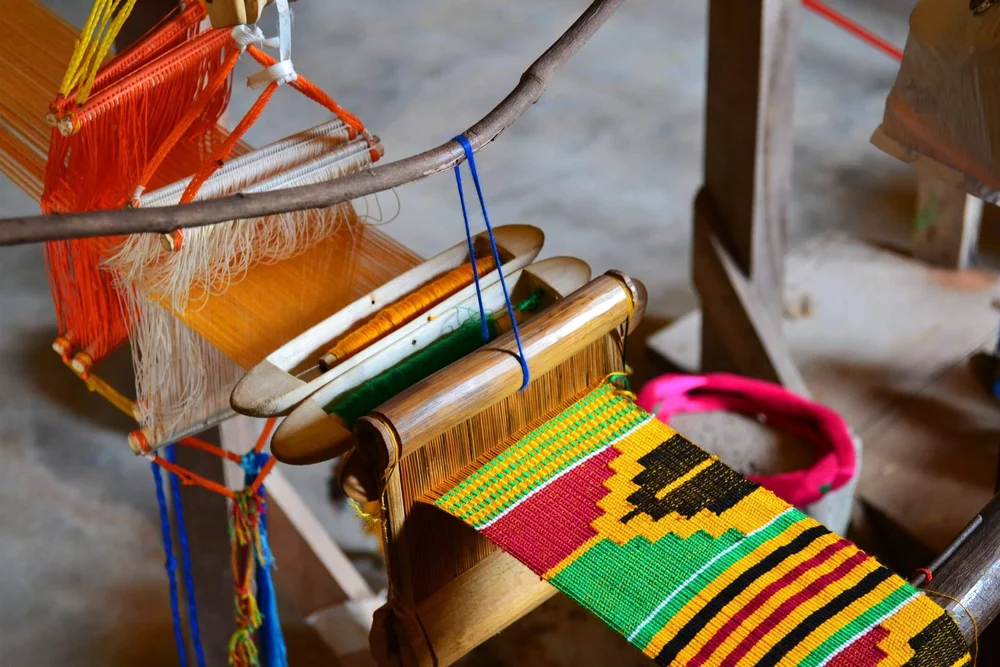 The weaving process itself involves managing multiple colored threads simultaneously, using foot pedals to control the loom’s heddles while the hands guide the shuttle carrying the weft threads through the warp. Complex patterns require the weaver to hold detailed pattern sequences in memory — historically transmitted through apprenticeship rather than written diagrams — making master weavers repositories of enormous accumulated knowledge. A young apprentice traditionally spent years learning under a master weaver, starting with simple patterns and progressing toward the most complex and prestigious designs only after demonstrating sufficient skill and, often, sufficient trustworthiness, since some patterns were considered too significant to entrust to an unproven weaver.
Once individual strips are completed, they are carefully sewn together edge to edge to create the wider cloths worn as garments. The alignment must be precise, as a skilled weaver’s strips will match pattern repeats seamlessly across the seams, while a less skilled assembly will show visible misalignment — another marker by which knowledgeable observers assess a cloth’s quality and the reputation of its maker.
Authentic handwoven Kente stands in stark contrast to the printed “Kente-patterned” fabrics that have proliferated globally, particularly in the diaspora, where machine-printed imitations mimic the visual pattern without any of the underlying structural weaving or symbolic pattern-naming tradition. This distinction matters enormously to Ghanaian weavers and cultural custodians, who have increasingly voiced concern about the erosion of both the economic livelihood of traditional weavers and the cultural integrity of the tradition when cheap imitations flood markets, both within Ghana and internationally.
The Language of Color in Kente
As introduced in the broader discussion of African dress symbolism, color in Kente is never arbitrary. Each hue carries specific, widely recognized meaning within Akan cultural understanding, and skilled weavers combine colors deliberately to construct a coherent symbolic statement, not merely a visually pleasing arrangement.
Gold or yellow represents royalty, wealth, high status, and spiritual purity, reflecting Ghana’s historical wealth in gold and its centrality to Ashanti political and economic power. Cloths heavy with gold-toned threads were historically reserved for the highest-status wearers, particularly the Asantehene and other paramount chiefs.
Green symbolizes growth, fertility, and the vitality of the natural and agricultural world, often incorporated into cloths intended to convey hope, renewal, or blessing for prosperity.
Blue represents peace, harmony, love, and spiritual calm, frequently included in cloths meant to convey benevolent or conciliatory messages.
Red carries dual symbolism, representing political and spiritual strength, passion, and determination, but also bloodshed, sacrifice, and the intensity of struggle — making it appropriate for both militant, empowering contexts and, in different combinations, solemn or serious ones.
Black signifies spiritual maturity, ancestral energy, antiquity, and communion with those who have passed on, appearing prominently in cloths associated with funerals, memorial services, and ceremonies honoring ancestral connection, though notably without the purely negative connotation “mourning black” carries in many Western contexts.
White represents purification, sanctification, and festive celebration, often worn during joyous occasions and spiritual purification rites.
Silver represents serenity and purity, associated with the moon, and often used to convey a gentler, more contemplative message than gold’s assertive wealth symbolism.
Master weavers combine these colors deliberately according to the message a specific cloth is meant to carry, meaning two Kente cloths with similar pattern structures but different color proportions can carry substantially different symbolic messages, legible to those trained in the tradition’s visual vocabulary.
Named Patterns and Their Meanings
Beyond color, Kente’s most distinctive feature is its system of named patterns, each carrying specific historical, proverbial, or philosophical significance. Unlike anonymous decorative motifs, Kente patterns function almost like titled works of art or named proverbs, each pattern name pointing toward a specific story, value, or historical reference that the wearer implicitly invokes by choosing that cloth.
Among the most renowned patterns is Adweneasa, meaning “my skill is exhausted” or “I have exhausted my ideas,” historically considered one of the most complex and prestigious patterns a weaver could produce, incorporating numerous other pattern motifs into a single elaborate composition. Its name reflects both the weaver’s claim to have poured every ounce of skill into the piece and, by extension, the cloth’s association with mastery and achievement.
Sika Futuro (“gold dust”) symbolizes wealth, preciousness, and royal status, frequently incorporating heavy gold-toned coloring appropriate to its name.
Emaa Da (“it has not happened before” or “unprecedented”) is traditionally associated with uniqueness, originality, and historic firsts, sometimes chosen to commemorate a significant, unrepeated event.
Fathia Fata Nkrumah, created in honor of Ghana’s first president Kwame Nkrumah and his wife Fathia, commemorates their marriage and stands as an example of Kente’s capacity to absorb and memorialize contemporary historical events into its pattern vocabulary, demonstrating that the tradition is not frozen in antiquity but continues to generate new named patterns in response to significant occurrences.
Obaakofoo Mmu Man (“one person does not rule a nation”) encodes a political philosophy emphasizing collective governance and consultation over autocratic rule, illustrating how Kente patterns can carry explicitly political and philosophical statements, not merely decorative or celebratory ones.
Each of these patterns, and dozens of others in the broader Kente vocabulary, functions as a kind of woven proverb — a compact, visually encoded statement that a knowledgeable observer can “read” much as one might recognize a familiar saying. Selecting a particular pattern for a particular occasion is therefore an act of communication, not mere fashion choice, allowing the wearer to align themselves publicly with a specific value, historical reference, or aspiration.
Royal Association and Restricted Access
Historically, Kente’s most elaborate and symbolically weighty patterns were reserved for royalty and high-ranking chiefs within the Ashanti political structure. The Asantehene, as the paramount ruler, had access to the most complex and prestigious cloths, often woven specifically for royal use and not available for ordinary purchase or wear. Certain patterns were considered the exclusive prerogative of specific chiefs or royal lineages, and wearing such a pattern without appropriate status was considered a serious social transgression — a false claim to authority and status one had not earned.
This restricted-access system reinforced Kente’s function as a marker of social hierarchy, similar to how certain honors, titles, or regalia are restricted in other societal systems worldwide. Over time, particularly as Ghana moved through the twentieth century and into independence, access to Kente gradually broadened, with many patterns becoming available to the general public for special occasions such as weddings, graduations, and festivals, even as the most historically significant royal patterns retain their special status and association with chieftaincy institutions to this day.
Kente remains central to Ashanti royal ceremony in the present day. The Asantehene and other chiefs continue to wear elaborate, often museum-quality Kente cloths during durbars, festivals, and state occasions, with the scale and complexity of the cloth serving as a visible marker of the wearer’s rank within the traditional political hierarchy that continues to operate alongside Ghana’s modern democratic government.
Kente in Ceremony and Everyday Ghanaian Life
Beyond royal contexts, Kente occupies a significant place in Ghanaian ceremonial life more broadly. It is prominently worn during weddings, both traditional and, increasingly, blended with Western-style ceremonies, where couples and their families don coordinated or complementary Kente to visually represent the union of families and the celebratory nature of the occasion. Funerals, too, incorporate Kente, though with careful attention to appropriate color combinations reflecting the solemnity of loss balanced against the celebratory acknowledgment of a life well-lived — a nuanced approach reflecting the earlier discussion of black’s ancestral rather than purely mournful connotation in Akan symbolism.
Festivals such as the Ashanti Akwasidae, a ceremony honoring ancestors and royal lineage held according to the Akan calendar, showcase Kente prominently among chiefs, elders, and community members, reinforcing the cloth’s continued centrality to communal identity and historical memory. Graduation ceremonies within Ghana, and increasingly among the Ghanaian diaspora worldwide, frequently incorporate Kente stoles or sashes, symbolically connecting educational achievement to cultural heritage and ancestral pride.
Kente’s Global Journey
Kente’s international visibility expanded dramatically from the mid-twentieth century onward, closely tied to Ghana’s post-independence prominence under Kwame Nkrumah, who frequently wore Kente during international diplomatic engagements, presenting it as a proud symbol of African identity and post-colonial self-determination at a moment when many African nations were asserting new sovereignty on the world stage. This visibility helped establish Kente as perhaps the most internationally recognized African textile pattern, a status it retains today.
Within the African diaspora, particularly in the United States, Kente became closely associated with the Black pride and Afrocentric movements from the 1960s onward, worn as a deliberate assertion of African heritage and connection amid a cultural environment that had long devalued or erased that connection. Kente stoles worn during graduation ceremonies, a tradition that began gaining prominence in the late twentieth century, exemplify this diaspora adoption — a garment historically tied to specific Akan royal and ceremonial contexts repurposed as a broader pan-African symbol of achievement and heritage pride, even among individuals with no direct genealogical connection to Akan communities.
This global embrace has brought both opportunity and tension. On one hand, it has generated significant economic opportunity for Ghanaian weavers and exporters, and it has elevated global awareness of Ghanaian culture and craftsmanship. On the other hand, it has generated the imitation-fabric problem noted earlier, alongside broader questions about cultural appropriation, appropriate compensation for traditional knowledge, and the risk of the pattern’s specific meanings being flattened into generic “African print” branding that erases its precise cultural and historical specificity.
Preservation Efforts and the Path Forward
Recognizing both the economic and cultural stakes involved, various efforts have emerged to protect and promote authentic Kente weaving. Bonwire and other weaving centers continue to train new generations of weavers, and cultural tourism initiatives bring visitors directly to weaving communities, generating income that supports the continuation of traditional techniques while also increasing public understanding of Kente’s genuine complexity and meaning, as opposed to its flattened commercial imitations.
Ghanaian cultural institutions, alongside international bodies interested in intangible cultural heritage preservation, have engaged in ongoing discussions about intellectual property protections for traditional textile patterns, though the legal mechanisms for protecting communally-held traditional knowledge remain complex and, in many respects, still developing globally.
Contemporary Ghanaian and diaspora fashion designers increasingly seek to incorporate authentic Kente, woven in collaboration with traditional weavers, into modern fashion lines, positioning the cloth within global luxury and contemporary fashion contexts while working to preserve, rather than erase, its handwoven authenticity and specific symbolic vocabulary — an approach many cultural advocates view as a promising model for balancing economic modernization with cultural integrity.
Conclusion: A Cloth That Carries a Nation’s Memory
Kente stands as one of the clearest examples of African traditional clothing’s capacity to function simultaneously as art, history, philosophy, and social structure woven into a single physical object. From its legendary origins observing a spider’s web, through centuries of royal association and restricted access, to its contemporary status as a global symbol of African pride and achievement, Kente demonstrates how a textile tradition can carry a community’s accumulated wisdom across generations while continuing to absorb new history and meaning, as seen in patterns like Fathia Fata Nkrumah commemorating contemporary events.
To wear authentic Kente, understood in its full cultural context, is to participate in a centuries-old conversation about wealth, wisdom, governance, ancestry, and celebration — one strip, one color, one named pattern at a time. As the broader series on African traditional clothing continues, Kente’s example — precise symbolic vocabulary, skilled craft production, royal association, and successful (if complicated) global expansion — offers a template against which other traditions, from Nigeria’s Adire to South Africa’s Zulu beadwork, can be usefully compared.
