

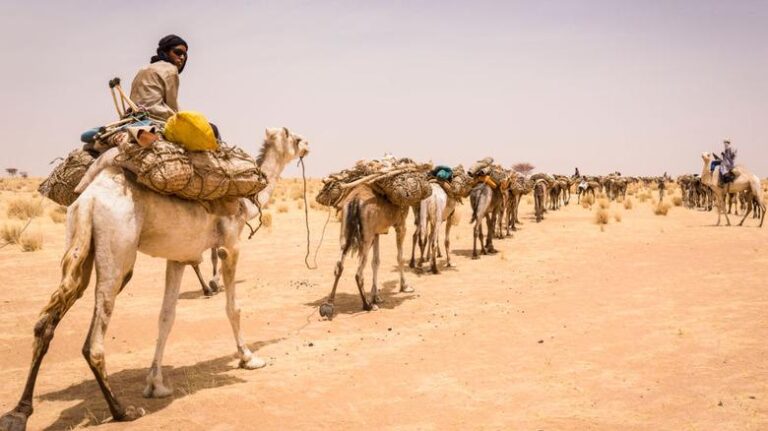
Africa is often imagined as a collection of isolated regions separated by deserts, forests, mountains and enormous distances. But for thousands of years, people found ways to move across those barriers.
Caravans crossed the Sahara. Boats traveled along the Nile and Niger. Merchants sailed the Red Sea and Indian Ocean. Traders moved through savannas, river valleys, forests and coastal settlements. Goods traveled from one ecological zone to another, while languages, religions, technologies, artistic traditions and ideas moved with them.
Long before modern roads, railways and airports connected African countries, trade routes created their own networks of connection.
The most famous were the trans-Saharan routes linking West Africa with North Africa and the Mediterranean. But these were only part of a much larger commercial world. Trade also connected the Nile Valley with northeastern Africa, the Horn of Africa with Arabia, and the East African coast with the Arabian Peninsula, Persia, India and other parts of the Indian Ocean world.
OpenStax describes trans-Saharan trade as a network that eventually stretched across North and West Africa, carrying commodities including gold, salt, ivory, copper, textiles and enslaved people.
These networks helped cities grow, strengthened kingdoms, created wealthy merchant communities and encouraged cultural exchange.
They also remind us that Africa’s precolonial societies were not isolated from the wider world.
They were participants in it.
 Africa’s Geography Created the Need for Trade
Africa’s enormous geographical diversity was one of the reasons trade became so important.
The continent contains deserts, tropical forests, grasslands, highlands, river valleys and extensive coastlines. Different environments produced different resources.
A community living near salt deposits might have access to something that was scarce in agricultural regions.
A gold-producing region might lack sufficient salt.
Pastoral communities could exchange livestock products with agricultural societies.
Coastal communities could acquire goods arriving by sea and exchange them with people living inland.
This created a basic economic principle:
Different environments produced different resources, and trade connected the people who needed them.
The Sahara is an excellent example.
It is one of the world’s largest deserts, but it was never an impenetrable wall separating North Africa from the south.
People developed knowledge of desert geography, water sources and routes through the Sahara. The introduction and widespread use of camels transformed long-distance desert commerce because camels were exceptionally suited to arid conditions.
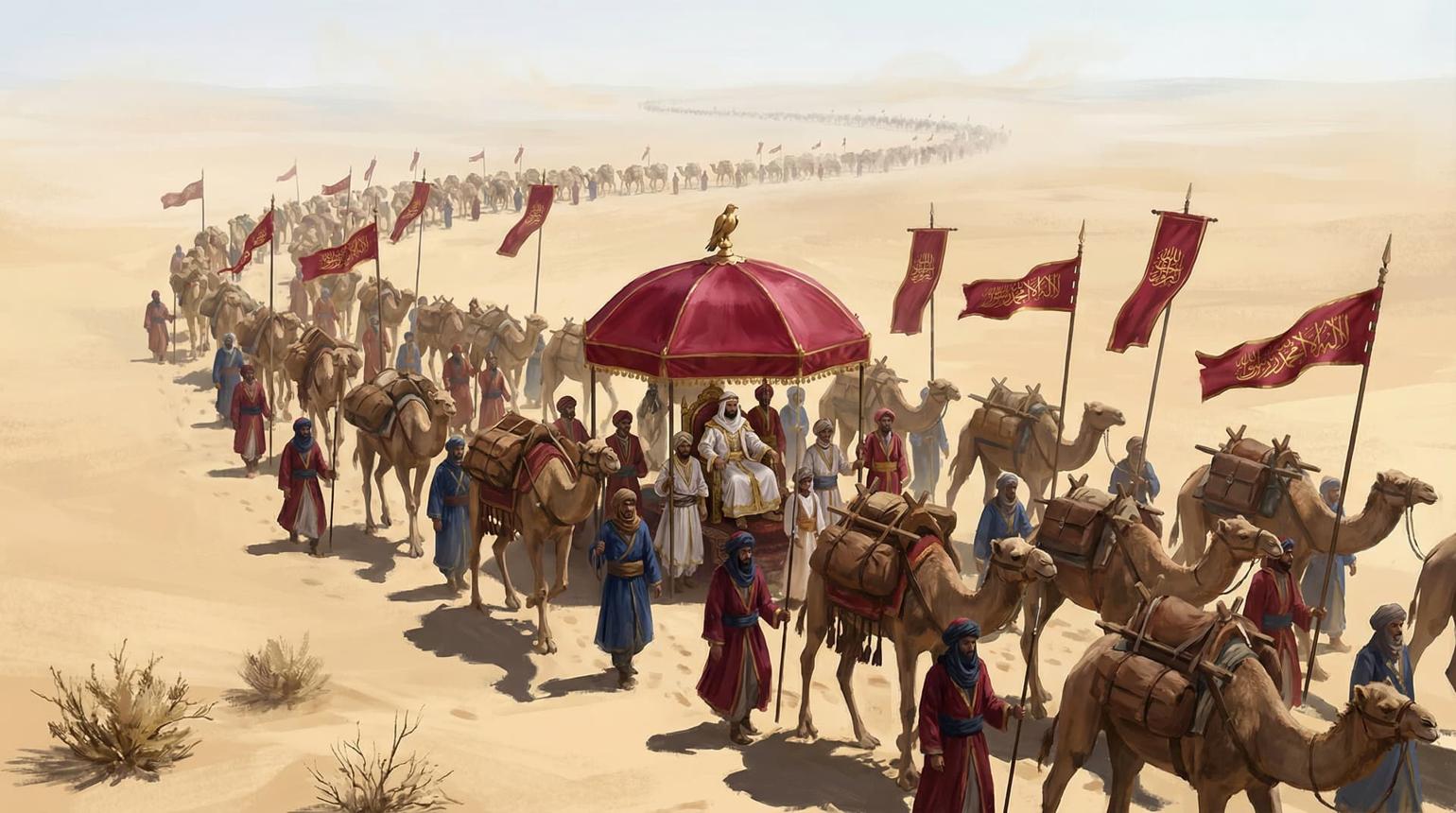
By the medieval period, organized camel caravans could travel enormous distances between North African and West African trading centers.
The Sahara therefore became not simply a barrier, but also a commercial corridor.
The Trans-Saharan Trade Network
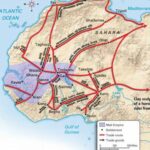
The trans-Saharan trade was one of the most important commercial systems in African history.
Although forms of exchange across the Sahara existed much earlier, the network expanded significantly over time. The Metropolitan Museum of Art notes that camel-assisted trans-Saharan commerce became particularly important from around the seventh century onward, with gold emerging as a major commodity.
OpenStax describes the major trans-Saharan network as reaching its height between approximately the ninth and fifteenth centuries, when camel caravans crossed a web of routes connecting North and West Africa.
The routes were not one single road.
They were a collection of interconnected paths.
Some routes passed through oases. Others connected major commercial cities. Traders had to understand water availability, seasonal conditions, political boundaries and the risks associated with desert travel.
A caravan could contain merchants, guides, camel handlers, guards and other travelers.
The journey could take weeks or months.
Yet the potential rewards were enormous.
Gold from West Africa could be exchanged for salt from the Sahara and other goods from North Africa and beyond.
The movement of commodities created wealth for merchants, rulers, transporters and communities located along the routes.
Gold: The Commodity That Attracted the World
Gold was one of the most important commodities in the history of African trade.
West Africa possessed major gold-producing regions, particularly in areas associated with the ancient and medieval western Sudan.
The Metropolitan Museum of Art identifies gold from western and central Sudan as the principal commodity of the trans-Saharan trade and notes that demand for gold was strongly connected to the monetary systems of North Africa and the Mediterranean world.
Gold’s value made the regions that produced it strategically important.
But gold did not simply remain in African royal treasuries.
It entered wider commercial networks.
Merchants transported it north across the Sahara, where it could eventually circulate through Mediterranean and Islamic markets.
This helps explain the wealth associated with states such as Ghana, Mali and Songhai.
Their power was not based on gold alone, but access to gold-producing areas and taxation of commerce could provide rulers with significant revenue.
The result was a powerful relationship between natural resources, trade and political authority.
Salt: The Other Half of the Equation
If gold was one of the great attractions of the southern trade routes, salt was one of the most important commodities moving in the opposite direction.
Salt was essential for human health and food preservation.
In regions where naturally available salt was limited, large deposits became economically valuable.
Saharan salt-producing areas supplied communities farther south.
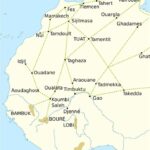
Places such as Taghaza became famous for salt production and trade.
The contrast was striking.
Gold was relatively scarce but highly valuable.
Salt was essential and could be extremely valuable in regions where it was difficult to obtain.
Their exchange became one of the most famous examples of long-distance commerce in African history.
The expression “gold and salt trade” has therefore become shorthand for a much larger commercial system.
But the trade involved far more than two commodities.
What Else Did African Traders Exchange?
African trade networks carried an enormous variety of goods.
Depending on the region and period, merchants exchanged:
- gold;
- salt;
- ivory;
- copper;
- iron;
- textiles;
- leather goods;
- livestock;
- agricultural products;
- kola nuts;
- beads;
- ceramics;
- weapons;
- horses;
- perfumes;
- spices;
- precious and semi-precious materials;
- and enslaved people.
OpenStax specifically identifies commodities such as copper, salt, ivory, textiles, gold and enslaved people among goods moving across trans-Saharan networks.
The movement of these goods created opportunities for specialized occupations.
Some people became merchants.
Others became caravan guides.
Some produced pottery, metalwork, textiles or leather goods.
Others operated markets, warehouses, transport services or inns.
Trade therefore generated entire economic ecosystems.
Camels Changed Desert Commerce
One of the most important technologies in trans-Saharan commerce was not a complicated machine.
It was the camel.
Camels are exceptionally adapted to desert environments. They can travel long distances with limited water and withstand harsh conditions.
Their use made long-distance caravan travel across the Sahara more practical.
The Metropolitan Museum of Art notes the growing importance of camel-based crossings by Berber-speaking peoples from around the fifth century onward, with more established caravan routes documented from later centuries.
The camel did not create Saharan trade by itself.
People already possessed knowledge of desert travel.
But camel transport dramatically increased the potential scale and reliability of long-distance commerce.
Caravans could carry heavier loads across routes that would have been extremely difficult for other forms of transport.
In this sense, transportation technology became an economic technology.
The Sahel: Africa’s Great Commercial Middle Ground
Between the Sahara and the wetter savanna regions lies the Sahel.
Historically, the Sahel became one of the most important transition zones in African commerce.
It connected North Africa and the Sahara with West Africa’s agricultural and gold-producing regions.
This geographical position helped cities such as Timbuktu, Gao and Djenné develop into important commercial centers.
The cities were not merely places where goods were exchanged.
They became places where people met.
Merchants from different regions interacted with scholars, artisans, farmers, religious teachers, political officials and travelers.
Consequently, trade encouraged cultural exchange.
A merchant could arrive carrying goods but leave carrying new ideas, religious beliefs, stories, technologies or language influences.
This is one reason trade routes are so important to cultural history.
They moved people as much as they moved commodities.
Timbuktu: Where Trade and Knowledge Met
Few African cities symbolize the relationship between commerce and intellectual life more strongly than Timbuktu.
Located near the Niger River and close to major trans-Saharan routes, Timbuktu became an important center of trade.
Merchants brought goods into the city, while traders connected it with other West African and North African markets.
Its commercial importance helped support a wider urban economy.
But Timbuktu became famous for something else too.
Learning.
Islamic scholarship developed around mosques, scholars, teachers and study communities.
Manuscripts circulated among learned families and institutions.
Religious studies were particularly important, but scholarship also included law, grammar, literature, mathematics, astronomy and other fields.
The connection between trade and scholarship was not accidental.
A wealthy commercial center could attract educated people.
Travelers could carry books and ideas along the same routes that carried gold and salt.
In this way, commercial networks became intellectual networks.
Djenné and the Niger River
Timbuktu was not the only important trading center.
Djenné, situated in the inland Niger Delta region, became another major commercial city.
Its location gave it access to agricultural production, waterways and wider trading networks.
The Niger River was especially important because it provided transportation through a region where overland travel could be difficult.
River transport could move larger quantities of goods than individual people carrying loads.
Fishing and agriculture also supported populations living around the river.
As a result, the Niger River became both an economic resource and a transportation system.
The growth of cities along the river illustrates how geography and commerce could reinforce each other.
Gao and the Niger River Trade
Gao was another major center in the history of West African commerce.
Its location along the Niger made it strategically valuable.
It eventually became the capital of the Songhai Empire and an important center of political and commercial power.
The rise of Songhai illustrates the relationship between trade routes and empire-building.
Control of major cities meant access to markets.
Control of the river meant transportation.
Control of surrounding territories meant access to agricultural production and taxation.
Trade therefore became one component of imperial power.
This relationship had already been important under Mali.
Songhai inherited and expanded many of the commercial systems that had previously helped Mali flourish.
Trade and the Rise of African Empires
Trade did not automatically create empires.
However, it could provide the resources that allowed political states to expand.
A ruler who controlled a major trading center could collect taxes.
A government controlling gold-producing regions could benefit from mineral wealth.
A state controlling caravan routes could impose duties on merchants.
A kingdom able to protect traders could become more attractive to commercial communities.
This produced a cycle of economic and political development.
Trade created wealth.
Wealth strengthened political authority.
Political authority could protect trade.
Protected trade generated additional wealth.
This relationship helped contribute to the power of the Ghana, Mali and Songhai empires.
It also explains why rulers competed for control of strategically located cities.
The Nile as an Ancient Trade Corridor
The Niger was not Africa’s only major inland trade artery.
The Nile had connected communities in northeastern Africa for thousands of years.
Ancient Egypt depended heavily on the river for agriculture, transportation and communication.
The Nile also connected Egypt with Nubia and regions farther south.
Goods, people and ideas moved along the river.
Nubian kingdoms such as Kush participated in these networks while also maintaining their own relationships with regions beyond the Nile Valley.
The river therefore functioned as a natural transportation corridor.
This illustrates a recurring theme in African history:
Rivers could become highways before highways existed.
Trade in the Horn of Africa
Farther east, the Horn of Africa developed commercial connections across the Red Sea.
Aksum became one of the most important ancient states in this region.
Its strategic location gave it access to the port of Adulis and maritime networks linking Africa with Arabia and the Mediterranean world.
The Aksumite economy therefore depended partly on international commerce.
Goods from the African interior could be moved toward the coast, while foreign goods traveled inland.
The Red Sea became a bridge rather than a boundary.
This is important because it demonstrates that African trade was not solely land-based.
Maritime commerce was equally significant in some regions.
The Red Sea and Indian Ocean
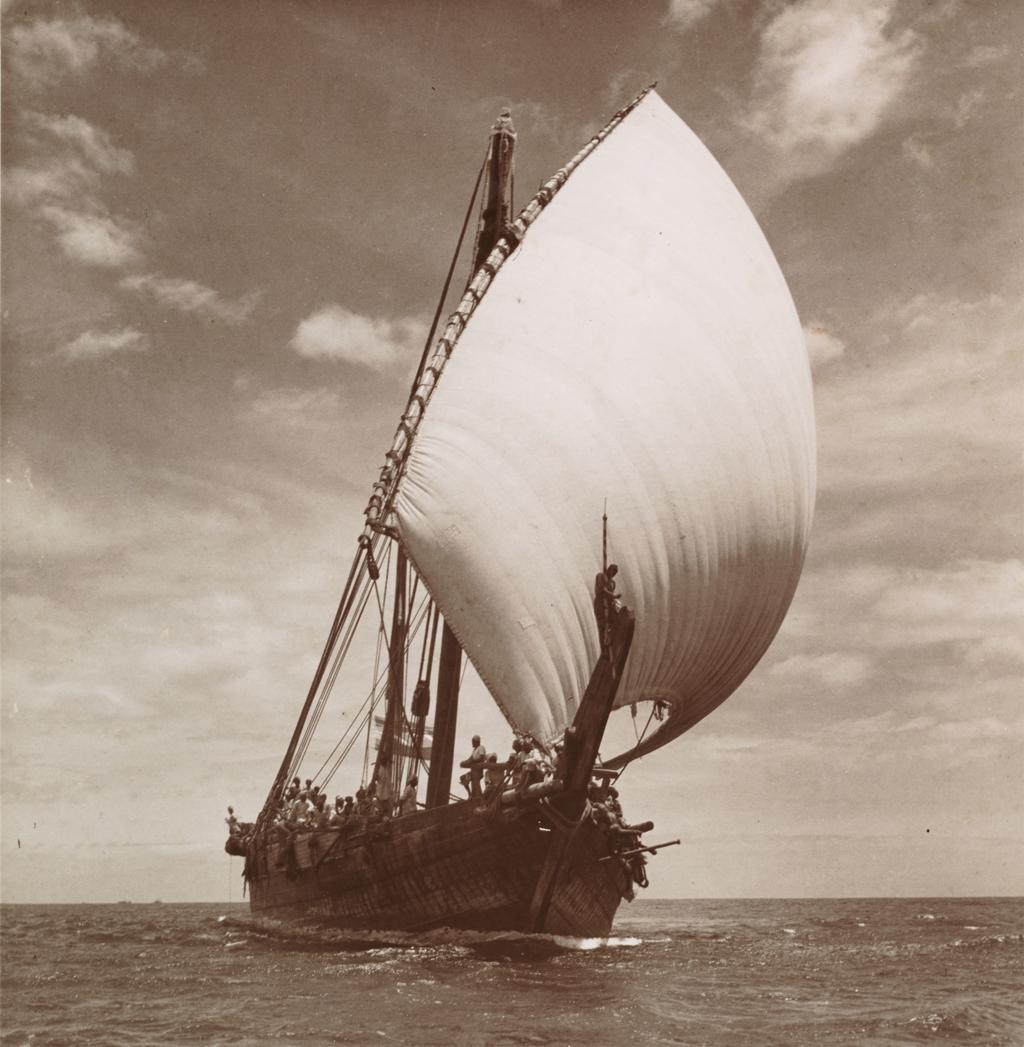
The East African coastline eventually became part of one of the largest maritime trading systems in premodern history: the Indian Ocean trade network.
African coastal communities interacted with merchants from Arabia, Persia, India and other parts of the Indian Ocean world.
The monsoon winds played an important role in making seasonal maritime travel possible.
Sailors learned to work with changing wind patterns to travel between the African coast, Arabia and South Asia.
This produced a commercial world stretching thousands of kilometers.
African coastal cities became important points of exchange.
Among the best-known were Kilwa, Mombasa, Malindi and other Swahili Coast settlements.
These cities were not simply African ports receiving foreign merchants.
They were active commercial societies with their own merchants, sailors, political institutions, architecture and cultural traditions.
The Swahili Coast: Africa’s Maritime Marketplace
The Swahili Coast became one of Africa’s great commercial frontiers.
Cities along the coast developed connections with Arabia and the wider Indian Ocean.
Goods moving through these networks included African gold, ivory and other commodities, while imported goods included textiles, ceramics, beads and luxury items.
The commercial interaction also contributed to the development of Swahili culture.
Swahili society developed from complex interactions involving African coastal communities and overseas connections.
Islam became deeply established along many coastal trading centers.
Swahili itself developed as a major African language with extensive vocabulary influenced by Arabic and other languages.
This demonstrates how commerce can influence language.
When people trade regularly, they need ways to communicate.
Over generations, commercial contact can produce new linguistic forms and cultural identities.
Kilwa and the Gold Trade
Kilwa, on the East African coast, became particularly important because of its connections to the gold-producing regions of southeastern Africa.
Gold from the interior could be transported toward the coast and then entered Indian Ocean commercial networks.
This demonstrates another important feature of African trade.
Trade routes did not always run directly from one continent to another.
Goods often moved through multiple stages.
A commodity might travel:
Interior → River or caravan route → Regional market → Coastal city → Ocean route → Foreign market
At every stage, different communities could participate in the process.
Transporters carried goods.
Merchants negotiated prices.
Rulers taxed commerce.
Craftspeople produced trade goods.
Sailors transported cargo.
Port cities provided storage and markets.
Trade was therefore a complex economic system involving thousands of people.
Trade Was Also an Exchange of Ideas
It is easy to focus on gold, salt and ivory because these commodities are tangible.
But some of the most important things carried along trade routes could not be touched.
Ideas traveled.
Religions traveled.
Languages traveled.
Stories traveled.
Technologies traveled.
Artistic styles traveled.
OpenStax emphasizes that African trading centers facilitated not only the distribution of goods but also the spread of cultural influences, including religion.
Islam is an important example.
Muslim merchants and scholars traveled through North Africa, across the Sahara and into West Africa.
Islam spread through multiple mechanisms, including trade, scholarship, political patronage and religious teaching.
Yet African societies did not simply abandon their existing cultures.
Islam interacted with local traditions.
African languages remained important.
Local political institutions adapted.
Traditional religious practices continued in many communities.
The result was not cultural replacement but complex cultural interaction.
Language Followed the Marketplace
Trade also encouraged multilingualism.
A merchant traveling across several regions could encounter numerous languages.
Commercial centers therefore became places where people developed ways of communicating across linguistic boundaries.
In West Africa, languages such as Arabic, Hausa, Mande languages, Songhay languages and others participated in commercial and cultural exchange.
Along the East African coast, Swahili became an important language of commerce.
This is one reason language history and trade history are closely connected.
Economic networks can create linguistic networks.
When people repeatedly interact, their languages influence one another.
Words can be borrowed.
Pronunciation can change.
New expressions can emerge.
Entire lingua francas can develop.
Markets Were More Than Places to Buy and Sell
African markets were also social institutions.
People gathered to exchange news, meet acquaintances, arrange marriages, discuss politics, hear stories and build relationships.
A market could therefore function as an information center.
Merchants arriving from distant places brought news from other regions.
Travelers could share information about political developments, weather conditions, conflicts and economic opportunities.
This information itself had value.
A merchant who knew where prices were high or where a political conflict had disrupted a route could make better decisions.
Trade therefore depended not only on physical goods but also on information.
The People Who Made Trade Possible
Trade routes are sometimes described as if merchants simply appeared with caravans and goods.
In reality, entire communities made commerce possible.
There were farmers who produced food for travelers.
Blacksmiths repaired tools and weapons.
Leatherworkers produced saddles and containers.
Potters created storage vessels.
Caravan guides knew the terrain.
Camel handlers managed animals.
Boat builders constructed vessels.
Sailors navigated coastal waters.
Guards protected caravans.
Market officials regulated commerce.
Rulers provided political authority.
Religious institutions sometimes offered hospitality.
All of these people contributed to the commercial system.
Trade was therefore not an activity performed only by wealthy merchants.
It involved a wide social network.
Oases and Caravan Towns
Crossing the Sahara required careful planning.
Water was essential.
This made oases strategically important.
An oasis could provide water, food, rest and opportunities to exchange information.
Settlements that developed around important desert routes could become commercial centers.
Over time, some caravan towns became wealthy because traders repeatedly passed through them.
Their importance depended heavily on geography.
A settlement located near a reliable water source could become more important than another settlement only a few days away.
The desert therefore created its own economic geography.
Knowledge of that geography was a form of power.
Trade, Politics and Security
Long-distance commerce was dangerous.
Caravans could face banditry, harsh weather, lack of water, political conflicts and attacks.
Merchants therefore needed some degree of security.
Political authorities could benefit from providing that security.
A ruler who protected trade routes could attract merchants.
A ruler who failed to protect them could lose commercial activity.
This created an incentive for governments to maintain order around important markets and routes.
Taxes collected from merchants could then help finance administration and military forces.
Again, trade and political power reinforced one another.
The Darker Side of African Trade Networks
Trade also had a darker side.
Human beings were among the commodities transported through some African trade networks.
Enslaved people were trafficked across the Sahara and through other regional networks long before the Atlantic slave trade.
OpenStax includes enslaved people among the commodities moved through trans-Saharan commercial networks.
This history should not be ignored when discussing African commerce.
The systems that connected communities could also facilitate exploitation.
People could be captured during warfare, raids or political conflicts and sold through commercial networks.
The existence of these forms of slavery varied considerably across time and place, and they should not be treated as identical to the later Atlantic plantation system.
Nevertheless, forced movement of people was part of several precolonial African and transregional trading systems.
Recognizing this complexity gives us a more honest understanding of the past.
Trade Did Not Mean Equality
Commercial connections could create prosperity, but wealth was rarely distributed equally.
Rulers, merchants and elites could accumulate considerable wealth.
Workers and producers might benefit from markets while receiving far less of the final value.
Political authorities could impose taxes or tribute.
Communities located along major routes could prosper, while others could be drawn into conflicts over resources and control of commerce.
Trade therefore had both positive and negative consequences.
It encouraged urban development and cultural exchange.
But it could also intensify competition.
Empires fought for commercial centers.
Rulers competed for control of gold-producing regions.
Communities could become targets because of their strategic location.
Economic power and political conflict were often closely connected.
Trade Routes Helped Build Cities
Many of Africa’s historic cities grew partly because of their location along commercial networks.
Timbuktu grew around trans-Saharan and Niger River commerce.
Gao became an important political and commercial center.
Djenné flourished within the inland Niger Delta.
Kilwa developed as a major Indian Ocean port.
Other cities and settlements rose and declined as trade patterns changed.
This shows that cities are often products of networks.
A city does not become important simply because people live there.
Its importance can come from its ability to connect different populations.
Markets, ports, rivers, caravan routes and political capitals can transform settlements into major urban centers.
When Trade Routes Shifted
Trade routes were never permanent.
They changed because of political developments, environmental conditions, warfare, technological changes and shifts in demand.
If a ruler became too hostile to merchants, traders could choose another route.
If a city lost access to water, its importance could decline.
If a new political power controlled a strategic crossing, commercial patterns could change.
The development of maritime commerce could also redirect economic activity.
This happened repeatedly in African history.
The rise and decline of trading cities should therefore be understood as part of constantly changing economic networks.
Africa Was Part of a Wider World
The greatest lesson of African trade history is that the continent was connected internally and externally.
West Africa was connected to North Africa and the Mediterranean.
The Nile linked northeastern African communities.
Aksum connected the Horn of Africa with Red Sea commerce.
The East African coast connected African societies with Arabia, Persia and India.
These were not isolated events.
They formed overlapping networks.
A merchant in West Africa might participate in a chain of exchanges extending across the Sahara.
A coastal trader in East Africa might participate in commerce extending across the Indian Ocean.
A ruler could become wealthy because goods from distant regions passed through his territory.
A scholar could travel thousands of kilometers because commercial routes made long-distance movement possible.
The result was a continent that was far more interconnected than many popular histories suggest.
Trade Before European Colonialism
It is especially important to place these networks within their chronology.
European colonial expansion radically transformed African economies from the nineteenth century onward.
But commercial systems existed long before that transformation.
African merchants, rulers, farmers, sailors and artisans already participated in regional and international exchange.
European traders eventually entered some of these existing networks and later established increasingly powerful forms of control over African commerce.
Understanding the earlier trade systems helps explain why colonial economic structures did not emerge in an empty economic landscape.
They interacted with existing African commercial systems.
The Legacy of Africa’s Historic Trade Routes
Many modern African cities continue to exist because of historical patterns of settlement and commerce.
Some old caravan routes have become modern roads.
Some ancient markets remain active.
Historic ports continue to serve as major commercial centers.
Languages that developed through commercial contact remain widely spoken.
Cultural practices created through centuries of interaction continue to shape African identities.
The legacy of trade is therefore not confined to archaeological sites.
It survives in modern cities, languages, cuisines, architecture, religious traditions and cultural identities.
Conclusion: The Roads That Connected Africa
Africa’s historic trade routes were much more than pathways for moving commodities.
They were systems of human connection.
Across the Sahara, camel caravans carried gold, salt, textiles, ivory and other goods between West and North Africa.
Along the Niger River, cities such as Timbuktu, Gao and Djenné became centers of commerce and scholarship.
Along the Nile, river transportation connected northeastern African communities.
In the Horn of Africa, Aksum participated in Red Sea commerce linking Africa with Arabia and the wider Mediterranean world.
Along the East African coast, Swahili cities participated in Indian Ocean trade reaching Arabia, Persia and India.
These networks helped build powerful kingdoms and empires.
They supported cities.
They enriched merchants and rulers.
They encouraged migration.
They spread religions and languages.
They carried technologies and artistic traditions.
And sometimes, they also facilitated warfare, exploitation and the trafficking of enslaved people.
Trade was therefore neither purely beneficial nor purely destructive.
It was a powerful force that reshaped societies.
Perhaps most importantly, these networks demonstrate that Africa was never a collection of completely isolated communities.
Its peoples were connected by rivers, deserts, coastlines, markets, caravan routes and maritime networks.
The continent’s history was built not only by kingdoms and rulers but also by the ordinary people who traveled, traded, produced, transported and exchanged goods across extraordinary distances.
The roads may have been made of sand.
The routes may have followed rivers.
The ships may have followed seasonal winds.
But together, they created something remarkably modern in character:
a connected African commercial world.
