

There is a quote, now inseparable from the story of Robben Island itself, spoken by the man who spent eighteen of his twenty-seven years in prison within its walls: it always seems impossible until it is done. Nelson Mandela’s words, uttered long after his release and often applied to the broader struggle against apartheid, could equally describe the improbable transformation of the small, windswept island in Table Bay, just off the coast of Cape Town, from a maximum-security prison built to isolate and break the spirits of South Africa’s most defiant anti-apartheid political prisoners into one of the most visited symbols of human resilience and eventual triumph over injustice anywhere in the world. This article, the ninth in a ten-part series on Africa’s heritage sites, examines Robben Island’s long and layered history, its central role in the anti-apartheid struggle, and its transformation into a globally significant site of memory, education, and reconciliation.
An Island of Isolation Long Before Apartheid
Robben Island’s history as a site of confinement and banishment stretches back considerably further than the apartheid era for which it is now most widely known. The island, whose Dutch name derives from the word for seal, in reference to the large seal colonies early European sailors observed there, was used from the earliest period of Dutch colonial settlement in the seventeenth century as a place of exile and imprisonment for individuals the colonial authorities of the Cape wished to remove from mainland society, including political prisoners from various Dutch colonial territories, indigenous Khoikhoi leaders who resisted early colonial expansion, and individuals confined for reasons of mental illness or leprosy during periods when the island served variously as a hospital and isolation facility for those considered a threat to public health or social order.
This long history of using the island’s physical isolation, surrounded by cold, treacherous currents that made escape extraordinarily difficult, as a tool of social exclusion and control, established a pattern of usage that would continue, in dramatically intensified form, once the apartheid government came to power in South Africa in 1948 and began searching for a secure location to imprison the growing number of political activists and leaders who opposed its system of institutionalised racial segregation and oppression.
Robben Island Under Apartheid
The apartheid government formally repurposed Robben Island as a maximum-security prison specifically for political prisoners beginning in 1961, following the government’s banning of the African National Congress and Pan Africanist Congress the previous year in the aftermath of the Sharpeville massacre, a watershed moment that dramatically escalated the confrontation between the apartheid state and the organised anti-apartheid movement. Over the following decades, Robben Island became the primary detention site for a significant portion of South Africa’s most prominent political prisoners, individuals imprisoned not for conventional criminal offences but specifically for their opposition to apartheid, including membership in banned political organisations, participation in resistance activities, and, in many cases, advocacy for basic democratic and civil rights denied to the Black majority population under the apartheid system.
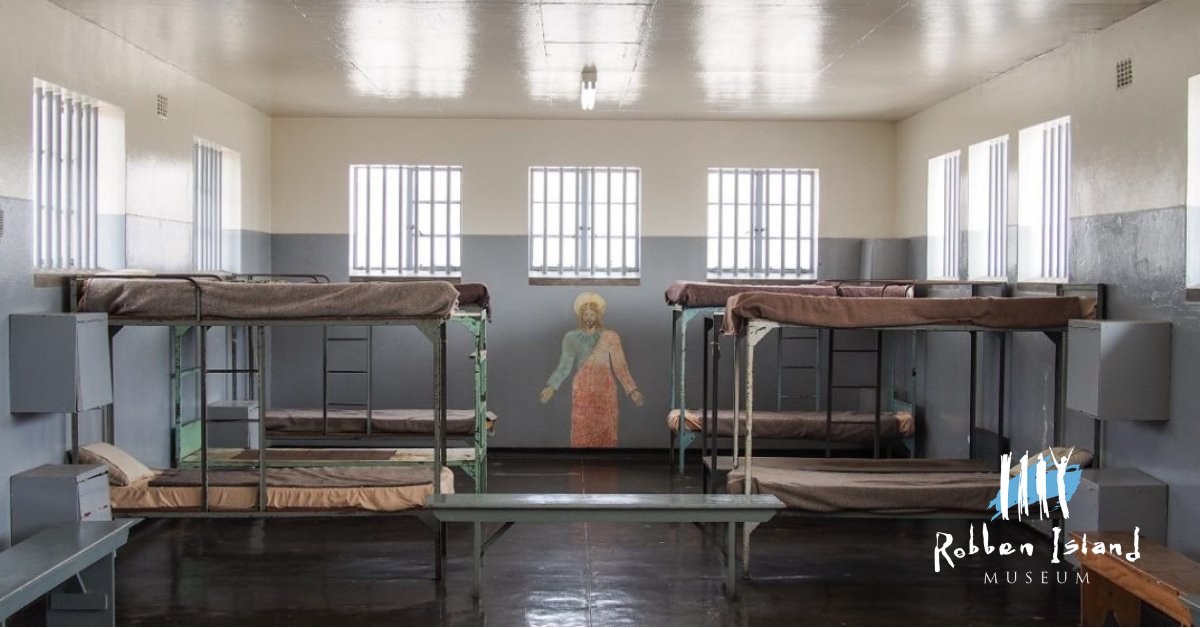
Conditions at the prison were deliberately harsh, reflecting the apartheid government’s explicit intention to isolate, demoralise, and ultimately break the political will of those it imprisoned there. Prisoners were subjected to a racially discriminatory internal classification and treatment system that mirrored and, in some respects, intensified the broader racial hierarchy of apartheid society itself, with Black prisoners typically receiving harsher treatment, inferior food rations, and more limited privileges than prisoners of mixed race or Indian descent held in the same facility, a deliberate extension of apartheid’s racial ideology into even the physical administration of imprisonment and punishment.
Forced labour, primarily quarrying limestone under harsh conditions in the island’s blinding, glare-intensive limestone quarry, formed a central and deliberately punishing feature of daily prison life for many political prisoners, with the intense reflected sunlight causing lasting eye damage to numerous prisoners, including Nelson Mandela himself, whose eyesight was permanently affected by years of forced labour in the quarry without adequate eye protection. Despite these severe and deliberately dehumanising conditions, the prison population of political detainees developed remarkable networks of solidarity, informal education, and continued political organisation and debate, even while confined, transforming the prison, in the recollection of many former inmates, into what became informally known among prisoners themselves as “the University,” a reference to the extensive informal educational and political discussion activities that continued among prisoners despite the authorities’ explicit intention to isolate and silence them.
Nelson Mandela and Robben Island’s Most Famous Prisoner
While Robben Island held many hundreds of political prisoners over the decades of its operation as an apartheid-era detention facility, it is most closely and internationally associated with Nelson Mandela, the African National Congress leader who would go on to become South Africa’s first democratically elected president following the end of apartheid, and who spent eighteen of his twenty-seven total years of imprisonment on the island, from 1964 until his transfer to mainland prisons in 1982. Mandela’s small, sparsely furnished cell, measuring roughly two metres by two metres, has become one of the most internationally recognised physical symbols of the anti-apartheid struggle, drawing visitors from around the world who come specifically to view the confined space in which one of the twentieth century’s most significant political leaders spent nearly two decades of his life.
Mandela’s own writings and later recollections of his time on Robben Island describe both the severity of conditions there and the extraordinary discipline, political education, and strategic thinking he and his fellow political prisoners cultivated during their imprisonment, developing political ideas, negotiating strategies, and personal resilience that would later prove crucial during the extraordinarily complex negotiations that eventually led to the peaceful, if difficult and protracted, transition from apartheid rule to South Africa’s first fully democratic elections in 1994. In this sense, Robben Island functioned not simply as a site of punishment and suffering, but, paradoxically and remarkably, as an important incubator of the political leadership and strategic vision that would ultimately guide South Africa’s transition to democracy.
Other Notable Prisoners and the Broader Struggle
While Mandela remains by far the most internationally recognised figure associated with Robben Island, it is important to recognise that he was one among many hundreds of political prisoners held there over the decades of the apartheid era, including numerous other significant anti-apartheid leaders such as Walter Sisulu, Ahmed Kathrada, and Govan Mbeki, each of whom played their own significant roles within the broader anti-apartheid movement and endured years of imprisonment under similarly harsh conditions. Focusing exclusively on Mandela’s individual experience, while understandable given his subsequent global prominence, risks obscuring the much larger collective story of resistance, solidarity, and sacrifice that Robben Island represents, a story involving hundreds of individuals whose names remain far less internationally known but whose contributions to the anti-apartheid struggle were, in their own context, no less significant or courageous.
The End of the Prison Era and Transition to Heritage Site
Robben Island’s use as a prison for political detainees gradually wound down during the final years of apartheid, with the last political prisoners released or transferred by the early 1990s as the apartheid government entered into formal negotiations with the African National Congress and other liberation movements that would ultimately lead to South Africa’s first democratic elections. The island’s general prison function, for non-political offenders, continued briefly afterward before the facility was finally closed entirely in 1996, two years following the establishment of South Africa’s new democratic government under President Mandela himself.
Following its closure as an operational prison, Robben Island was rapidly and deliberately transformed into a museum and heritage site, opening to the public as early as 1997, with the explicit intention, strongly supported by the new South African government and by many former political prisoners themselves, of preserving the site not as a painful memory to be forgotten or erased, but as a powerful and permanent educational resource documenting the realities of apartheid-era repression and the ultimately triumphant story of the struggle against it. Many of the museum’s guides in the years following its establishment were themselves former political prisoners who had personally been incarcerated on the island, offering visitors an unusually direct and personally informed connection to the history being presented, a practice that continued for many years and added significant additional depth and authenticity to the site’s educational mission.
UNESCO Recognition and Global Significance
Robben Island was inscribed as a UNESCO World Heritage Site in 1999, with the organisation specifically recognising the island’s buildings, and particularly the prison itself, as powerful symbols of the triumph of the human spirit over enormous adversity, oppression, and racial discrimination. This recognition placed Robben Island within a relatively small category of heritage sites internationally recognised primarily for their significance as sites of conscience, documenting relatively recent historical injustice and its ultimate resolution, alongside comparable sites of memory such as Auschwitz-Birkenau in Poland and Hiroshima’s Peace Memorial in Japan, each representing, in different historical and geographic contexts, humanity’s capacity for both devastating injustice and remarkable resilience and reconciliation in its aftermath.
Today, Robben Island receives substantial numbers of visitors annually, most arriving via a dedicated ferry service from Cape Town’s Victoria and Alfred Waterfront, with guided tours of the former prison facility, including Mandela’s preserved cell and the limestone quarry where forced labour once took place, forming the centrepiece of the visitor experience, complemented by exhibits documenting both the island’s pre-apartheid history and the broader story of the anti-apartheid struggle and South Africa’s subsequent democratic transition.
Preservation, Education, and Ongoing Challenges
Managing Robben Island as a heritage site presents distinctive challenges related to its relatively recent historical significance, with many individuals directly connected to the island’s apartheid-era history, whether as former prisoners, former prison staff, or family members of those affected, still living and, in many cases, actively involved in shaping how the site’s history is researched, preserved, and presented to visitors. This creates a heritage management context considerably different from most of the more ancient sites explored elsewhere in this series, requiring careful, ongoing collaboration between heritage professionals, historians, and the living community of individuals whose personal experiences and memories the site is directly responsible for honouring and accurately representing.
The island’s physical heritage also requires active, ongoing conservation given its harsh, salt-laden coastal environment and the practical challenges of maintaining historic buildings, including the prison facility itself, on a small, wind-exposed island accessible only by boat. Beyond physical preservation, Robben Island’s heritage authorities continue to develop and expand the site’s educational programming, seeking to ensure that the lessons of the apartheid era and the anti-apartheid struggle remain vividly and accurately conveyed to younger generations of South African and international visitors increasingly distant in age from the events themselves.
Daily Life, Resistance, and the “University” Behind Bars
Beyond the physical hardships of forced labour and harsh confinement, daily life on Robben Island for political prisoners was shaped by an extraordinary and deliberately cultivated culture of intellectual and political engagement that prisoners themselves organised in defiance of the isolation the apartheid authorities had intended the island to impose. Prisoners smuggled in reading materials where possible, organised informal lecture series and structured debates covering political theory, history, and strategy, and in some sections of the prison developed sophisticated systems for communicating between cells and sections despite strict rules prohibiting such contact, using methods ranging from carefully coded messages passed during work details to conversations conducted in whispered, coded language during supervised exercise periods.
This informal educational culture, which came to be known among former prisoners themselves as “Robben Island University,” reflected a deliberate and remarkably effective act of collective psychological and political resistance, one that ensured many prisoners emerged from years or even decades of imprisonment not broken or demoralised, as the apartheid authorities had explicitly intended, but instead further politically educated, strategically prepared, and personally strengthened for the crucial negotiations and leadership roles many would go on to assume during South Africa’s subsequent democratic transition. Younger and less experienced political prisoners frequently credited more senior figures imprisoned alongside them, including Mandela himself, with mentorship and political education that proved directly formative to their later roles within the post-apartheid government and civil society, illustrating how the island’s intended function as a tool of isolation and suppression was, in a remarkable historical irony, substantially subverted by the very prisoners it was designed to silence.
Robben Island’s Pre-Apartheid Layers of History
While the apartheid-era prison understandably dominates most contemporary understanding and heritage presentation of Robben Island, the site’s much longer history as a place of banishment and confinement, discussed briefly above, adds important additional layers of historical significance that the island’s heritage management continues to work to preserve and present alongside its more recent and internationally prominent history. The island’s leper colony and mental health facility, which operated at various points from the nineteenth century through the mid-twentieth century, represent an important and historically significant, if considerably less internationally known, chapter in South African medical and social history, reflecting broader historical patterns of institutional isolation and stigmatisation applied to individuals affected by illness and disability during this period.
Similarly, the island’s earlier use as a site of exile for indigenous Khoikhoi leaders and prisoners from other Dutch colonial territories during the seventeenth and eighteenth centuries connects Robben Island to the much longer, centuries-spanning history of colonial dispossession and resistance in southern Africa, situating the apartheid-era prison not as an isolated historical aberration but as the most recent, and most internationally documented, chapter within a considerably longer pattern of using the island’s physical isolation as an instrument of social and political control extending back over three centuries.
Conclusion
Robben Island stands as one of the most historically recent yet globally resonant heritage sites explored in this series, a place whose significance derives not from ancient monumental achievement but from its unflinching documentation of one of the twentieth century’s most consequential struggles for human dignity and democratic rights. As Mandela’s own words remind visitors who walk through the cell where he spent eighteen years of his life, what once seemed impossible, a democratic, non-racial South Africa, was ultimately achieved, in significant part through the resilience, political education, and strategic patience cultivated by prisoners held on this small, isolated island in Table Bay. Robben Island’s transformation from an instrument of oppression into a globally recognised monument to the triumph of the human spirit stands as perhaps the most powerful available proof of its own central lesson: that even the most entrenched systems of injustice, however impossible their defeat may once have seemed, can ultimately be overcome.
For the visitor standing today in the narrow confines of Mandela’s former cell, or looking out across the glare of the limestone quarry where so many political prisoners laboured under deliberately punishing conditions, Robben Island offers a rare and valuable kind of heritage experience: one in which the distance between historical tragedy and present-day triumph can be measured not in centuries, but within the lifetimes of people still living, guiding tours, and sharing their own firsthand memories of a struggle whose outcome, however inevitable it may appear in hindsight, was very much in doubt for those who lived and were imprisoned through it.
