

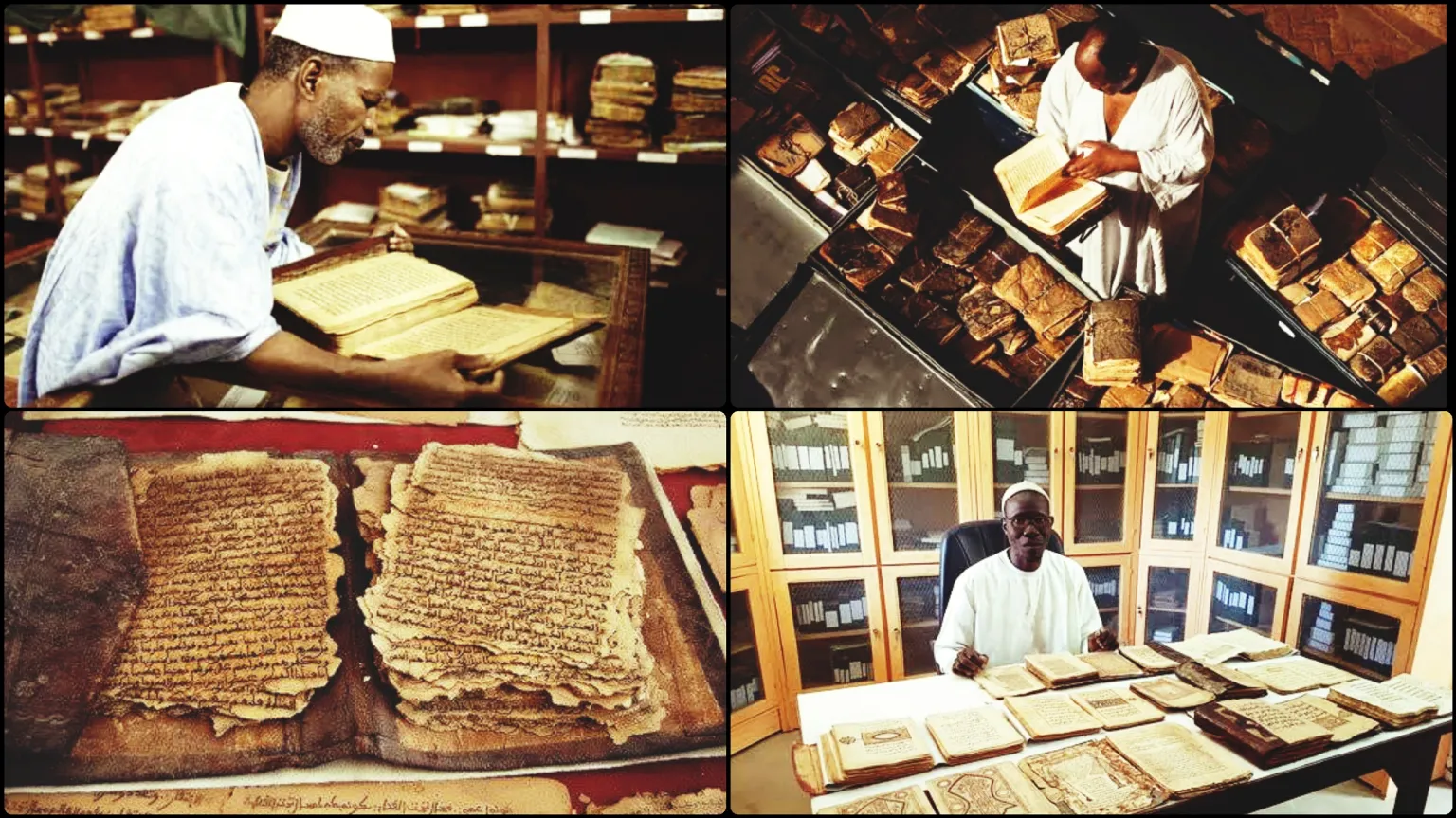
There is a West African proverb, often traced to the Songhai and Tuareg communities of the Sahel, that says,
“Salt comes from the north, gold from the south, and silver from the country of the white men, but the word of God and the treasures of wisdom are only to be found in Timbuktu.”
The saying, recorded by nineteenth-century European travellers who reached the city after decades of it being spoken of in Europe as a place of near-mythical, almost unreachable wealth, captures something that modern popular usage of the city’s name has almost entirely lost: for several centuries, Timbuktu was not a byword for remoteness, as it has become in much of the English-speaking world today, but one of the most important centres of Islamic scholarship, manuscript production, and intellectual exchange anywhere on Earth. This article, the fifth in a ten-part series on Africa’s heritage sites, tells the story of Timbuktu as it actually was and, in significant part, still is: a city of scholars, students, and hundreds of thousands of manuscripts whose survival across the centuries stands as one of the most remarkable stories in the entire history of African heritage.
Founding and Early Growth
Timbuktu was founded around the eleventh or twelfth century CE, according to tradition by Tuareg nomads who established a seasonal camp at the site, strategically located near the point where the Niger River bends closest to the southern edge of the Sahara Desert. This geographic position proved decisive to the city’s later fortunes, placing it at the natural meeting point between trans-Saharan camel caravan routes arriving from the north, carrying salt, copper, and goods from North Africa and the wider Mediterranean and Islamic worlds, and river-based trade routes along the Niger connecting the city to the gold-producing regions and agricultural heartlands further south.
What began as a modest seasonal settlement grew rapidly into a major commercial hub as successive regional powers recognised and sought to control its strategic value. Timbuktu came under the influence, in turn, of the Mali Empire, then at the height of its power and wealth under rulers such as the legendary Mansa Musa, whose extraordinary pilgrimage to Mecca in 1324, during which he reportedly distributed such vast quantities of gold that he temporarily disrupted currency values across parts of the Mediterranean world, brought Timbuktu and the wider Mali Empire to the attention of the broader Islamic and European worlds for the first time. Later, the city fell under the control of the Songhai Empire, which by the fifteenth and sixteenth centuries had grown into one of the largest and most powerful states in African history, with Timbuktu serving as one of its most important cultural and commercial centres.
The Golden Age of Scholarship
It was under Songhai rule, particularly during the fifteenth and sixteenth centuries, that Timbuktu reached its zenith as a centre of Islamic learning, a period now widely regarded as the city’s golden age. At the heart of this intellectual flowering stood the Sankore Madrasah, often described, with reasonable justification, as one of the world’s earliest universities, though it operated on a decentralised model quite different from the campus-based European universities that the term “university” typically evokes today. Rather than a single institution with a unified administration, Sankore functioned as a loose but highly organised network of independent scholars, each teaching within their own homes or small madrasahs clustered around the Sankore Mosque, with students moving between different teachers to study specific subjects according to each scholar’s particular expertise and reputation.
At its height, Timbuktu is estimated to have supported a scholarly and student population in the tens of thousands, drawn not only from across West Africa but from North Africa, the Middle East, and beyond, studying an extraordinarily broad curriculum encompassing Islamic law and jurisprudence, theology, grammar and rhetoric, mathematics, astronomy, medicine, and history. Graduates of Timbuktu’s scholarly community went on to serve as judges, religious leaders, and advisors across West Africa, spreading the intellectual traditions cultivated in the city throughout the wider region and cementing Timbuktu’s reputation as an unrivalled centre of learning in sub-Saharan Africa.
This scholarly culture was explicitly documented and celebrated by visitors of the era. The sixteenth-century traveller Leo Africanus, whose detailed accounts of Timbuktu were widely read across Europe following their translation and publication, wrote admiringly of the city’s wealth and, notably, of the far higher value placed on manuscripts than on almost any other commodity in the local market, an observation that speaks directly to the intensity of the intellectual culture the city had cultivated by that period.
 The Manuscripts of Timbuktu
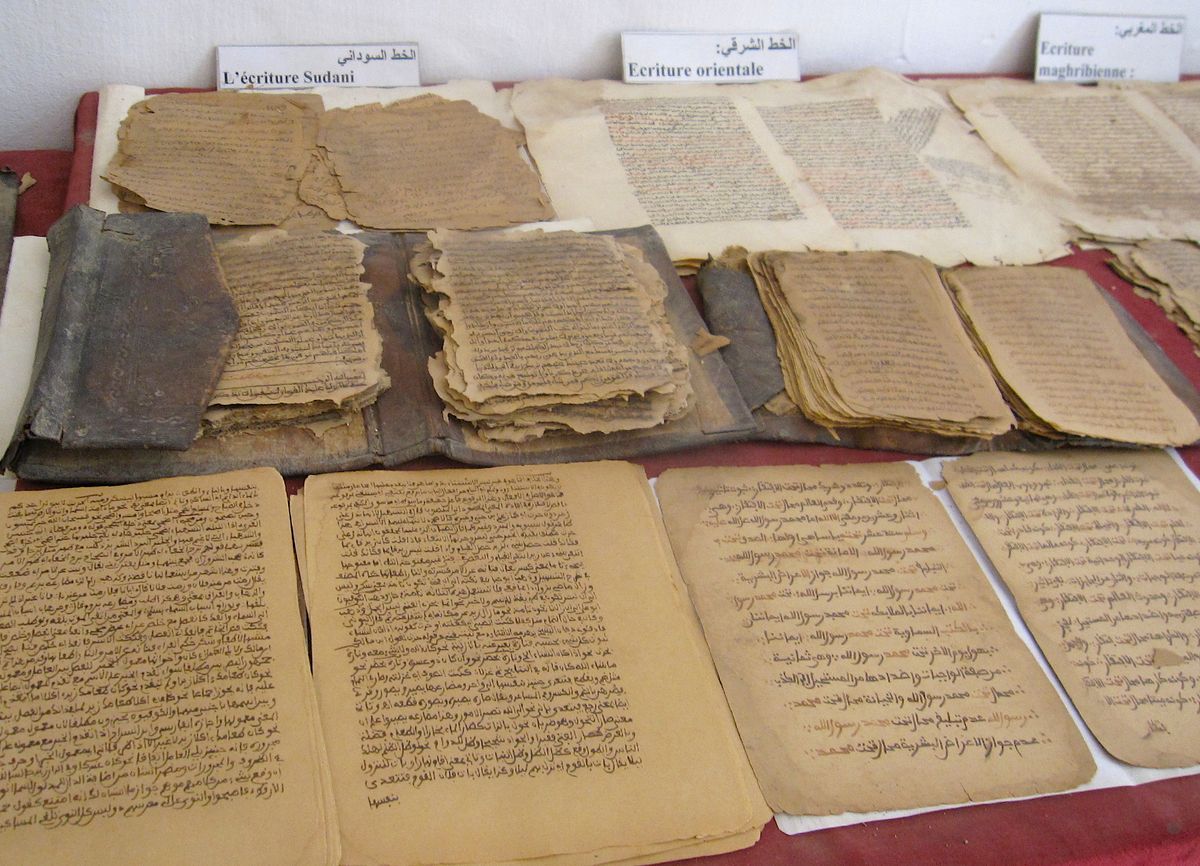
The physical legacy of this golden age of scholarship survives today in an extraordinary collection of manuscripts, estimated by various scholarly assessments to number somewhere between three hundred thousand and one million individual documents, held both in formal institutional collections and, crucially, in private family libraries that have been passed down and protected by individual Timbuktu families for many generations, in some cases for well over four centuries.
These manuscripts cover an astonishingly broad range of subject matter, decisively refuting any lingering notion that pre-colonial West African intellectual culture was narrowly religious or unsophisticated. Alongside extensive collections of Islamic legal and theological texts, the Timbuktu manuscripts include treatises on astronomy and mathematics, medical texts detailing treatments and pharmacological knowledge, works of poetry and grammar, historical chronicles documenting the region’s political history, and correspondence and legal documents offering rich insight into the everyday commercial and social life of the city across several centuries. Many manuscripts feature elaborate calligraphy and decorative elements, reflecting not only their intellectual content but their status as valued artistic and material objects in their own right.
The survival of this vast manuscript collection owes an enormous debt to the private families of Timbuktu, who developed sophisticated traditions of manuscript preservation, storing documents in wooden and leather chests, wrapping them in protective cloth, and in some cases burying or hiding collections during periods of political instability or external threat across the centuries, a practice of protective custodianship passed down through generations that would prove critically important during the crisis the city faced in the early twenty-first century.
Decline After the Golden Age
Timbuktu’s status as a leading centre of Islamic scholarship began to decline following the Moroccan invasion of the Songhai Empire in 1591, during which invading forces, seeking to seize control of the lucrative trans-Saharan trade routes, disrupted the city’s political stability and scholarly institutions, with a number of leading scholars killed or exiled in the aftermath of the conquest. Though scholarly activity in the city continued in reduced form for generations afterward, Timbuktu never fully regained the intellectual pre-eminence it had enjoyed during the Songhai golden age, and the broader shift of major trans-Saharan and, later, transatlantic and coastal trade patterns over subsequent centuries gradually reduced the city’s economic and strategic importance relative to its earlier peak.
By the time the first European explorers, motivated in part by the legendary reputation for wealth that had circulated in Europe for centuries, finally reached Timbuktu in the early nineteenth century, they generally found a considerably diminished city compared to the fabled metropolis described in earlier travellers’ accounts, a disparity that has sometimes been misused to cast doubt on the historical accuracy of Timbuktu’s golden-age reputation altogether, despite substantial manuscript and architectural evidence confirming the scale of its earlier scholarly and commercial achievement.
The Great Mud Mosques
Alongside its manuscript heritage, Timbuktu is home to three architecturally significant mosques constructed largely from mudbrick and adobe using building techniques adapted to the harsh climate of the southern Sahara: the Djingareyber Mosque, built in the fourteenth century reportedly at the direction of Mansa Musa following his return from his famous pilgrimage to Mecca; the Sankore Mosque, closely associated with the scholarly community described above; and the Sidi Yahya Mosque. These structures represent an important and distinctive West African architectural tradition, employing timber support beams, known locally as toron, that protrude from the mosque walls both for structural reinforcement and to serve as a permanent built-in scaffolding for the ongoing maintenance the mudbrick construction requires.
This maintenance requirement is not incidental to the architecture but central to it. Mudbrick structures of this kind require regular replastering, traditionally undertaken as a communal effort involving large numbers of local residents working together, often on an annual basis following the rainy season, to repair the erosion inevitably caused by seasonal weather. This ongoing, collective maintenance tradition means that, much like the churches of Lalibela described elsewhere in this series, Timbuktu’s mosques exist as genuinely living heritage, continuously renewed through active community participation rather than preserved as static, frozen monuments maintained solely by outside conservation professionals.
Crisis and Rescue: The 2012 Occupation
Timbuktu’s manuscript and architectural heritage faced its gravest modern threat in 2012, when extremist armed groups affiliated with al-Qaeda seized control of the city during a period of broader political instability in northern Mali, imposing a strict interpretation of Islamic law that led directly to the deliberate destruction of numerous historic shrines and mausoleums the occupying forces considered idolatrous, alongside credible fears that the city’s vast manuscript collections, viewed by the occupiers as representing an unacceptably diverse and syncretic intellectual tradition, might also be targeted for destruction.
In response, a remarkable rescue operation unfolded, led substantially by Timbuktu residents themselves rather than by outside intervention. Librarians, archivists, and ordinary citizens smuggled tens of thousands of manuscripts out of the city under cover of darkness, hidden in rice sacks, buried in family courtyards, and transported by boat and vehicle along dangerous routes to safer locations in the Malian capital, Bamako, at considerable personal risk to those involved. This operation, coordinated substantially through local institutions including the Ahmed Baba Institute and numerous private family libraries, succeeded in preserving the overwhelming majority of the city’s manuscript heritage even as extremist forces occupied the city and, before French-led military intervention restored government control in early 2013, destroyed a number of the historic mausoleums that had stood, in some cases, for over five centuries.
The 2012 crisis prompted a significant international response, with UNESCO and various international partners subsequently supporting extensive restoration work on the damaged mausoleums and continued digitisation and conservation efforts for the manuscript collections, work that continues today alongside ongoing local efforts to catalogue, preserve, and, increasingly, digitise the vast manuscript archive for both preservation and expanded scholarly access.
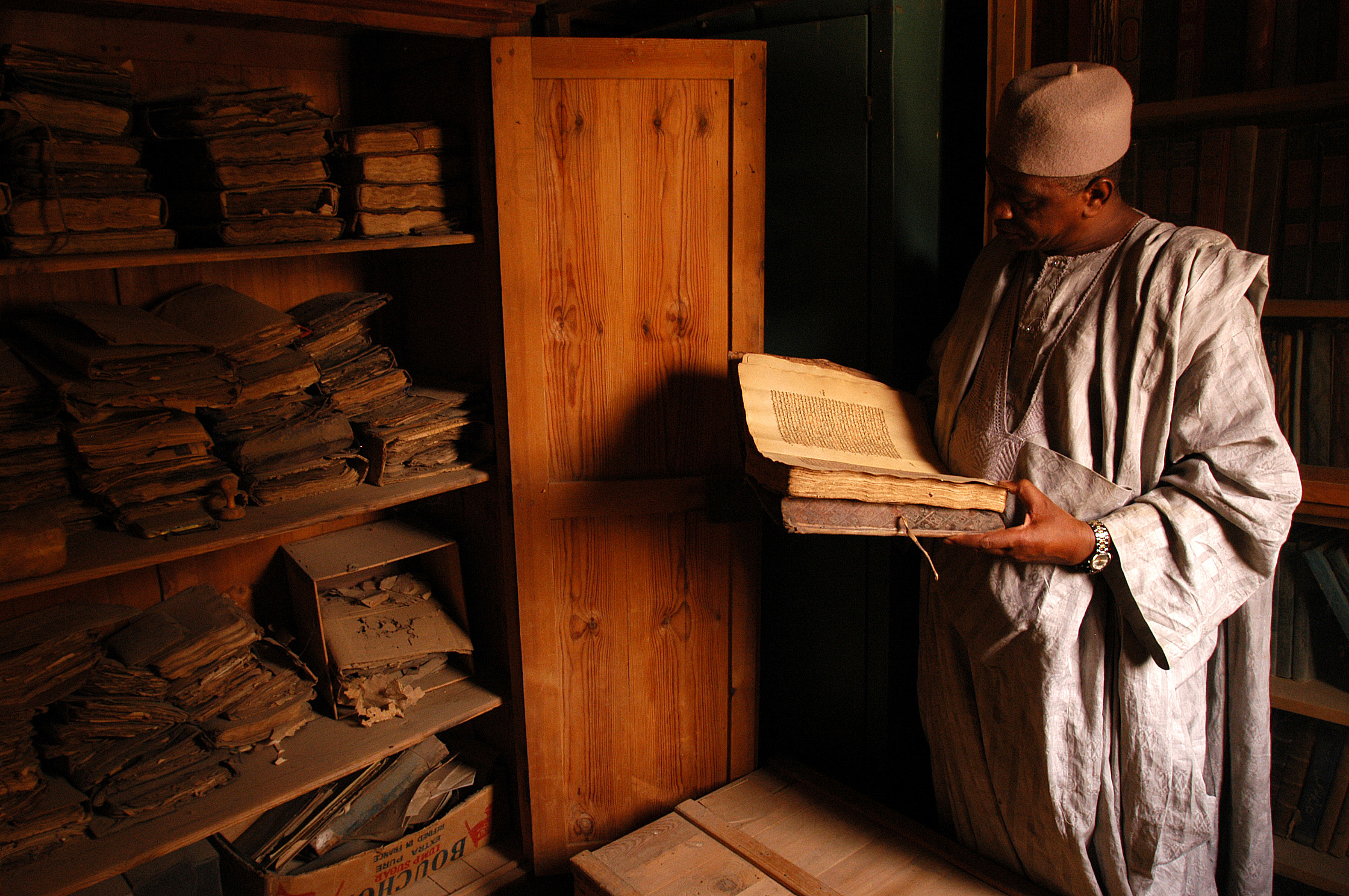
mal 00042003 tombouctou
le chemin de l’encre
Abdelkhader Es-Sayuti avec une partie de la bibliothque de la famille Es-Sayuti entrepos dans un vieux placard
Timbuktu Today
Timbuktu was inscribed as a UNESCO World Heritage Site in 1988, recognising both its architectural heritage and its historical significance as a centre of Islamic scholarship, and was subsequently added to UNESCO’s List of World Heritage in Danger following the 2012 crisis, reflecting the ongoing security and conservation challenges the city continues to face. Northern Mali’s continued political instability in the years since has meant that Timbuktu remains difficult and, at various points, dangerous for international visitors and researchers to access, significantly limiting the tourism revenue and scholarly exchange that might otherwise flow more freely to a site of such extraordinary historical importance.
Despite these ongoing challenges, work to preserve and study Timbuktu’s manuscript heritage continues, increasingly supported by digitisation initiatives that create permanent digital records of individual manuscripts, expanding access for researchers worldwide while reducing the risk that any single future crisis could result in the permanent loss of this irreplaceable intellectual legacy. Local manuscript families, many of whom have safeguarded their collections across more than a dozen generations, remain central to this ongoing preservation effort, continuing a tradition of protective custodianship considerably older than any international heritage organisation now supporting their work.
Trade, Commerce, and the City’s Economic Foundations
Timbuktu’s scholarly reputation, however celebrated, developed atop an equally significant foundation of commercial activity, without which the city’s intellectual golden age would have been financially unsustainable. As the critical junction point between Saharan camel caravan routes and Niger River trade networks, Timbuktu functioned as a major marketplace where salt mined from deposits deep in the Sahara, transported south by camel caravan in quantities so valuable that salt slabs sometimes functioned as a form of currency in their own right, was exchanged for gold, kola nuts, and agricultural goods arriving from the forest and savanna regions further south, alongside slaves, ivory, and other commodities moving through the broader regional trading system.
This commercial wealth directly financed the city’s scholarly infrastructure. Wealthy merchant families frequently funded the construction of mosques and madrasahs, endowed scholarly salaries, and commissioned or purchased manuscripts, creating a mutually reinforcing relationship between commercial prosperity and intellectual achievement that characterised Timbuktu at its height, not unlike similar dynamics that shaped other great historic centres of learning built atop successful trading economies elsewhere in the medieval world. The city’s markets themselves became sites of intellectual as well as commercial exchange, as scholars, students, and travelling merchants brought news, texts, and ideas from across the Islamic world into direct contact with local West African intellectual traditions.
Women, Family Networks, and Manuscript Custodianship
While the formal scholarly institutions of Timbuktu, like most Islamic educational institutions of the period, were predominantly male-directed spaces, women played a significant, if historically under-documented, role in the city’s broader intellectual and manuscript culture, both as patrons who funded scholarly activity and manuscript production, and, critically, as custodians within the family-based manuscript preservation networks that have proven so essential to the collection’s long-term survival.
The family library system that safeguarded the overwhelming majority of Timbuktu’s manuscripts across the centuries, and which proved decisive during the 2012 crisis, was never simply an institutional or male-only endeavour but a genuinely intergenerational family responsibility, in which knowledge of manuscript storage locations, preservation techniques, and the content and significance of specific texts was passed down through households as a form of family inheritance every bit as significant, in its own way, as any material wealth. This deeply embedded family custodianship model stands as one of the most distinctive features of Timbuktu’s heritage preservation story, differing significantly from the more institution-centred preservation models that dominate manuscript conservation in much of the rest of the world.
Timbuktu’s Place in the Global Story of Islamic Scholarship
Timbuktu’s scholarly achievements did not develop in isolation from the wider Islamic intellectual world but were instead deeply integrated into it, with scholars, texts, and ideas flowing continuously between Timbuktu and major centres of Islamic learning in North Africa and the Middle East, including Cairo, Fez, and the holy cities of Mecca and Medina, which many Timbuktu scholars visited during pilgrimage and extended periods of study abroad. Manuscripts produced or copied in Timbuktu frequently cite and engage directly with legal and theological scholarship from across this wider network, demonstrating that the city functioned not as an isolated outpost of learning on the geographic margins of the Islamic world, but as a genuine participant in a shared, continent-spanning intellectual conversation.
This point carries particular importance for correcting a persistent and damaging historical misconception: the assumption, still surprisingly common in popular understanding, that sub-Saharan Africa remained largely disconnected from the major intellectual currents of the medieval and early modern world prior to European colonial contact. The manuscripts of Timbuktu, addressing subjects ranging from advanced mathematics to detailed astronomical observation to sophisticated legal reasoning, and doing so in direct dialogue with scholarly traditions from across the Islamic world, stand as definitive physical evidence against this misconception, placing West African intellectual achievement squarely within, rather than outside, the broader currents of global medieval scholarship.
The two-way nature of this exchange also deserves emphasis. Just as Timbuktu’s scholars absorbed and engaged with legal and theological traditions arriving from North Africa and the wider Islamic heartlands, so too did visiting scholars and travellers carry knowledge and impressions of Timbuktu’s own intellectual culture back with them across the Sahara, contributing to the city’s growing reputation abroad and reinforcing a genuinely reciprocal relationship rather than the one-directional flow of knowledge that older, more Eurocentric accounts of medieval intellectual history have sometimes assumed to be the default pattern of cultural exchange between North Africa and the lands south of the Sahara.
Conclusion
Timbuktu’s story is, in many respects, the story of African intellectual achievement writ large: a golden age of extraordinary scholarly accomplishment, centuries of relative obscurity during which its true historical significance was doubted or diminished by outside observers, and a twenty-first-century crisis during which its heritage was deliberately threatened, only to be saved substantially through the courage and resourcefulness of ordinary local custodians rather than outside intervention. As the proverb quoted at the outset of this article reminds us, Timbuktu’s true treasure was never gold or salt but wisdom, the word of God, and the accumulated scholarship of centuries, treasures that, unlike gold, could be smuggled out in rice sacks and hidden in courtyards precisely because their value was never primarily material. That those treasures survive today, still cared for by the descendants of the families who first collected them centuries ago, stands as one of the most quietly heroic chapters in the entire history of African heritage preservation.
For all the international attention Timbuktu has received, first as a legendary city of unimaginable wealth in medieval European rumour, and later as a global symbol of extremist cultural destruction and the fragility of heritage under conflict, the most accurate and enduring image of the city may ultimately be the simplest one: a family, in an ordinary Timbuktu household, quietly maintaining a wooden chest of centuries-old manuscripts exactly as their grandparents and great-grandparents did before them, understanding, without needing any outside validation, that what they were protecting was never merely paper and ink but the accumulated intellectual inheritance of an entire civilization.
That family, and thousands like it across Timbuktu and its surrounding region, are the true inheritors of the golden age described at the outset of this article, proof that the city’s greatest treasure was never its gold, nor even its magnificent mudbrick mosques, but the quiet, generational discipline of people who understood, long before any international heritage body existed to tell them so, that wisdom itself was worth protecting at any cost.
