

There is an ancient Arabic saying still repeated by guides along the Nile:
“Man fears time, but time fears the pyramids.”
Whatever the saying’s precise origin, its truth is difficult to dispute. More than four and a half thousand years after the first stones were laid at Saqqara and Giza, the pyramids of Egypt remain standing, still drawing the eyes of the world, still provoking wonder, still refusing to fully surrender their secrets. They are, without question, the most recognisable heritage structures on the African continent, and among the most recognisable structures ever built by human hands anywhere on Earth. Yet for all their fame, the pyramids are frequently discussed in ways that strip them of their African context, treated in popular imagination as though they belong to some separate, disconnected civilization rather than to the same continent that produced Great Zimbabwe, Timbuktu, and Meroë. This article, the second in a ten-part series on Africa’s heritage sites, places the pyramids firmly where they belong: as one of the earliest and most monumental expressions of African civilization’s capacity for organisation, engineering, spirituality, and enduring ambition.
The Birth of Monumental Egypt
Ancient Egyptian civilization emerged along the Nile Valley more than five thousand years ago, its fortunes tied inseparably to the river’s annual floods, which deposited rich silt across the surrounding land and made large-scale agriculture possible in an otherwise arid environment. This agricultural surplus allowed Egyptian society to support specialists who did not need to farm — priests, scribes, architects, artisans, and administrators — laying the foundation for one of the earliest and longest-lasting centralised states in human history.
Egypt’s early rulers, the pharaohs, were not merely political leaders but were understood by their subjects to be divine or semi-divine figures, intermediaries between the human world and the realm of the gods. This religious framework is essential to understanding why the pyramids were built at all. For the ancient Egyptians, death was not an ending but a transition, and the preservation of the pharaoh’s body and the provision of a suitably grand resting place were considered essential to ensuring the ruler’s successful passage into the afterlife and, by extension, the continued wellbeing of the entire kingdom. A pyramid, in this worldview, was not an extravagant vanity project but a piece of essential cosmic infrastructure — a stairway, quite literally in its stepped form, by which a departed king could ascend to join the sun god Ra among the stars.
From Mastaba to Pyramid
The earliest Egyptian royal tombs were not pyramids at all but flat-roofed rectangular structures known as mastabas, built from mudbrick and later stone, which housed burial chambers beneath a solid superstructure. The transformation from mastaba to pyramid is credited to the architect Imhotep, who served under the pharaoh Djoser during the Third Dynasty, roughly 2670 BCE. Imhotep’s innovation was to stack six mastabas of decreasing size on top of one another, creating the Step Pyramid of Saqqara — widely regarded as the world’s oldest large-scale cut-stone building and the direct ancestor of every pyramid that followed.
Imhotep himself is a remarkable figure in his own right: originally a commoner who rose through skill and intellect to become vizier, chief architect, and high priest, he was later deified by the ancient Egyptians themselves, worshipped as a god of medicine and wisdom for over two thousand years after his death. His story stands as an early and striking example of African intellectual achievement being formally recognised and honoured by the very civilization it served, centuries before comparable developments in most other parts of the ancient world.
Following Djoser’s Step Pyramid, subsequent pharaohs experimented with pyramid design, most notably Sneferu, who oversaw the construction of no fewer than three pyramids during his reign, including the so-called Bent Pyramid, whose angle changes partway up the structure, likely due to structural concerns discovered mid-construction, and the Red Pyramid, generally considered the first successful true smooth-sided pyramid. These experimental structures at Dahshur represent a crucial, often overlooked chapter in the story of pyramid-building, demonstrating that the iconic smooth pyramid shape familiar from Giza was the product of decades of trial, error, and engineering refinement rather than a single flash of architectural genius.
The Great Pyramids of Giza
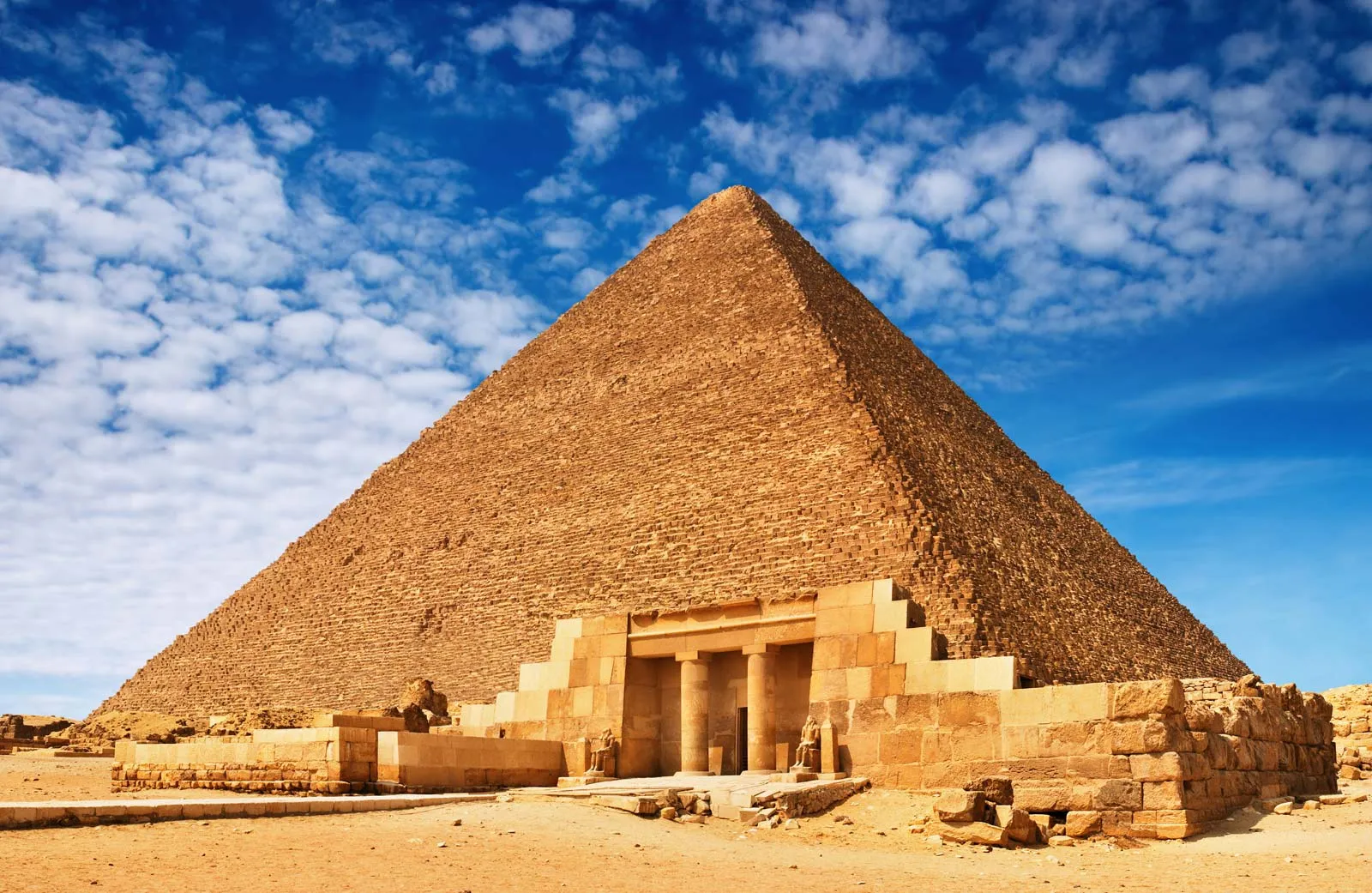
The pyramids most familiar to the world today are those at Giza, on the outskirts of modern Cairo, built during the Fourth Dynasty for the pharaohs Khufu, Khafre, and Menkaure. The Great Pyramid of Khufu, completed around 2560 BCE, is the largest of the three and was, at approximately 146 metres in its original height, the tallest human-made structure on Earth for nearly four thousand years, a record unbroken until the construction of Lincoln Cathedral in England in the fourteenth century.
The scale of the Great Pyramid remains staggering by any measure. It is estimated to contain approximately 2.3 million blocks of stone, with individual blocks weighing anywhere from two to more than fifty tonnes, arranged with a precision that continues to impress modern engineers: the base of the pyramid is level to within just a few centimetres across its entire 230-metre length, and its sides are aligned to the cardinal directions with an accuracy that rivals modern surveying techniques. How exactly the ancient Egyptians achieved this level of precision, using tools no more sophisticated than copper chisels, wooden sledges, ramps, and rope, remains a subject of ongoing research and occasional controversy, though the broad academic consensus rejects speculative theories involving lost technologies or extraterrestrial assistance in favour of explanations rooted in sheer organisational capacity, skilled labour, mathematical knowledge, and generations of accumulated engineering experience.
That organisational capacity is itself one of the most impressive aspects of the Giza pyramids. Far from being built by enslaved masses, as popularised in some older depictions, archaeological evidence — including the discovery of a purpose-built workers’ village near Giza containing bakeries, breweries, medical facilities, and worker cemeteries — suggests that the pyramids were constructed largely by a rotating labour force of skilled and semi-skilled Egyptian workers, likely including farmers conscripted during the Nile’s annual flood season when agricultural work was impossible. These workers were provided with food, housing, and medical care, and were buried with honour near the monuments they helped construct, a far cry from the popular image of enslaved labourers toiling under the lash.
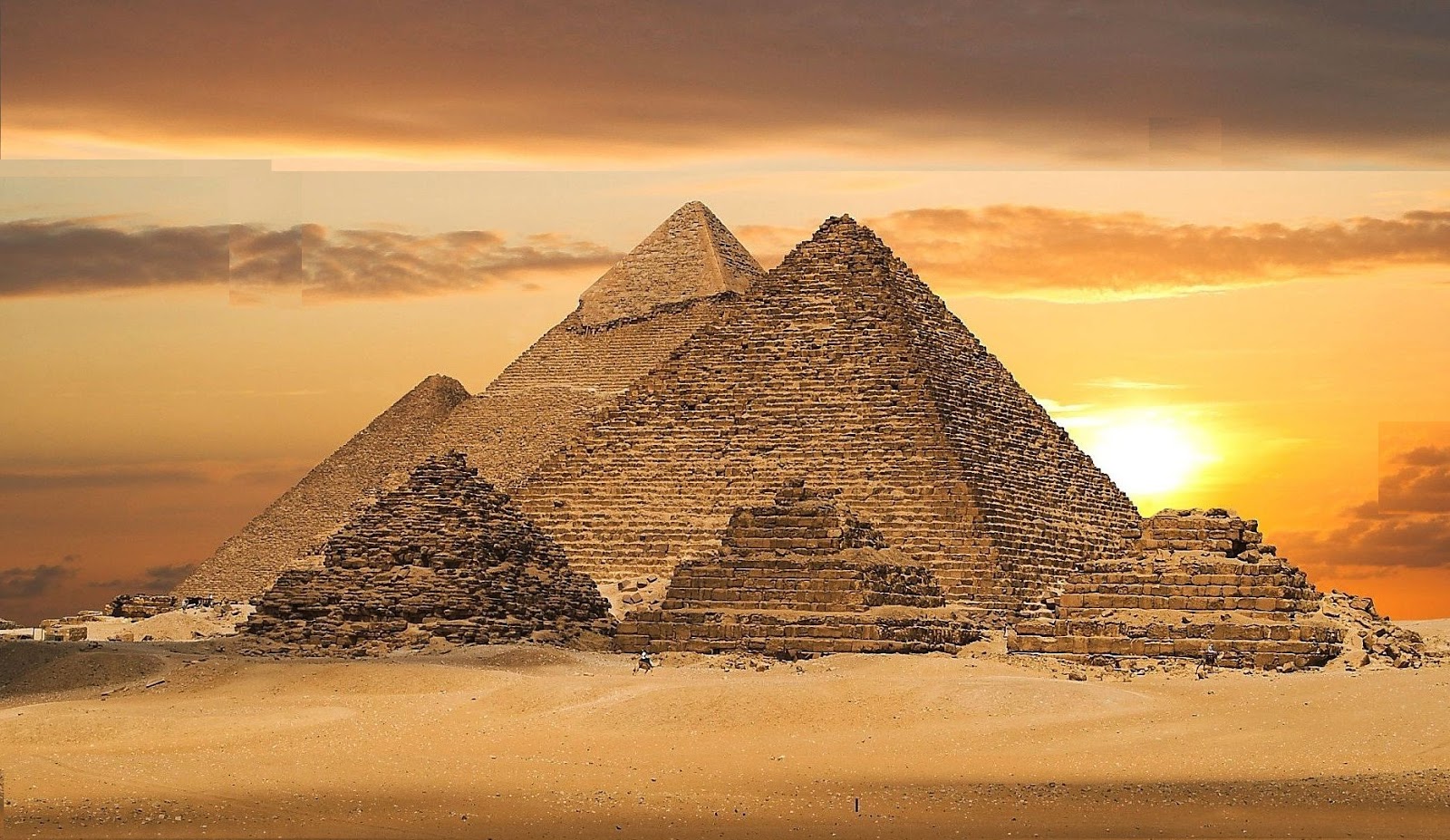
Alongside Khufu’s pyramid stand the slightly smaller pyramid of his son Khafre, notable for retaining some of its original smooth limestone casing near its peak, and the smallest of the three principal pyramids, built for Menkaure. Nearby stands the Great Sphinx, a colossal limestone statue with the body of a lion and a human head widely believed to represent Khafre himself, standing guard over the pyramid complex for more than four thousand years despite centuries of erosion, vandalism, and the loss of its nose, whose exact cause remains debated among historians.
Engineering, Astronomy, and Mathematics
The construction of the pyramids required an extraordinary command of mathematics and astronomy for its time. Egyptian architects and surveyors developed sophisticated methods for measuring right angles, calculating volumes, and aligning structures with remarkable precision to true north, likely using observations of circumpolar stars. The internal chambers and passages of the pyramids, particularly the Great Pyramid, incorporate narrow shafts that some researchers believe were deliberately aligned with specific stars associated with Egyptian religious beliefs about the afterlife, reflecting the deep integration of astronomy, mathematics, religion, and architecture in ancient Egyptian thought.
The logistics behind pyramid construction were equally sophisticated. Stone for the pyramid casings was often quarried at considerable distance and transported via barges along the Nile during flood season, when water levels allowed boats to travel closer to the construction sites. Ramps, sledges, and levers, combined with an enormous coordinated labour force, allowed workers to move and place multi-tonne blocks with an accuracy that still prompts admiration from structural engineers today. This combination of mathematical sophistication, logistical coordination, and sheer organisational discipline stands as one of the clearest possible rebuttals to any lingering suggestion that pre-modern African societies lacked the capacity for large-scale technical achievement.
Beyond Giza: A Nationwide Pyramid Landscape
While Giza dominates popular imagination, it represents only a fraction of Egypt’s pyramid landscape. Over one hundred pyramids have been identified across Egypt, stretching from Abu Rawash in the north to sites well south of Cairo, spanning multiple dynasties and centuries of continued royal burial tradition. Many of these later pyramids, particularly those built during the Fifth and Sixth Dynasties, are considerably smaller and less well preserved than their Fourth Dynasty predecessors, often having been built with less durable core materials and stripped of their outer limestone casing over the centuries by later builders seeking construction material. Nevertheless, sites such as the pyramid complex at Abusir and the pyramid of Unas at Saqqara, the latter notable for containing some of the earliest known religious texts in human history — the Pyramid Texts — remain of enormous historical and archaeological importance, offering insight into the evolution of Egyptian religious thought over more than a thousand years of pyramid-building tradition.
Decline, Rediscovery, and Modern Fascination
Pyramid construction as the dominant form of royal burial gradually declined after the Old Kingdom, giving way in later periods to rock-cut tombs, most famously those of the Valley of the Kings, partly in response to the widespread looting that had plagued earlier pyramid complexes almost from the moment they were sealed. Despite this shift, the pyramids never faded from cultural memory, remaining objects of fascination for successive civilizations, from ancient Greek and Roman visitors who marvelled at structures already thousands of years old in their own time, to medieval Arab scholars who documented and studied them, to the wave of European explorers, collectors, and eventually professional archaeologists who arrived in Egypt from the eighteenth century onward.
This latter period of engagement was deeply complicated by the dynamics of colonialism, as European powers, particularly Britain and France, exercised significant political and economic control over Egypt during the nineteenth and early twentieth centuries. Vast quantities of Egyptian artifacts were removed during this period, many ending up in European museums where a great many remain today, a legacy that continues to fuel ongoing debates about restitution and the rightful custodianship of Egyptian antiquities — debates that echo similar conversations taking place around heritage items removed from other African nations during the colonial era.
 The Pyramids Today
Today, the Giza pyramid complex remains one of the most visited heritage sites in the world, drawing millions of tourists annually and generating substantial revenue for Egypt’s economy. The pyramids were designated a UNESCO World Heritage Site in 1979 as part of the wider “Memphis and its Necropolis” listing, which also includes Saqqara and Dahshur, recognising the full breadth of Egypt’s pyramid-building tradition rather than Giza alone.
Modern conservation efforts face a complex balancing act: managing the pressures of mass tourism, urban encroachment from nearby Cairo, pollution, and the ongoing physical stresses of time and weather, all while continuing to support archaeological research that regularly yields new discoveries. Advances in remote sensing, ground-penetrating radar, and other non-invasive technologies have, in recent years, revealed previously unknown chambers and voids within the pyramids, demonstrating that even after nearly two centuries of intensive archaeological study, Egypt’s pyramids have not yet finished revealing their secrets.
The Grand Egyptian Museum, opened near the Giza plateau in the 2020s, represents a significant modern investment in presenting Egypt’s pyramid-era heritage to the world on Egyptian terms, housing an extensive collection of artifacts, including the complete treasures of Tutankhamun, in a facility designed to keep this heritage rooted in its country of origin rather than dispersed across foreign institutions.
Religion, Symbolism, and the Meaning of the Pyramid Shape
To fully appreciate why the ancient Egyptians invested such enormous resources into pyramid construction, it is necessary to understand the religious symbolism embedded in the shape itself. The pyramid form is widely believed to represent the primordial mound of creation described in Egyptian mythology, the first patch of dry land said to have emerged from the waters of chaos at the beginning of time, upon which the sun god first stood. By building the pharaoh’s tomb in this shape, Egyptian architects were symbolically linking the ruler’s death and rebirth to the very creation of the world itself, reinforcing the pharaoh’s semi-divine status and his essential role in maintaining cosmic order, a concept the Egyptians called maat.
The pyramid’s sloping sides have also been interpreted as representing the rays of the sun descending to earth, offering the deceased pharaoh a ramp of light by which to ascend to the heavens and join the sun god in his eternal journey across the sky. This solar symbolism was reinforced by the pyramids’ association with the sun god Ra, whose cult centre at Heliopolis, near modern Cairo, exercised enormous religious and political influence throughout the Old Kingdom period during which the great pyramids were constructed.
Every element of the pyramid complex, from the mortuary temple where daily offerings were made to the deceased king’s spirit, to the causeway connecting the valley temple on the Nile to the pyramid itself, to the smaller subsidiary pyramids built for queens and the boat pits designed to provide the pharaoh with vessels for his celestial journey, reflects this deeply integrated religious worldview in which architecture, astronomy, and theology were inseparable from one another.
Life at the Foot of the Pyramids
The archaeological rediscovery of the workers’ settlement near the Giza pyramids in the late twentieth century fundamentally reshaped scholarly understanding of who built these monuments and how they lived. Excavations revealed a purpose-built town complete with bakeries capable of producing bread on an industrial scale, breweries, extensive food storage facilities, and cemeteries where workers were buried with grave goods and inscriptions indicating pride in their labour, some explicitly identifying themselves as having worked on the pyramid of Khufu.
Skeletal analysis of workers buried at the site has revealed evidence of healed fractures and medical treatment, suggesting that injured labourers received care rather than being abandoned, further reinforcing the picture of an organised, provisioned workforce rather than a brutalised mass of forced labour. Texts and administrative records, including papyri discovered at the Red Sea port of Wadi al-Jarf detailing the transport of limestone for Khufu’s pyramid, provide additional insight into the remarkably sophisticated logistical and bureaucratic systems that ancient Egyptian administrators developed to coordinate the movement of materials, food, and labour across the kingdom in service of these enormous building projects.
This picture of organised, provisioned, and honoured labour stands as an important corrective to centuries of popular mythology, much of it rooted in later, non-Egyptian sources, including the biblical account of Hebrew slaves building Egyptian monuments, a narrative that, whatever its other historical or religious significance, does not correspond to the archaeological evidence specifically associated with the construction of the Giza pyramids, which were built roughly a thousand years before the traditional dating of the events described in Exodus.
Global Cultural Influence
Few structures in human history have exercised as much influence over global visual and popular culture as the Egyptian pyramids. Their unmistakable silhouette has been reproduced in architecture, corporate logos, currency, film, literature, and countless other forms of media across every continent, making the pyramid one of the most universally recognisable symbols of ancient achievement in the world. This global fascination, while a testament to the pyramids’ extraordinary power as monuments, has occasionally come at the cost of accurate historical understanding, as pseudo-scientific and often thinly veiled racially motivated theories questioning African authorship of the pyramids have periodically resurfaced over the past two centuries, despite being thoroughly rejected by mainstream archaeology and Egyptology.
Modern Egyptology, increasingly shaped by Egyptian scholars themselves rather than solely by foreign institutions, continues to push back against these persistent myths, insisting on locating the pyramids firmly within their proper historical, geographical, and cultural context: as an extraordinary African achievement, built by African hands, under African leadership, in service of an African civilization’s understanding of life, death, and eternity.
Conclusion
The pyramids of Egypt stand as perhaps the ultimate proof of what organised, ambitious, and technically skilled African societies were capable of achieving in antiquity. They are monuments to mathematics, astronomy, religious devotion, and above all, human cooperation on a scale that remains impressive by any standard, ancient or modern. As this series continues to explore heritage sites across the continent — from the pyramids of Meroë further south along the Nile to the stone city of Great Zimbabwe and the rock-hewn churches of Lalibela — the Giza pyramids serve as a fitting early chapter, a reminder that Africa’s monumental achievements did not begin with, and were never limited to, contact with the outside world. As the old saying reminds us, time may fear the pyramids, but the pyramids themselves stand as Africa’s enduring answer to time.
For visitors standing before the Great Pyramid today, dwarfed by a structure whose builders have been dead for well over four millennia, it is worth remembering that this monument was never intended merely to impress the living. It was built to speak to eternity itself, to outlast every empire, language, and belief system that might rise and fall in the millennia to come. In that singular, audacious ambition, the pyramid builders of ancient Egypt succeeded beyond what even they could likely have imagined, leaving behind a legacy that continues, more than four and a half thousand years later, to anchor Africa’s claim to some of the most extraordinary monumental achievements in all of human history.
