

There is an Ethiopian proverb that says,
“Wisdom is like a baobab tree; no one individual can embrace it.”
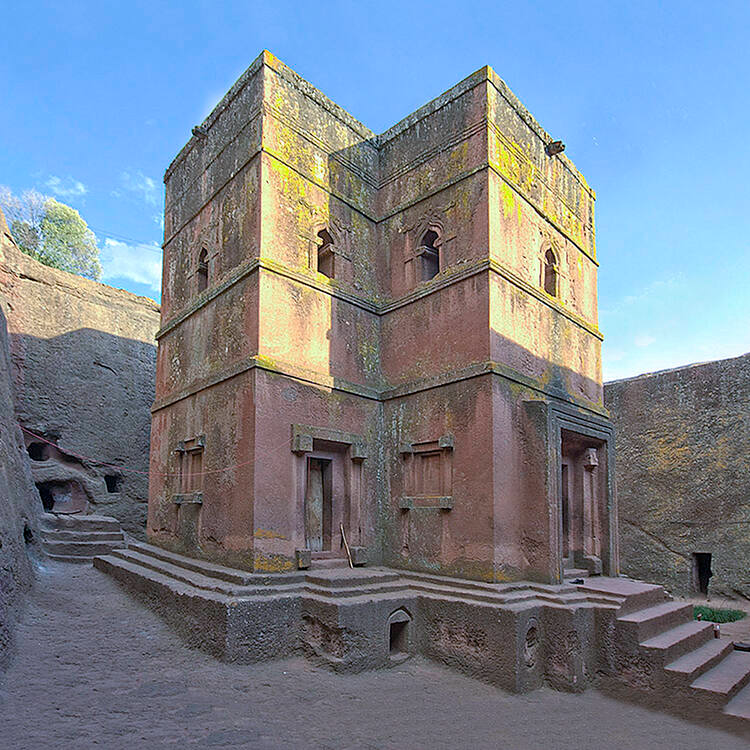
It is a saying about scale — about achievements too vast, too deeply rooted, and too collectively built to belong to any single mind. Few structures on Earth embody this idea as literally as the eleven monolithic churches of Lalibela, carved not from stacked stone but downward, out of the living volcanic rock of the Ethiopian highlands, entire buildings excavated from a single continuous mass of red basalt rather than assembled piece by piece. Nearly eight centuries after their construction, these churches remain active places of Christian worship, still filled with the scent of incense and the sound of chanted liturgy on any given Sunday, making Lalibela not a ruin to be admired from behind a rope barrier but a living heritage site in the fullest sense of the term.
This article, the fourth in a ten-part series on Africa’s heritage sites, explores the origins, construction, religious significance, and enduring legacy of Lalibela — a place that stands, alongside the pyramids of Egypt and the walls of Great Zimbabwe, as one of the clearest physical rebuttals to any notion that pre-colonial African societies lacked the vision or capability for monumental architectural achievement.
 Ethiopia’s Deep Christian Roots
To understand Lalibela, it is necessary first to understand the depth and antiquity of Ethiopian Christianity, which is frequently underestimated or entirely overlooked in popular understanding of the global spread of the faith. Christianity arrived in the Kingdom of Aksum, the powerful trading empire that dominated the northern Ethiopian highlands and parts of the Red Sea coast, in the fourth century CE, when King Ezana adopted the religion as the state faith. This makes Ethiopia one of the very first nations in the world, and by far the oldest in sub-Saharan Africa, to formally embrace Christianity, predating its arrival in most of Western Europe by several centuries.
This deep, independent Christian tradition — largely unconnected to and unshaped by later European missionary activity — developed its own distinct theological character, liturgical language in the ancient Ge’ez script, monastic practices, and architectural styles over the centuries that followed Aksum’s decline. By the time the Zagwe dynasty rose to power in the Ethiopian highlands around the twelfth century, following the eventual weakening of Aksumite political authority, Ethiopian Christianity had already matured into a sophisticated and firmly rooted religious tradition, one confident enough in its own identity to undertake one of the most ambitious building projects in the history of African Christianity.
King Lalibela and the Vision Behind the Churches
The churches take their name from King Gebre Mesqel Lalibela, the Zagwe dynasty ruler credited with commissioning their construction, generally dated to the late twelfth and early thirteenth centuries, roughly between 1187 and 1225 CE. According to Ethiopian tradition, Lalibela’s very name — said to mean “the bees recognise his sovereignty” in the local Agew language — originated from a legend that a swarm of bees surrounded him at birth, an omen his mother interpreted as a sign that he was destined to become king.
The traditional account holds that Lalibela, prior to ascending the throne, was poisoned by a jealous sibling and fell into a coma so deep that he was believed dead, during which he experienced a vision in which he was carried to heaven and shown a city of churches carved entirely from rock, with angels instructing him to recreate this vision upon his return to the earthly world. Whether understood as literal religious history or as a foundational legend layered over a more complex political and religious reality, this story reflects the depth of spiritual ambition attributed to Lalibela’s building project from the very beginning: not simply the construction of impressive churches, but the deliberate creation of a “New Jerusalem” on Ethiopian soil.
This ambition becomes explicit in the very geography and naming of the site itself. The town’s river was renamed the River Jordan, a nearby hill was named Mount Golgotha in reference to the site of Christ’s crucifixion, and various locations across the complex were given names directly echoing the topography of the Holy Land, transforming Lalibela into a symbolic Jerusalem for Ethiopian Christians unable, for political and logistical reasons, to make the far more difficult and dangerous pilgrimage to the actual Holy Land during a period of intensifying conflict between Christian and Muslim powers across the wider region.
The Architecture of Excavation
What sets Lalibela apart from virtually every other religious monument on Earth is its method of construction. Rather than building upward from a foundation, as is the case with essentially every other church, temple, or cathedral in human history, the builders of Lalibela worked in reverse, carving their churches downward and inward out of the solid volcanic tuff bedrock of the region, a technique known as monolithic rock-hewn architecture.
The process began with workers excavating deep trenches around the perimeter of each intended structure, isolating a massive block of stone from the surrounding bedrock. From this isolated block, craftsmen then carved inward and downward, hollowing out windows, doors, interior chambers, columns, and roof structures entirely by removing stone, with no material added at any stage of construction. This meant that every architectural error was permanent and irreversible; there was no possibility of adding a block back if a cut proved too deep, placing an extraordinary premium on precision, planning, and accumulated masonry skill.
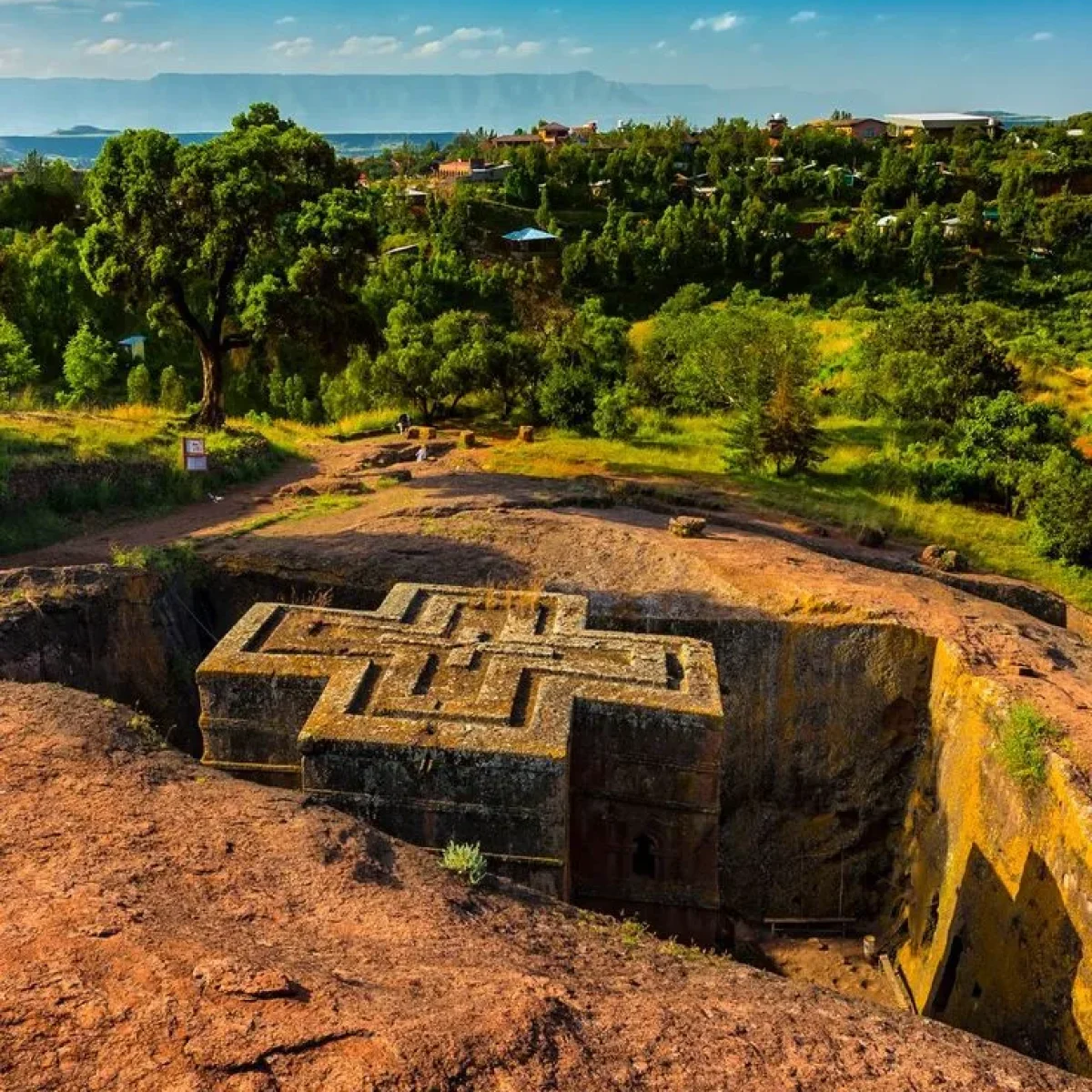
The eleven churches of Lalibela are traditionally divided into two main groups connected by a network of trenches, tunnels, and courtyards carved into the rock, along with a further, somewhat separate structure. The northern group includes Bete Medhane Alem, believed to be the largest monolithic rock-hewn church in the world, its roof supported by rows of carved columns both inside and along its external colonnade. The southern group includes Bete Amanuel, noted for its particularly refined and intricate carving, thought by some scholars to have originally served as a royal chapel. Standing somewhat apart from both groups is Bete Giyorgis, the Church of Saint George, widely regarded as the single most architecturally accomplished structure at the site, carved in the shape of a Greek cross when viewed from above and sunk roughly twelve metres into a pit cut directly into the rock, its precise cruciform roofline invisible from ground level and revealing itself only to those who approach the edge of the surrounding trench and look down.
Engineering Achievement and Open Questions
The scale of labour and skill required to complete the Lalibela complex remains a subject of genuine scholarly astonishment. Modern engineering assessments have estimated that excavating a single church of this scale using period-appropriate tools — essentially hammers, chisels, and picks — would have required the sustained effort of hundreds of workers over a period of years, and the complex as a whole, comprising eleven distinct churches interconnected by an elaborate network of tunnels, trenches, drainage channels, and courtyards, represents a construction undertaking of truly extraordinary ambition for its time and place.
Persistent local tradition holds that the churches were completed with the assistance of angels, who continued the carving work at night while human labourers rested, a legend that, whatever its literal historical accuracy, speaks to just how difficult it has always been, even for the people living closest to the site, to fully comprehend how such an achievement was accomplished by human effort alone within the relatively compressed timeframe traditionally attributed to Lalibela’s reign. Modern archaeological and architectural research suggests that construction may in fact have unfolded across a longer period than the traditional single-reign narrative implies, potentially spanning contributions from earlier Aksumite-era rock-cut traditions through later Zagwe-era expansion, though the core complex is still firmly attributed to Lalibela’s patronage and vision.
Beyond the raw excavation work, the builders also demonstrated sophisticated hydraulic engineering, incorporating drainage systems designed to channel rainwater away from the churches during the highland region’s seasonal rains, a critical consideration given that uncontrolled water infiltration could otherwise have caused serious structural damage to structures cut so deeply into porous volcanic rock.
A Living Site of Worship
Unlike many of the world’s most famous historic religious monuments, which have long since been secularised, converted into museums, or preserved primarily as archaeological curiosities, the churches of Lalibela remain active, functioning places of Ethiopian Orthodox Tewahedo Christian worship to this day. Priests and monks continue to conduct daily services within the churches, robed in traditional vestments and chanting liturgy in the ancient Ge’ez language, while local worshippers move through the complex much as their ancestors did centuries earlier.
This continuity reaches its dramatic peak each year during the celebration of Genna, the Ethiopian Orthodox Christmas observance held in early January according to the Ethiopian calendar, when tens of thousands of pilgrims converge on Lalibela from across Ethiopia and, increasingly, from the Ethiopian diaspora worldwide, filling the ancient courtyards with white-robed worshippers holding candles through overnight vigils that stretch from dusk until dawn. For these pilgrims, Lalibela is not a historical curiosity to be photographed and left behind but an active spiritual destination, a genuine substitute Jerusalem that continues to fulfil precisely the devotional purpose its original builders intended nearly eight centuries ago.
Recognition, Preservation, and Modern Challenges
Lalibela was inscribed as a UNESCO World Heritage Site in 1978, among the earliest African sites to receive this designation, in recognition of both its outstanding architectural achievement and its ongoing religious and cultural significance. This international recognition has brought welcome resources and attention to the site’s preservation, but it has also introduced significant conservation challenges of its own.
The soft volcanic tuff from which the churches are carved is naturally susceptible to weathering, erosion from rainfall, and structural stress, concerns significantly heightened by the churches’ great age and their continuous exposure to the elements over nearly eight centuries. In response, large protective shelters were erected over several of the most vulnerable churches in the early twenty-first century, an intervention that has proven necessary for structural preservation but has also generated considerable controversy, since the modern steel and fabric canopies, while functional, sit in visually jarring contrast to the ancient stonework they protect and were installed, in part, without full consensus from the local community and religious authorities regarding their design and long-term presence.
Ethiopia’s recent history has added further layers of difficulty to heritage preservation efforts at Lalibela and elsewhere in the country. The Tigray conflict that erupted in the northern Ethiopian highlands in 2020 raised serious concerns among heritage organisations internationally about the safety of Lalibela and other historic sites in the region, given the town’s relative proximity to the conflict zone, underscoring once again, as with Timbuktu’s experience further west in the Sahel, how heritage sites remain acutely vulnerable to the disruptions of contemporary political and military conflict even after surviving many centuries of more purely natural threats.
Lalibela in the Wider Story of African Christianity
Lalibela’s significance extends well beyond its remarkable engineering. The site stands as one of the most powerful physical testaments to the depth, independence, and antiquity of African Christian tradition, a tradition that developed largely on its own terms, shaped by African theological interpretation, African liturgical language, and African architectural innovation, centuries before the era of European missionary activity that many popular narratives mistakenly treat as Christianity’s primary introduction to the African continent.
In this sense, Lalibela occupies a similar corrective role in the broader story of African heritage as Great Zimbabwe and the pyramids of Meroë: physical, undeniable evidence of sophisticated, independent African civilizational achievement that persistently challenges reductive external narratives about the continent’s pre-colonial past. Where Great Zimbabwe rebuts myths about African statecraft and engineering, and Timbuktu rebuts myths about African scholarship, Lalibela rebuts equally persistent myths about the supposed foreignness of African Christianity itself.
The Symbolic Landscape Beyond the Churches
The eleven churches themselves represent only the most visible portion of a far larger symbolic landscape that the builders of Lalibela constructed around them. Beyond the carved sanctuaries, the site incorporates an intricate network of trenches, tunnels, and courtyards that pilgrims traditionally walk through in a specific sequence, moving between the northern and southern church groups via passages carved directly into the rock, some barely wide enough for a single person, deliberately narrow and dim in places to evoke a sense of spiritual passage and humility before entering the light-filled church interiors beyond.
This choreography of movement was, by most scholarly interpretations, entirely intentional, designed to guide worshippers through a physical and spiritual journey mirroring the biblical geography the site was built to evoke. Crossing the carved channel renamed the River Jordan, passing beneath the shadow of the hill named for Golgotha, and finally emerging into the courtyard of a church built in the shape of a cross, pilgrims at Lalibela were never meant simply to view isolated monuments in sequence, but to physically inhabit a symbolic re-creation of the Holy Land itself, reinforcing through embodied movement the site’s founding purpose as a substitute Jerusalem for Ethiopian Christians.
Numerous smaller carved features throughout the complex reinforce this symbolic programme, including baptismal pools, hermit cells cut into the rock walls for monks pursuing solitary contemplation, and burial chambers, some traditionally associated with King Lalibela himself, whose remains are said by some traditions to rest within the complex he commissioned, binding his personal legacy permanently to the sacred landscape he created.
Craftsmanship, Iconography, and Artistic Detail
Beyond the sheer scale of excavation, Lalibela’s churches display remarkable artistic sophistication in their interior detailing. Carved relief work depicting crosses, geometric patterns, and biblical motifs adorns walls, ceilings, and doorways throughout the complex, executed with a level of precision that becomes especially striking when one considers that any carving error, unlike a mistake in painted or applied decoration, could not be corrected or painted over but only worked around within the same irreplaceable block of stone.
Bete Giyorgis in particular is celebrated for the refinement of its proportions and the precision of its cruciform design, carved with such exactness that its four arms of equal length meet at perfectly balanced right angles, a geometric achievement made all the more impressive by the fact that the entire structure had to be planned and executed from the top of the rock face downward, with the finished shape only becoming visible once excavation was essentially complete, leaving little room for the kind of incremental correction possible in conventional above-ground construction.
Many of the churches also house significant collections of religious artifacts, including hand-copied illuminated manuscripts, ornate processional crosses used in religious ceremonies, and centuries-old religious paintings, some depicting scenes from Ethiopian royal and religious history alongside more familiar biblical narratives, reflecting the way Ethiopian Christian art has long woven local historical memory together with broader Christian iconographic tradition rather than simply reproducing imported religious imagery unchanged.
Conclusion
The eleven rock-hewn churches of Lalibela remain, nearly eight centuries after their creation, one of the most extraordinary religious and architectural achievements found anywhere on Earth, a monument to faith made permanent not by construction but by subtraction, carved downward into the very bones of the earth by builders whose names have mostly been lost to history but whose collective vision, like the wisdom of the proverbial baobab tree with which this article began, was simply too vast for any single mind to have conceived and executed alone. As Lalibela continues to draw pilgrims, scholars, and travellers from around the world today, it stands as living proof that some heritage sites are not merely windows into the past, but doorways still open, through which faith, memory, and devotion continue to pass in the present moment, exactly as they have for nearly eight hundred years.
For the traveller or researcher approaching Lalibela today, it is worth remembering that every trench, tunnel, column, and carved cross in this complex represents rock physically removed rather than material added, an act of subtraction so total and so precisely controlled that it produced, against every intuitive expectation of how architecture is supposed to work, some of the most spiritually resonant buildings in the entire history of Christian worship. In the same way that no single person could carry the whole of the baobab’s wisdom, no single mind conceived Lalibela alone; it stands instead as the collective inheritance of generations of Ethiopian faith, skill, and vision, still bearing witness, one carved courtyard at a time, to what that inheritance was capable of achieving.
