

There is a saying among the Yoruba people of West Africa: “Ẹniyan tí kò lọ́rọ̀ inú, kò lè mọ ohun tí ìlẹ̀kẹ̀ ń sọ “— “A person without inner depth cannot understand what beads are saying.” It is a proverb that captures, in a single breath, the entire philosophy behind one of Africa’s oldest and most expressive art forms. Beads on the continent have never simply been ornaments. They are sentences written on the body, paragraphs of status stitched onto collars, and entire autobiographies looped around wrists, necks, waists, and ankles. To walk through a market in Lagos, Nairobi, Johannesburg, or Ouagadougou and see strands of coloured beads hanging from a vendor’s stall is to look, unknowingly, at a language most outsiders have never learned to read.
Beadwork occupies a curious and beautiful space in African material culture — it is simultaneously the most intimate of art forms, worn against skin, and the most public, broadcasting information about the wearer’s age, marital status, spiritual standing, wealth, and community before a single word is spoken. This article explores the origins of African beadwork, the raw materials and techniques that shaped its evolution, the extraordinary diversity of bead traditions from the Maasai steppes to the palaces of Yorubaland, and the enduring symbolism that keeps beadwork alive as both craft and code.
Origins: Beads Before Empires
Long before glass beads arrived on African shores through trans-Saharan and later transatlantic trade routes, African communities were already adept at bead-making using materials sourced directly from their environment. Archaeological evidence from sites across the continent — including the Blombos Cave in South Africa — has revealed shell beads dating back over 70,000 years, among the oldest personal ornaments ever discovered anywhere in the world. These early beads were fashioned from ostrich eggshell, snail shell, seeds, bone, ivory, and stone, painstakingly shaped, drilled, and polished by hand using tools of similarly humble origin.
Ostrich eggshell beads, in particular, became a hallmark of southern African beadwork traditions among groups such as the San and Khoikhoi, who ground shell fragments into small discs, pierced them, and strung them into intricate patterns. In East Africa, seeds, coral, and bone were common. In the forest regions of West Africa, materials like raffia, carved wood, and local stones such as carnelian and agate were transformed into wearable art. This deep prehistory matters because it dismantles a persistent misconception — that African beadwork is largely a colonial-era phenomenon built entirely on imported glass. In truth, bead-making on the continent predates most known civilizations, and imported beads, when they eventually arrived, were absorbed into pre-existing systems of meaning rather than inventing them from scratch.
 The Arrival of Glass: Trade, Wealth, and Transformation
From roughly the ninth century onward, glass beads began entering Africa through extensive trade networks — first via Arab and Indian Ocean traders bringing beads from India and the Middle East to East African coastal city-states like Kilwa and Mombasa, and later via European traders along the Atlantic coast from the fifteenth century onward. Venetian glassmakers, particularly those on the island of Murano, became major suppliers of what would come to be known across the continent simply as “trade beads.” These small, often vividly coloured glass objects were manufactured specifically for African markets and became, for a period, a form of currency in their own right — exchanged for gold, ivory, palm oil, and, tragically, human beings during the transatlantic slave trade.
This history is not incidental to the art form; it is woven into its very fabric. Certain antique trade beads — such as the deep blue “Russian” beads or the layered “chevron” beads with their distinctive star-shaped cross-section — became so prized that they were treated as heirlooms, passed down through generations, sometimes valued more highly than gold itself in specific regions. In parts of Ghana and Nigeria, antique beads are still sought after by collectors and worn during the most important ceremonial occasions, their age and rarity contributing directly to the prestige of the wearer.
What makes African beadwork remarkable is the way communities did not merely adopt these imported materials but reinterpreted them entirely, layering onto glass beads meanings and systems of use that had nothing to do with their European or Asian origins. A bead manufactured in a Venetian workshop might travel thousands of miles only to become, in the hands of a Maasai woman or a Zulu bride, a precise marker of clan identity or readiness for marriage — a transformation of raw material into cultural code.
Regional Traditions: A Continent of Distinct Languages
Southern Africa: Zulu and Ndebele Beadwork
Among the Zulu people of South Africa, beadwork developed into one of the most sophisticated visual communication systems in African art. Known as ucu, Zulu beadwork historically functioned as a courtship language — a young woman could craft a beaded panel or “love letter” for a suitor, its colours and patterns conveying specific messages that he was expected to interpret. White beads might signal purity and love, black beads could indicate marriage or sorrow depending on their arrangement, and pink beads often expressed poverty or a plea for gifts. The precise meaning of a colour could shift depending on region, era, and the surrounding pattern, making the reading of Zulu love letters a genuinely literate skill, taught from mother to daughter.
 The Ndebele people, also of southern Africa, developed an equally distinctive beadwork tradition, closely tied to their striking geometric mural art. Ndebele beadwork includes large, stiff beaded aprons and neck rings worn by married women, whose designs grow more elaborate as a woman ages and passes through different life stages — from the isiphephetu apron worn by young girls to the fuller, more ornate garments worn by elder married women. These pieces are not static; they are updated and added to throughout a woman’s life, effectively turning the body into a living record of her personal and social journey.
East Africa: Maasai Beadwork
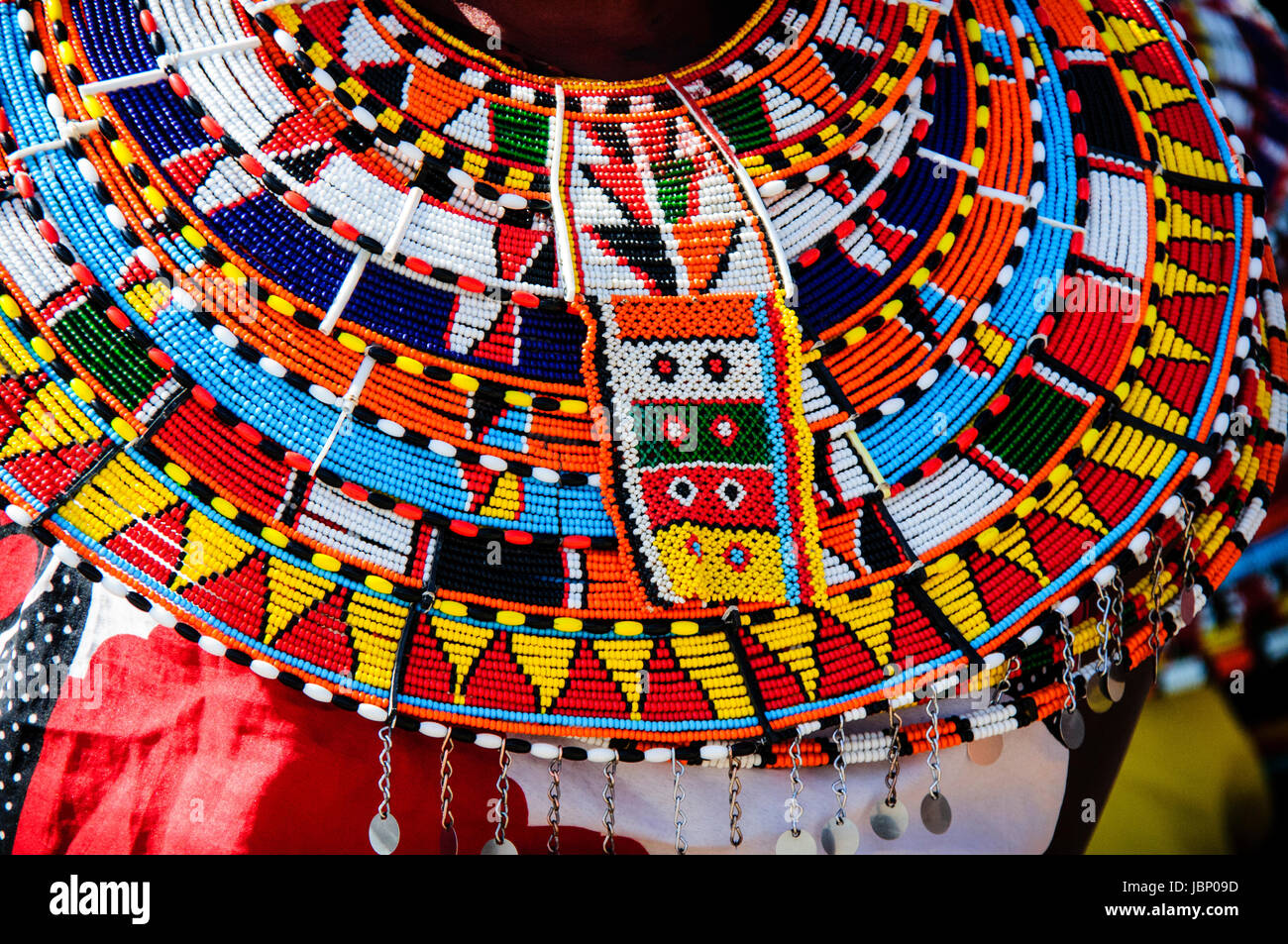
Perhaps no beadwork tradition is more internationally recognisable than that of the Maasai people of Kenya and Tanzania. Maasai beadwork is instantly identifiable by its bold, wide collars — isurutia — layered in concentric circles of red, blue, white, orange, and green, often accompanied by beaded earrings, bracelets, and headpieces. Colour symbolism runs deep: red typically represents bravery, unity, and the blood central to Maasai cattle-herding life; blue evokes the sky and the energy it provides; green symbolizes the land and its produce; white speaks to purity, health, and peace; and black is associated with the hardships the community has endured and overcome.
Beadwork among the Maasai is deeply tied to the age-set system that structures social life — different beaded ornaments mark a person’s progression through childhood, warriorhood (moranism), and elderhood. Young Maasai women learn beadwork from an early age, and the crafting of elaborate collars for warriors during initiation ceremonies is both an artistic and a deeply social act, reinforcing bonds between age-mates and across generations.
West Africa: Yoruba and Kalabari Beadwork
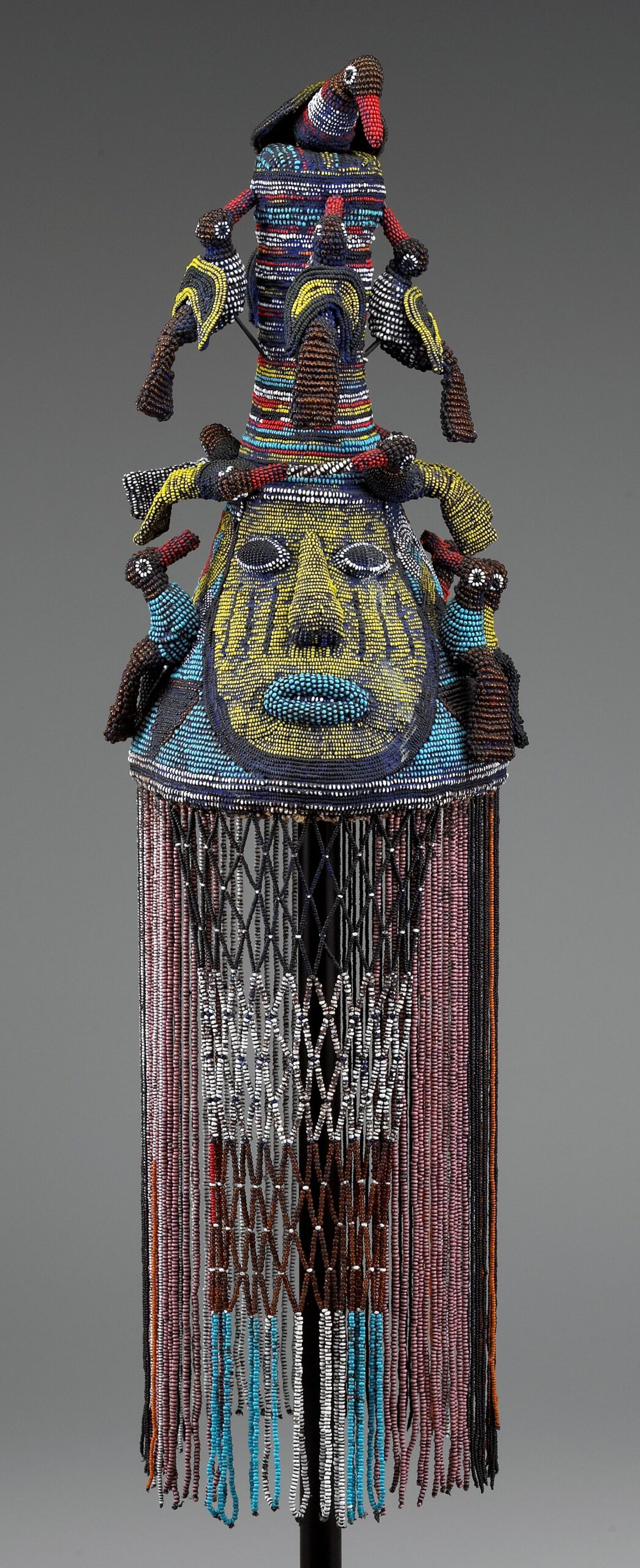
In Yorubaland, beadwork historically reached its most elevated cultural expression in the beaded crowns — adé — worn exclusively by kings, or obas. These crowns, often conical and fully covered in intricately beaded imagery, are far more than royal headwear; they are considered sacred objects believed to house ase, the vital spiritual force that legitimizes a king’s rule. The beaded veil that typically hangs from the front of an adé, obscuring the king’s face, is said to protect both the ruler and his subjects from the overwhelming power of his direct gaze, understood in Yoruba cosmology as spiritually charged.
The imagery on these crowns frequently includes birds — representing the mystical power of “our mothers” (spiritually powerful elder women) — as well as faces of past kings, geometric patterns, and symbolic animals, each carrying layers of historical and spiritual meaning legible primarily to initiated members of the royal court. The creation of an adé is entrusted to specialist beadworkers, often organized into guilds, whose knowledge of proportion, colour sequencing, and symbolic imagery is passed down within families over centuries.
Among the Kalabari people of the Niger Delta, coral beads hold similarly elevated status, worn in dense, heavy strands by chiefs and titled women during major ceremonies, their weight and abundance a direct, visible marker of lineage wealth and social rank.
Beadwork and the Life Cycle
Across nearly every African bead tradition, one consistent thread emerges: beadwork marks time. It announces birth, initiation, marriage, motherhood, chieftaincy, and death. Among many East and Southern African communities, infants are adorned with simple protective bead strands believed to guard against illness or the evil eye. As children grow, their beadwork grows more elaborate, often marking rites of passage such as circumcision ceremonies or initiation schools that formally transition boys and girls into adulthood.
 Marriage, in particular, is one of the most bead-intensive events in African social life. Among the Maasai, a bride may wear beaded ornaments so extensive and heavy that they require assistance simply to stand upright, each piece contributed by female relatives over months of preparation. Among the Ndebele, a new bride receives a beaded ijogolo — a long apron marking her transition into married womanhood, distinct from the garments of unmarried girls. These transitions are rarely private; the entire community reads and understands the shift in status the moment a change in beaded attire is observed.
Even death carries its own beaded vocabulary in many traditions, with mourning beads or the removal of certain ornaments signalling grief and the disruption of normal social order, to be resumed only after appropriate mourning periods have passed.
Techniques: Hands, Patience, and Precision
Traditional African beadwork employs a range of techniques, many requiring years of apprenticeship to master. Loom beading, used extensively in Zulu and Ndebele work, involves stringing beads across a fixed warp to create flat, patterned panels with clean geometric precision — a technique well suited to the bold, symmetrical designs characteristic of southern African beadwork. Off-loom techniques, including netting, peyote stitch (though named after Native American traditions, structurally similar methods appear independently in African beadwork), and simple stringing, allow for more three-dimensional, sculptural forms, seen in collars, crowns, and ceremonial regalia.
Colour selection and sequencing are rarely improvised. In many communities, master beadworkers — almost universally women, with some notable exceptions in royal or priestly contexts — hold this knowledge as a form of intellectual property, guarded and transmitted carefully. A young apprentice does not simply learn to string beads; she learns an entire grammar of colour, proportion, and pattern that took her teachers decades to fully internalize. This oral, hands-on transmission of knowledge is precisely why the loss of elder beadworkers, discussed further in this series’ final article on preservation, poses such a serious threat to the survival of these traditions in their full depth.
Beadwork as Economic Life
Beyond its symbolic and ceremonial functions, beadwork has long constituted a genuine economic engine within African communities. In pre-colonial trade networks, beads themselves functioned as a medium of exchange, valued alongside gold, salt, and cloth. Today, beadwork remains a significant source of livelihood, particularly for women, across much of the continent. Cooperative beadwork groups in Kenya, South Africa, and elsewhere have become vital economic structures, allowing women — often in rural areas with limited access to formal employment — to generate independent income while sustaining traditional knowledge.
The global fashion and interior design industries have taken notice, and Maasai and Zulu-style beadwork in particular has found its way into international runways, boutique jewelry lines, and home décor collections. This global appetite has been a double-edged development: it has created valuable new markets and income streams for African beadworkers, but it has also given rise to concerns about cultural appropriation, underpayment of original artisans, and the mass-produced imitation of designs whose deeper meanings are stripped away in translation to foreign markets, reduced to mere aesthetic trend rather than living cultural language.
Symbolism Beyond Colour: Pattern, Number, and Placement
While colour symbolism receives the most attention from outside observers, experienced readers of African beadwork understand that meaning is constructed through a much fuller vocabulary — the number of strands, the placement of a piece on the body, the density of beading, and the specific geometric patterns employed all carry significance. In Zulu beadwork, a triangle pointing upward may indicate an unmarried man, while a triangle pointing downward may indicate an unmarried woman; two triangles placed base to base can suggest marriage. Diamond shapes, formed by combining triangles, often signify a married woman, layering multiple meanings into what might appear, to an untrained eye, as simple decorative geometry.
Placement matters equally. A beaded ornament worn on the forehead may carry entirely different implications from an identical pattern worn around the ankle. In many traditions, beadwork on the head and neck is reserved for the most significant declarations of status — royalty, priesthood, or marriage — while beadwork on the wrists and ankles often serves more everyday protective or aesthetic functions. Understanding African beadwork fully, then, requires understanding it as a complete visual grammar, not a palette of isolated colour meanings.
Spiritual and Protective Dimensions
In many African cosmologies, beads are not spiritually neutral objects. Certain beads, particularly those made from specific materials such as cowrie shells, coral, or particular stones, are believed to carry inherent spiritual properties — protection from malevolent forces, connection to ancestral spirits, or association with specific deities. Among the Yoruba, cowrie shells are closely associated with Ifa divination and with deities such as Osun, the orisha of rivers, fertility, and beauty, whose devotees often wear beaded regalia in her sacred colours of yellow, gold, and coral.
Diviners, priests, and spiritual leaders across numerous African traditions wear specific beaded regalia that both identifies their spiritual role to the community and is believed to actively participate in their spiritual practice — a physical conduit between the wearer and the unseen forces they serve. This spiritual dimension elevates beadwork beyond mere craft into a category closer to sacred technology, an object understood to actively do something in the world, not merely represent something about the wearer.
Beadwork in Contemporary Africa
Today, African beadwork exists in a fascinating dual reality. In many rural and traditional communities, it continues to function much as it has for generations — marking rites of passage, denoting status, and preserving spiritual practice. Simultaneously, in Africa’s rapidly growing urban centres, beadwork has been reimagined by a new generation of designers who blend traditional techniques with contemporary fashion sensibilities, creating pieces that speak to both heritage and modern identity.
Designers across Lagos, Nairobi, Johannesburg, and Accra now incorporate traditional beading techniques into contemporary jewelry lines, bridal wear, and even high fashion, presenting African beadwork on international runways and in global boutiques. This contemporary movement has sparked important conversations about authenticity, ownership, and fair compensation — questions of who benefits when traditional knowledge, developed over centuries by specific communities, becomes a global commercial product.
At the same time, cultural festivals, museum exhibitions, and educational initiatives across the continent and its diaspora are working to ensure that the deeper meanings behind these beautiful objects are not lost even as their popularity grows. Understanding the difference between a beaded necklace as fashion accessory and a beaded crown as a vessel of sacred royal power is essential to genuinely honouring this art form rather than merely consuming its surface beauty.
Beadwork and Gender: Who Holds the Knowledge
Across most African beadwork traditions, women are the primary custodians and practitioners of the craft, though the reasons for this are rarely simple. In many communities, beadwork is understood as an extension of domestic and social labour traditionally assigned to women — the labour of preparing a bride, adorning children, and maintaining the visual record of a family’s status. Yet this framing risks understating the sheer intellectual and artistic sophistication required. A senior Zulu or Ndebele beadworker is, in effect, a trained semiotician, fluent in a symbolic system with regional dialects, historical shifts, and individual creative expression layered on top of inherited convention.
There are notable exceptions to female dominance in bead-based art. Among the Yoruba, the beading of royal crowns has historically been the preserve of specialist male guild members, reflecting the sacred and politically sensitive nature of the objects they produce. In some East African pastoralist communities, men participate actively in the wearing — though rarely the making — of elaborate beaded ornaments, particularly during the warrior stage of the male age-set system. This gendered division of labour and privilege is itself a form of cultural information, revealing how a society organizes authority, sacred knowledge, and public display along lines of gender, age, and social role.
The Ecology of a Bead: From Ostrich Farm to Ocean Trade Route
It is worth pausing on the sheer material journey embedded within a single traditional beaded object. An ostrich eggshell bead required a hunter or herder to source the shell, a craftsperson to break it into rough fragments, another stage of grinding each fragment against stone until uniformly circular, a hand-drill — often a simple bow-drill — to pierce the centre without shattering the fragile material, and finally, careful stringing using plant fibre or sinew. Multiply this by the hundreds or thousands of beads required for a single ceremonial garment, and the labour embedded in a “simple” beaded object becomes staggering.
Imported glass beads carried their own extraordinary journey — raw silica and mineral colourants melted in furnaces in Venice, Bohemia, or later Czechoslovakia and the Netherlands, shaped by glassblowers into rods, cut into small segments, polished, sorted by colour and size, packed into ships, and carried across oceans and then inland along trade routes stretching hundreds or thousands of kilometres by caravan, canoe, and foot porterage before ever reaching the hands of an African beadworker. Understanding this material history reframes beadwork not as a “simple” or “primitive” craft — a colonial-era mischaracterization that persists in some corners of the art world even today — but as the product of sophisticated, transcontinental systems of production, exchange, and skilled interpretation.
Beadwork, Colonialism, and Cultural Suppression
The colonial period brought significant disruption to African beadwork traditions, though the nature of that disruption varied considerably by region and colonial administration. Missionary activity in many areas actively discouraged elaborate beaded regalia, particularly where it was closely tied to practices Christian missionaries viewed as “pagan” — initiation ceremonies, polygamous marriage customs, or traditional religious worship. In some cases, colonial administrators imposed restrictions on the movement, congregation, or dress of indigenous populations that indirectly suppressed the communal ceremonies during which elaborate beadwork was traditionally produced and worn.
At the same time, colonial trade intensified the flow of manufactured glass beads into the continent, often overwhelming and, in some documented cases, deliberately undercutting local bead-production industries that had operated for centuries — including glass and stone bead workshops in parts of West Africa such as the famous powder-glass bead makers of Bida in present-day Nigeria. This created a complicated legacy: increased access to imported materials alongside pressure against the practices and beliefs that gave those materials meaning. Many communities responded not by abandoning beadwork but by adapting it — continuing ceremonies more discreetly, embedding traditional symbolism within garments that outwardly appeared more “acceptable” to colonial authorities, or shifting significant beadwork practice into contexts colonial administrations were less inclined to police, such as private family ceremonies.
Learning to Read: A Practical Look at Interpretation
For those encountering African beadwork for the first time, it can be useful to think of interpretation as operating on at least four simultaneous levels. First is colour — the broadest and most commonly discussed layer of meaning, though one that shifts significantly between communities and even between specific families or lineages within the same ethnic group. Second is pattern and geometry — the arrangement of triangles, diamonds, chevrons, and bands that encode information about marital and social status with a precision comparable to a written document. Third is quantity and density — the sheer volume of beadwork worn often correlates directly with wealth, seniority, or the importance of the occasion being marked. Fourth, and often overlooked by outside observers, is context — the same beaded object can carry entirely different meanings depending on the ceremony, season, or life stage during which it is worn.
A visitor to a Maasai enkang (homestead) during an ordinary day might see beadwork markedly different from what appears during an eunoto warrior-graduation ceremony, even if some of the same individual pieces are present in both settings. Learning to read African beadwork, in other words, is less like memorizing a fixed dictionary and more like developing fluency in a living, context-sensitive language — one that continues to be spoken, adapted, and passed down today.
To look closely at African beadwork is to encounter one of humanity’s oldest and most sophisticated systems of visual communication — one that predates written language in many of the regions where it developed and continues to evolve today. From the ostrich eggshell beads of prehistoric southern Africa to the beaded crowns of Yoruba kings, from the courtship love letters of Zulu beadwork to the age-marking collars of Maasai warriors, beads across the continent have consistently served as far more than decoration. They are memory made tactile, status made visible, and spirituality made wearable.
As the Yoruba proverb reminds us, beads speak — but only to those willing to look beyond their surface shimmer and learn the deeper language encoded in colour, pattern, number, and placement. In preserving African beadwork, communities are not simply preserving beautiful objects; they are preserving an entire grammar of identity, one bead at a time.
