

Reed Dance and Cultural Identity in Southern Africa
Introduction and Historical Foundations
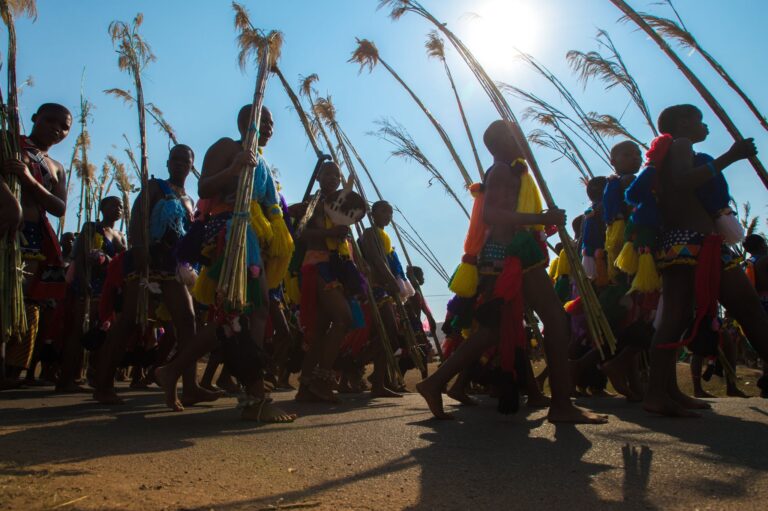
Across the sweeping hills of Eswatini and the rolling vales of KwaZulu-Natal in South Africa, late winter marks a period of profound cultural renewal. Every August and September, tens of thousands of young unmarried women assemble to participate in the Reed Dance—known as Umhlanga in Eswatini and Umkhosi Womhlanga among the Zulu nation. Carrying tall, freshly cut river reeds, these young women march in disciplined procession toward the royal residence, raising their voices in traditional song and moving to rhythmic folk choreography. What appears to the casual outsider as an immense cultural spectacle is, in truth, one of Southern Africa’s most enduring, sophisticated institutions of social cohesion, rites of passage, and monarchical legitimacy.
The historical origins of the Reed Dance are deeply intertwined with the nation-building projects of the Nguni-speaking peoples during the eighteenth and nineteenth centuries. Originally designed as both a practical labor custom and a moral rite of passage, the ceremony brought young women (tintfombi in SiSwati; izintombi in isiZulu) together from distant chiefdoms to repair the windbreaks (emahlandla) surrounding the Queen Mother’s royal residence (Ludzidzini in Eswatini or eNyokeni in KwaZulu-Natal). In an era preceding modern communications, this annual gathering allowed the central monarchy to maintain direct social contact with rural communities, unifying diverse clans under a single cultural banner.
While the tradition experienced periods of decline during the colonial and apartheid eras due to urbanization and Western missionary influence, it saw a dramatic revival in the late twentieth century. In South Africa, King Goodwill Zwelithini kaBhekuzulu revived Umkhosi Womhlanga in 1984 as a strategic effort to rebuild Zulu cultural pride, foster youth mentorship, and combat rampant social crises like teen pregnancy and HIV/AIDS. In Eswatini, under the reign of King Sobhuza II and continued by King Mswati III, Umhlanga remained an unbroken cornerstone of statecraft and national consciousness, serving as the kingdom’s primary annual expression of unity.
Today, the Reed Dance functions as a vital bridge between pre-colonial heritage and twenty-first-century African identity. It asserts that indigenous social structures possess enduring relevance, offering young women a structured peer network, moral leadership, and a tangible connection to their ancestors. Far from being a static historical reenactment, the Reed Dance is a dynamic, living cultural institution that continually adapts to contemporary social realities while preserving the core spiritual values of Southern Africa.
The Ritual Arc: Gathering, Cutting, and Presentation
The execution of the Reed Dance follows a strict liturgical timeline spanning approximately eight days. Every stage of the ritual carries symbolic weight, requiring physical endurance, collective discipline, and spiritual purity from its participants.
The ceremony begins with the mobilization of young women under the leadership of female royal chaperones (tingatja or imijindolo). Participants gather at designated royal villages, where they are grouped into regiments (mabutho) based on age and geographic origin. The first major phase involves a long trek to riverbanks—often covering up to twenty to thirty kilometers on foot—to harvest wild river reeds (umncanga). The harvesting process is governed by strict customary selection rules:
Purity of Choice: Only strong, tall, unbroken reeds with robust stems may be selected, representing the physical strength and moral integrity of the gatherer.
Environmental Balance: Harvesting takes place at specific times of year to encourage natural riverbed regeneration, reflecting traditional ecological stewardship.
Collective Labor: Young women work in pairs or groups to harvest and bundle seven reeds each, emphasizing cooperation over individual competition.
Once harvested, the maidens embark on the return journey to the royal palace, carrying their bundled reeds atop their heads or shoulders while singing traditional marching chants. The physical exertion of the trek functions as an intentional test of resilience, forging deep bonds of solidarity across regional and socio-economic lines.
The climax of the festival occurs on the sixth and seventh days, when the maidens present their harvested reeds to the Queen Mother (Indlovukazi). The reeds are used to construct and repair the reed fences that enclose the royal household, symbolically reinforcing the physical and spiritual walls protecting the nation’s heritage. Following the presentation, participants form massive, sweeping dance formations in the main arena, performing traditional choreography (ingadla and mimmiso) before the monarch, royal family, and international dignitaries.
Maidens from across the country report to royal administrative centers, where they are organized into age-based regiments (mabutho) under the guidance of senior female mentors.
Participants trek long distances to assigned river valleys to cut seven tall, unbroken reeds per maiden, spending the night in supervised field camps.
The maidens return to the royal palace in disciplined processions, carrying their bundled reeds and singing traditional regiment chants (tihlabelelo).
Participants lay their reeds at the Queen Mother’s residence, followed by two full days of televised traditional dancing, singing, and address by the King.
The King orders the slaughter of cattle for a national feast (emabutho dinner), concluding the festival and dismissing the maidens back to their home communities.
Material Culture, Regalia, and Symbolism
The visual identity of the Reed Dance is defined by an intricate language of beadwork, textiles, and traditional attire. Far from mere ornamentation, every element of a maiden’s regalia communicates her age group, marital status, regional heritage, and social standing within the community.
Central to this material culture is traditional Nguni beadwork. Color combinations, geometric patterns, and bead placement serve as a visual script:
In Eswatini, maidens wear a colorful short skirt made of wool and beads called an indlamu, paired with a patterned shoulder sash (lihhiya). Attached to the waist are bright, thick tassels (umgaco) that swing rhythmically with every step of the dance. Unmarried women wear their hair short or styled in natural coils, adorned with brass neck rings (insimbi) and beaded headbands. Royal princesses are distinguished by wearing red duiker feathers (ligwalagwala) in their hair, a symbol reserved exclusively for the royal lineage.
In the Zulu tradition (Umkhosi Womhlanga), maidens wear the isigolowane (heavy beaded waist hoops) and isicholo or beaded neckwear that drapes across the chest. The colors utilized in Zulu beadwork carry explicit philosophical meanings: blue represents the sky and divine blessing, white denotes purity and clarity of intent, red signifies deep commitment, and black indicates domestic stability.
The reed itself (umncanga) holds profound cosmological meaning. In Southern African indigenous creation narratives, particularly within Nguni and Sotho-Tswana traditions, humanity is said to have originally emerged from a primordial reed bed (Uthlanga or Uhlanga). By holding and offering river reeds during the ceremony, participants symbolically reconnect with the origin of life itself, recommitting themselves to the preservation of human life and communal harmony.
Social Cohesion, Female Empowerment, and Modern Debates
In contemporary Southern Africa, the Reed Dance operates as a powerful mechanism for youth development and female mentorship. In rural communities where modern social services can be limited, the festival offers young women a dedicated platform for peer education, health awareness, and leadership development.
Primary among its social functions is the tradition of female-led mentorship. Senior women and chaperones utilize the gathering to educate younger girls on reproductive health, personal hygiene, self-respect, and community responsibility. The ceremony creates an environment where young women are celebrated for their personal discipline and moral character, offering a counter-narrative to modern pressures surrounding early marriage and economic exploitation.
Despite its enduring popularity, the Reed Dance exists within a lively landscape of contemporary debate:
Virginity Testing (Ukuhlola): The customary practice of virginity testing associated with the Zulu Reed Dance has sparked intense discussions. Supporters argue it protects young girls, preserves traditional values, and combats HIV transmission. Human rights advocates and gender scholars, however, contend that the practice violates privacy rights and places disproportionate moral scrutiny on young women compared to men.
Cultural Preservation vs. Modernity: Western-style educational institutions and globalization have created friction with traditional calendars. Organizers have adapted by aligning the festival with school holiday breaks to ensure urbanized youth can participate without interrupting their formal education.
Political Dynamics and Statecraft: Critics occasionally question the financial costs of hosting large-scale state ceremonies in developing economies. Conversely, proponents highlight the immense domestic tourism revenue, regional trade, and national unity generated by the event.
Rather than weakening the institution, these ongoing debates have pushed cultural authorities to modernize health protocols, integrate professional medical counseling, and ensure that participation remains strictly voluntary. Consequently, the Reed Dance continues to evolve, demonstrating how ancient traditions can engage productively with modern human rights discourse without surrendering their cultural identity.
National Identity and Regional Tourism
Beyond its deep spiritual and social dimensions, the Reed Dance has become a cornerstone of cultural diplomacy and economic development in Southern Africa. For the Kingdom of Eswatini, Umhlanga represents the single largest annual tourist attraction, drawing thousands of international visitors, photographers, scholars, and cultural enthusiasts from across the globe.
The economic ripple effect of the festival is substantial:
| Economic Sector | Local Impact & Value Driver |
|---|---|
| Hospitality & Lodging | 100% hotel occupancy across Mbabane, Lobamba, and Manzini during festival week. |
| Artisanal Craft Economies | Surging demand for hand-woven baskets, traditional beadwork, wood carvings, and textiles. |
| Transport & Logistics | High utilization of regional bus networks and cross-border transport from South Africa and Mozambique. |
| Cultural Diplomacy | Hosting foreign delegations and cultural ambassadors to strengthen pan-African bilateral ties. |
The event provides direct economic support to rural craftspeople—particularly elderly women who spend months crafting the intricate beadwork, woven mats, and traditional garments worn by participants. By monetizing traditional skills, the festival helps sustain rural cottage industries that might otherwise vanish under the pressure of mass manufacturing.
On a broader diplomatic scale, the Reed Dance serves as a platform for Pan-African solidarity. Delegations of young women and traditional leaders regularly travel between South Africa, Eswatini, Mozambique, and Lesotho to attend each other’s cultural festivals. This cross-border exchange reinforces shared historical roots across Southern Africa, demonstrating that pre-colonial cultural geography continues to offer a meaningful framework for modern regional integration.
As Southern Africa navigates the complexities of the modern world, the Reed Dance stands as a vibrant testament to the resilience of African heritage. It affirms that identity is not merely inherited from the past, but actively performed, celebrated, and renewed by each generation. Through the rhythmic beat of drums, the flashing of beaded colors, and the symbolic offering of river reeds, young women continue to walk the paths of their ancestors—building a bridge of cultural pride toward the future.
