

Fes Festival and the Cultural Heritage of North Africa
Introduction and Historical Foundations
Nestled within the labyrinthine valleys of northern Morocco lies Fes, a city where time appears to flow backward through narrow, car-free stone alleys, carved cedar doorways, and towering minarets. Founded in the late eighth century by Idris I and expanded by his son Idris II, Fes quickly grew into the intellectual, spiritual, and artistic heart of the Maghreb. For over a millennium, it served as a crucial crossroads where Andalusian scholars fleeing the Iberian Peninsula met Saharan traders, Arab theologians, Amazigh artisans, and Jewish intellectuals. This extraordinary cross-pollination of cultures transformed Fes into a beacon of high Islamic civilization, leaving behind an urban fabric so rich and intact that UNESCO designated the ancient medina, Fes el-Bali, as a World Heritage site in 1981.
At the very center of this living urban monument stands the Fes Festival of World Sacred Music (Festival de Fès des Musiques Sacrées du Monde). Established in 1994 by Moroccan scholar and philanthropist Faouzi Skali in the wake of the Gulf War, the festival was conceived as a direct spiritual and artistic response to global division, religious conflict, and cultural misunderstanding. Skali recognized that Fes, with its historical legacy of interfaith coexistence, Sufi mysticism, and artistic excellence, provided the perfect sanctuary for a new kind of global dialogue—one conducted not through political posturing, but through the universal language of sacred sound, poetry, and shared human longing for the divine.
Over the past three decades, the Fes Festival has evolved into one of the most prestigious and transformative cultural gatherings on the African continent. Far from being a conventional music festival, it represents an annual pilgrimage that bridges global traditions. On its stages, master musicians from the high Atlas Mountains perform alongside Persian classical vocalists, Indian raga masters, Harlem gospel choirs, Celtic harpists, and Whirling Dervishes from Konya. The festival asserts that sacred music is not a dusty relic of religious history, but a vibrant, living technology capable of dissolving modern alienation, fostering global empathy, and preserving the intangible cultural heritage of humanity.
Understanding the Fes Festival requires recognizing its deep roots in the unique historical trajectory of North Africa. The Maghreb has always functioned as both a shield and a bridge—a geography bounded by the Mediterranean Sea to the north, the Atlantic Ocean to the west, and the vast expanse of the Sahara Desert to the south. Within this geography, Indigenous Amazigh traditions intertwined with Arab-Islamic theology, Gnawa spirit rituals brought across trans-Saharan trade routes, and Andalusian courtly arts refined in Granada and Córdoba. The Fes Festival does not merely present music to an audience; it reactivates this historical ecosystem, proving that North Africa’s greatest heritage is its capacity to synthesize disparate cultural threads into a harmonious, luminous whole.
The Architectural and Spatial Stage of the Medina
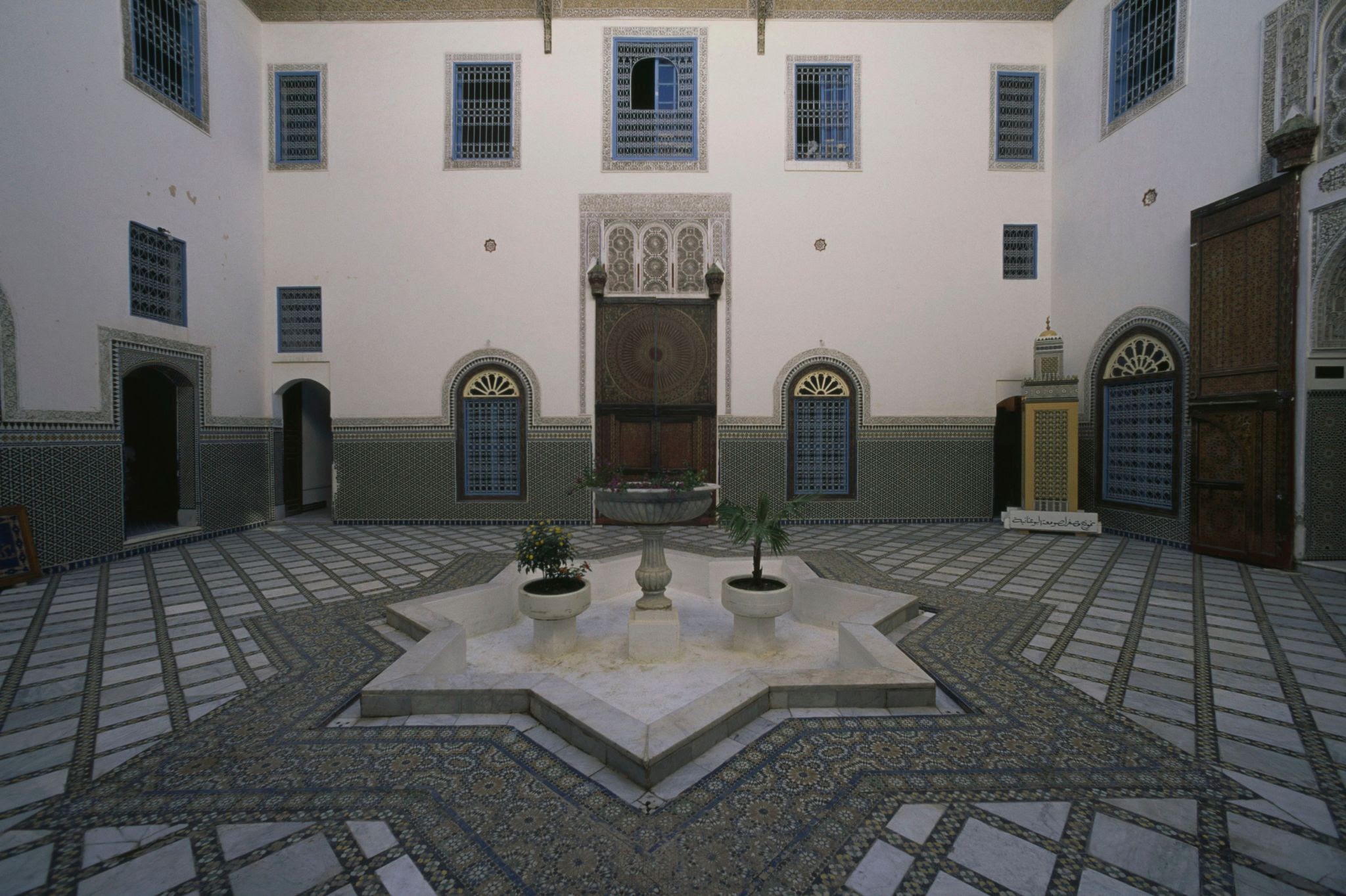
In Fes, the physical environment does not merely host the festival; it acts as an active, breathing acoustic participant. The ancient medina of Fes el-Bali is the largest contiguous car-free urban area in the world, a dense matrix of over nine thousand winding alleys, enclosed courtyards, and ancient stone walls constructed from rammed earth, cedarwood, and hand-cut glazed tilework (zellij). When the festival begins, this medieval city becomes an immersive sonic landscape where music reverberates off walls that have stood since the Marinid and Saadian dynasties.
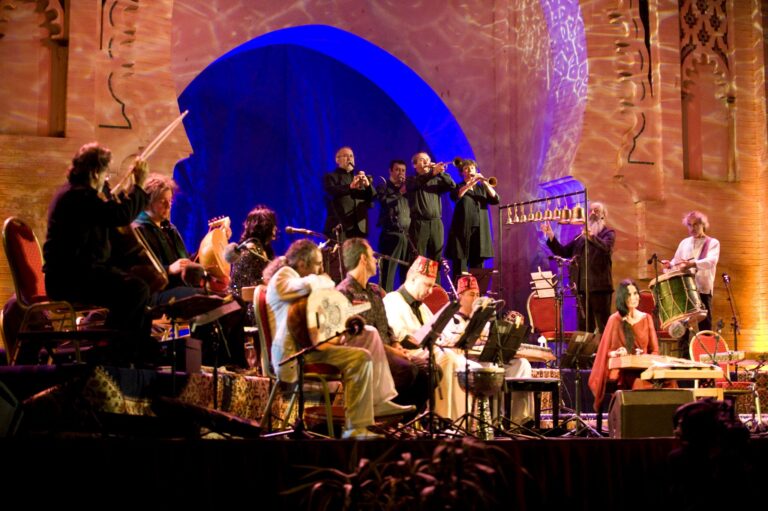
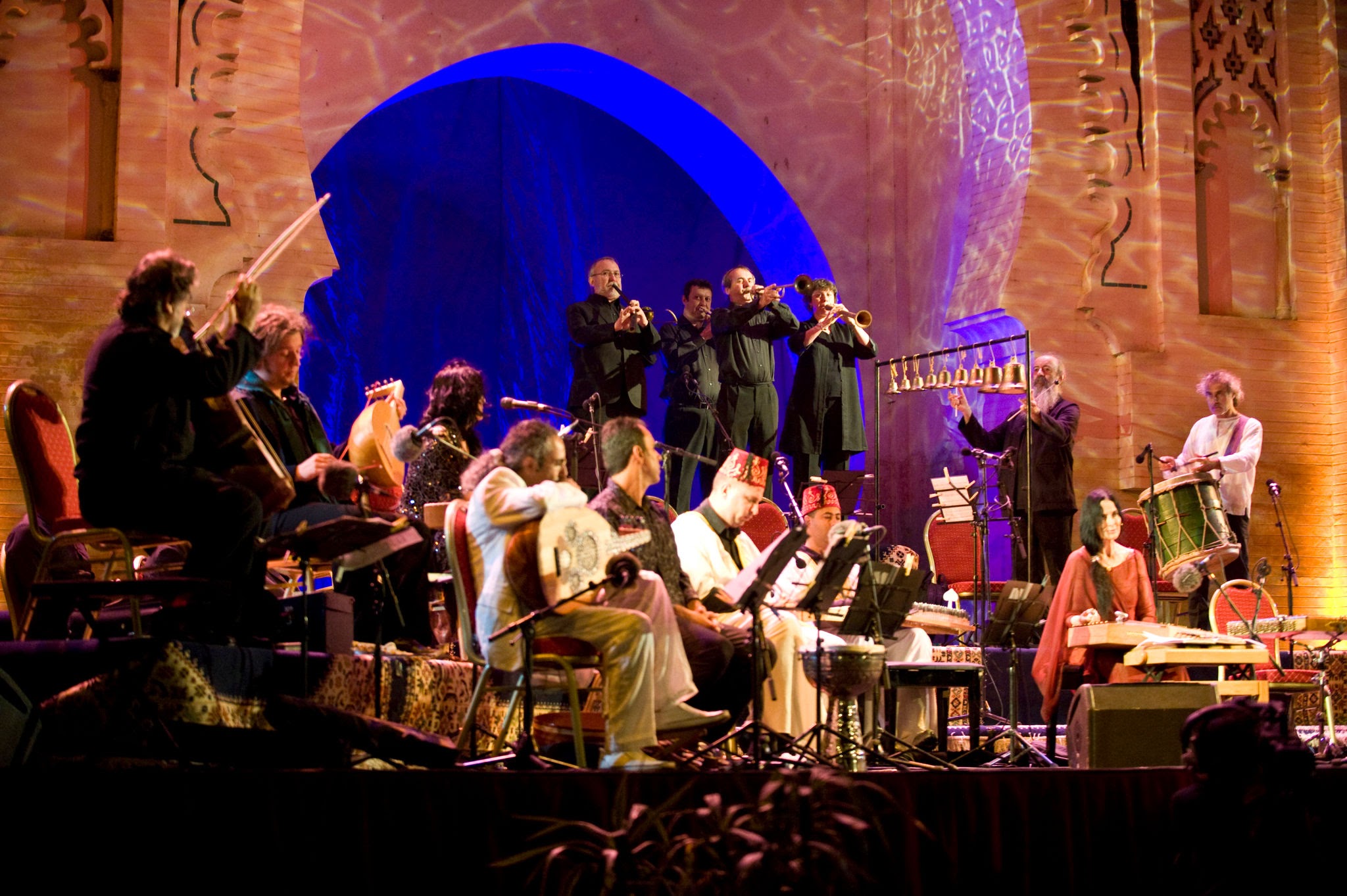
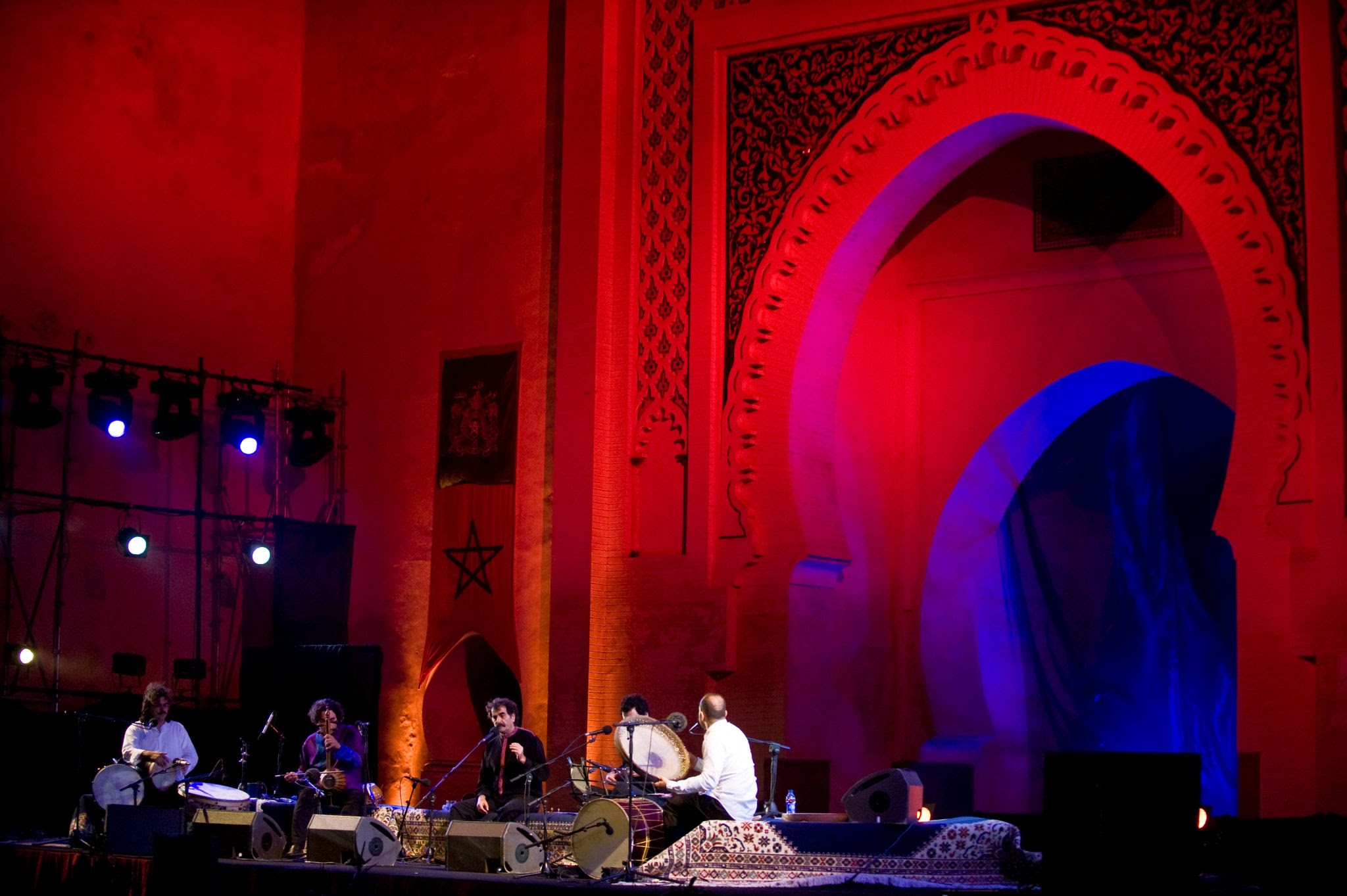
The primary open-air venue for the festival’s flagship evening concerts is Bab Al-Makina, the grand crenellated gateway to the Royal Palace (Dar al-Makhzen). Built in the late nineteenth century as an imperial parade ground and arms factory, Bab Al-Makina features monumental stone arches and towering bastions that create an imposing, dramatic backdrop. Under the night sky of Fes, illuminated by golden floodlights and projection mapping, this imperial courtyard accommodates thousands of spectators who sit in reverent silence as giant projection screens mirror the intricate movements of international performers set against the ancient stone facade.
During the afternoon, the festival moves inside the intimate, hidden architectural sanctuaries of the medina: the historic Riads and Batha Museum gardens. The Museum of Batha, a nineteenth-century summer palace built by Sultan Hassan I, features a traditional Andalusian garden shaded by a centuries-old oak tree, surrounded by Moorish arcades and trickling marble fountains. Here, under the dappled sunlight, afternoon concerts feature delicate acoustic traditions—such as classical Persian setar recitals, Armenian duduk duets, or Andalusian lute suites—where the rustle of leaves and the sound of splashing water blend seamlessly with the acoustic resonance of stringed instruments.
By nightfall, the spiritual center of the festival shifts to the various Sufi lodges (zawiyas) scattered throughout the medina, such as the Zawiya of Sidi Ahmed al-Tijani or the Dar Tazi gardens. These spaces host the free, late-night Nuits Sufis (Sufi Nights), where local and regional brotherhoods—including the Hamadsha, the Harqawa, and the Qadiriyya—gather to perform sacred chants (dhikr) that stretch until the early hours of the morning. In these sacred courtyards, where the air is thick with the scent of burning frankincense and orange blossom water, the distinction between performer and audience completely vanishes, replaced by a shared communal elevation.
The spatial magic of the Fes Festival lies in how it restores the original relationship between architecture, acoustics, and spiritual intent. Modern concert halls are built for sterile sound containment, but the historical venues of Fes were engineered by medieval masters who understood that geometry, natural materials, and water features alter human consciousness. The acoustics of a high-arched courtyard, lined with hand-carved plaster (stucco) and dense cedar beam ceilings, absorb harsh frequencies while amplifying warmth and resonance. To listen to a sacred chant inside a Fes courtyard is to experience architecture acting as a musical instrument in its own right.
The Musical Ecosystem: From Sacred Classical to Trans-Saharan Rhythms
The musical programming of the Fes Festival is a masterclass in artistic curation, representing a vast, multi-layered ecosystem of global sacred sounds. While the festival invites traditions from every continent, its foundational backbone remains the rich musical heritage of North Africa and the broader Islamic world. At the heart of this regional tradition is Tarab Al-Andalusi (Andalusian Classical Music), a sophisticated courtly genre brought to North Africa by Muslim and Jewish refugees following the Fall of Granada in 1492. Organized around complex melodic structures known as nuba, Andalusian music utilizes instruments like the oud (fretless lute), the rabab (bowed lute), the nay (reed flute), and the qanun (zither) to evoke a refined state of emotional and spiritual transcendence.
Running parallel to the classical court music is the deeply spiritual, trance-inducing genre of Gnawa music. Rooted in the historical experience of enslaved West Africans who were brought across Saharan trade routes to Morocco over the past several centuries, Gnawa music represents an extraordinary synthesis of sub-Saharan animist spirit rituals and North African Sufi mysticism. The leader of a Gnawa ensemble, the Maâlem (master), plays the gimbri (or hajhouj), a three-stringed, camel-skin-covered bass lute that produces low, resonant, hypnotic frequencies. He is accompanied by a chorus of musicians playing heavy iron castanets known as qraqeb, whose sharp, metallic clatter mimics the rhythmic sound of iron chains.
The structural arc of a Gnawa performance, known as a Lila, moves through a carefully ordered sequence of rhythmic keys designed to call upon spiritual entities, clean the mind, and heal emotional trauma through ritual movement. At the Fes Festival, Gnawa music is frequently paired with global sacred traditions—such as Indian raga ensembles, jazz improvisers, or Western classical orchestras—creating groundbreaking artistic collaborations that highlight the shared rhythmic and spiritual DNA linking sub-Saharan Africa to the rest of the world.
Another essential pillar of the festival’s sonic identity is Sufi devotional music, encompassing traditions from across the Muslim world. This includes the majestic Qawwali devotional singing of Pakistan and Northern India, made famous globally by Nusrat Fateh Ali Khan and continued by his successors. Qawwali performances build from slow, contemplative vocal introductions into thunderous, fast-paced rhythmic crescendos driven by hand-clapping, harmoniums, and tabla drums, carrying listeners into a state of ecstatic spiritual intoxication (wajd). Alongside Qawwali, the festival regularly features Turkish Mevlevi ensemble music accompanied by the hypnotic spinning of the Whirling Dervishes, Arab Inshad (poetic chanting), and West African Sufi vocal traditions from Senegal and Mali.
What distinguishes Fes from other international world music gatherings is its strict refusal to treat sacred traditions as commercial entertainment. Every performance is framed as an act of spiritual devotion and cultural preservation. Musicians do not perform merely to showcase technical virtuosity; they perform as custodians of ancient lineages, transmitting sacred knowledge that has been passed down orally from master to disciple over centuries. The audience at Fes, composed of a unique mix of local Moroccan citizens, Sufi pilgrims, international scholars, and music lovers, approaches the performances with deep listening and reverence, creating an atmosphere charged with focused spiritual attention.
The Fes Forum: Philosophical and Interfaith Dialogue
While the evenings in Fes are dominated by musical performances, the mornings belong to the realm of intellectual inquiry and philosophical debate through the Fes Forum (Rencontres de Fès). Held during the first four days of the festival in the shaded gardens of the Batha Museum or nearby conference halls, the Forum brings together world-renowned intellectuals, theologians, philosophers, environmentalists, artists, and political leaders to address the most pressing moral and spiritual crises facing contemporary civilization.
The founding premise of the Fes Forum is that the global challenges of the twenty-first century—including environmental destruction, economic inequality, religious extremism, and the erosion of human dignity—cannot be solved purely through technological or political fixes. Instead, they require a fundamental renewal of human consciousness and a return to spiritual, ethical values shared across human civilizations. Each year, the Forum operates under a unifying theme, such as “Giving a Soul to Globalization,” “The Spirit of Granada,” “An Soul for Sustainable Development,” or “Routes of the Sacred.”
The discussions at the Fes Forum are famously candid, deep, and transdisciplinary. A typical panel might feature a Muslim Sufi scholar, an American environmental scientist, a French philosopher, a Tibetan Buddhist monk, and a Nigerian economic activist sharing a single stage. Unlike academic conferences that rely on dense jargon or political summits that seek superficial policy compromises, the Fes Forum encourages open, vulnerable dialogue that seeks the underlying spiritual unity behind human diversity. It operates in the spirit of the ancient Islamic concept of Adab—a refined combination of etiquette, intellectual rigor, moral courtesy, and deep respect for the opposing voice.
The impact of the Fes Forum extends far beyond the walls of the venue. It has inspired the creation of similar dialogue initiatives across Europe, the Middle East, and the Americas, establishing Fes as a recognized intellectual incubator for global peacebuilding. By providing a platform where religious faith and modern critical thought engage in constructive dialogue rather than conflict, the Forum demonstrates that traditional African and Islamic intellectual heritage possesses vital, untapped resources for solving modern global dilemmas.
Intangible Cultural Heritage and Craft Traditions
The impact of the Fes Festival stretches far beyond the realm of sound and philosophy; it acts as a massive preservation engine for the tangible and intangible craft traditions of North Africa. When thousands of international visitors arrive in Fes for the festival, they step directly into an urban economy powered by traditional artisans whose techniques have remained virtually unchanged since the Middle Ages. The festival provides a vital economic market for these craft guilds, ensuring that ancient skills continue to be valued and economically viable in a rapidly industrializing world.
Primary among these historic crafts is the art of Zellij, the intricate hand-cut tile mosaic work that lines the walls of Fes’s mosques, madrasas, and fountains. Master craftsmen (Maâlems) spend years learning how to glaze terracotta tiles in traditional earth pigments before hand-chiseling them into tiny, precise geometric shapes. These shapes are then assembled upside-down from memory to form breathtaking complex geometric patterns that reflect Islamic cosmological principles regarding infinity, unity, and divine order. The festival’s venues, adorned with centuries-old zellij, serve as a permanent gallery displaying this mastercraft to the world.
Equally iconic is the city’s historic leatherworking tradition, centered at the famous Chouara Tannery, which dates back to the eleventh century. Here, tanners stand chest-deep in massive stone vats filled with natural dyes—such as saffron for yellow, poppy for red, indigo for blue, and cedar wood for brown—processing hides using ancient, organic methods. The resulting high-quality leather is then transformed by local cobblers, bookbinders, and bag makers into fine leather goods sold in the medina’s souks. The economic windfall generated by festival tourism directly supports these tanners, leatherworkers, and their families, preserving a centuries-old guild system.
Woodworking and Cedar Carving: The mountains surrounding Fes yield rich Atlas cedarwood, which master woodworkers carve into delicate screens (mashrabiya), painted ceiling beams, and liturgical furniture. The fragrant scent of carved cedar permeates the festival’s indoor venues, connecting the olfactory experience directly to the region’s natural environment.
Stucco and Carved Plaster: Artisans hand-carve intricate Arabic calligraphy and geometric arabesques into wet plaster on the upper walls of medina courtyards, creating delicate light-and-shadow effects that soften the acoustics of performance spaces.
Brass and Copper Metalwork: In the Seffarine Square, the rhythmic clinking of hammers shaping copper kettles, brass lamps, and silver tea sets provides a permanent metallic soundtrack to daily life in the medina, supplying the ornate lanterns that illuminate the festival’s night venues.
The preservation of these physical crafts is inextricably linked to the preservation of the music itself. In North African culture, music, architecture, and craft are not separate categories, but manifestations of a single aesthetic philosophy rooted in Ihsan (the pursuit of beauty and perfection). The same geometric proportions that govern a complex Andalusian musical composition (nuba) govern the layout of a zellij mosaic or the carving of a cedar panel. By bringing global attention to Fes, the festival reinforces the value of this holistic aesthetic ecosystem, encouraging younger generations of Moroccans to apprentice within traditional guilds and keep their ancestral heritage alive.
Social Impact, Tourism, and Sustainable Future
Thirty years after its inception, the Fes Festival of World Sacred Music stands at a critical juncture, balancing its original spiritual vision with the demands of modern international tourism and local economic development. The festival has transformed Fes from a city that was once overlooked in favor of Marrakech or Casablanca into a premier destination for global cultural tourism. This transformation has brought significant capital investment into the medina, funding the restoration of historic riads, the repaving of medina thoroughfares, and the installation of modern subterranean utilities.
However, this commercial success brings ongoing challenges that festival organizers and civic leaders navigate carefully. Chief among these is the risk of gentrification within the medina, where historic family homes are increasingly converted into luxury boutique hotels for foreign tourists, potentially displacing long-time local residents and altering the social fabric of neighborhood communities. Furthermore, there is a constant structural tension between maintaining the festival’s high-minded spiritual integrity and meeting the commercial expectations of corporate sponsors and international broadcast media.
To address these challenges, the festival has increasingly re-anchored itself in the local community through outreach programs, free public concerts, and youth engagement initiatives:
Free Public Concerts at Bab Boujloud: While evening concerts at Bab Al-Makina require ticket purchases, the festival hosts massive, free nightly concerts at the iconic Bab Boujloud square. These shows feature popular Moroccan artists, sub-Saharan musical groups, and regional Sufi performers, ensuring that local residents of Fes are active participants in the festival rather than sidelined observers.
Youth Educational Workshops: Masterclass programs bring visiting international musicians into local conservatories and youth centers, allowing young Moroccan musicians to study traditional instruments and cross-cultural improvisation techniques alongside master performers.
Sustainable Urban Heritage: The festival works in close partnership with the Agency for the Development and Restoration of Fes (ADER-FÈS), directing a portion of tourism revenues into the ongoing structural preservation of crumbling historical monuments, historic bridges, and public fountains across the medina.
Looking forward to the future, the Fes Festival serves as a model for cultural heritage preservation across North Africa and the broader global South. It demonstrates that traditional culture is not an economic burden or a barrier to modern development, but rather a powerful, renewable resource for economic vitality, social cohesion, and international diplomacy. In an increasingly fragmented global landscape, the festival’s core message—that diversity is not a threat to identity, but the very condition of human richness—resonates with greater urgency than ever before.
As the late evening sun sets over the hills of Fes, casting long shadows across the golden stone walls of Bab Al-Makina, and the first notes of an ancient oud rise into the evening air alongside the evening call to prayer, the city fulfills its eternal calling. It remains what it has been for over a thousand years: a sanctuary of light, sound, and sacred beauty, inviting the world to listen, to remember, and to rediscover its shared humanity.
